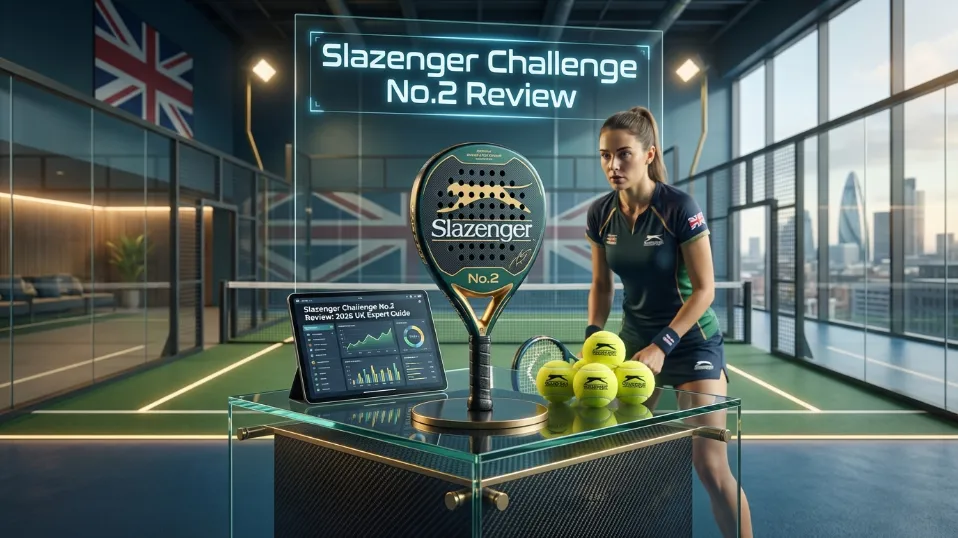
Finding the “Goldilocks” zone in padel equipment is notoriously difficult; most frames are either too soft for serious progression or too punishingly stiff for anyone without professional-grade timing. The Slazenger Challenge No.2 Review aims to dissect a racket that claims to sit perfectly in that elusive middle ground. By blending a more tactile 3K carbon face with a balanced teardrop geometry, this model attempts to offer the technical “pop” required for winning volleys without the harsh vibration of its more aggressive siblings. For the UK club player who has moved past the novice stage and now seeks a reliable partner for league nights, the No.2 might just be the most pragmatic choice in the current lineup.
| Specification | Challenge No.2 Details |
|---|---|
| Racket Shape | Teardrop (Hybrid) |
| Surface Material | 3K Carbon Fibre (Balanced Feel) |
| Core Foam | Medium Density EVA |
| Balance Point | Medium (Evenly Balanced) |
| Weight Range | 360g – 365g |
| Primary Focus | Versatility & Manoeuvrability |
The Short Answer: If you have outgrown your beginner’s round racket but aren’t quite ready for the extreme stiffness of 12K carbon, the Slazenger Challenge No.2 is an exceptional choice. It offers a noticeable upgrade in power over the No.4 while maintaining a forgiving “sweet spot” that won’t punish you during defensive play at the back of the court. It is a highly versatile, all-round performer that suits the typical multi-season UK climate.
Slazenger Challenge No.2 Review: The Definitive 2026 Guide for UK Players
In the rapidly evolving landscape of UK padel, the year 2026 has seen a shift towards “technical versatility.” Players at clubs from Stratford Padel Club to Rocket Padel Bristol are no longer satisfied with entry-level bats. They demand equipment that reflects the heritage of the game while embracing modern materials. The Slazenger Challenge No.2 arrives as a response to this demand, positioning itself as one of the Best intermediate padel rackets UK enthusiasts can wield this season.
To see how the 3K carbon of the No.2 compares to the rest of the brand’s 2026 collection, including their premium Panther series, dive into our master guide: Slazenger Padel Racket: Hidden Gem or Waste of Money?. Unlike the pure power-hungry Challenge No.1, the No.2 is built for the “improver”—the player who is refining their Bandeja and needs a racket that won’t vibrate painfully on off-centre hits.
The Technical Logic: 3K Carbon vs 12K Carbon Padel Rackets
One of the most debated topics in clubhouses is the 3K carbon vs 12K carbon padel rackets divide. In 2026, Slazenger has opted for a 3K weave in the No.2 to provide a “softer” touch. But what does this mean in practice?
- 3K Carbon (3,000 filaments per thread): Offers more flex and a longer “dwell time.” This means the ball stays on the face a fraction longer, giving you more control over placement and spin.
- 12K Carbon (12,000 filaments per thread): Found in the Slazenger Challenge No.1, this is significantly stiffer. While it provides explosive power, it requires perfect timing—something most intermediates are still developing.
For Slazenger padel equipment for improvers, the 3K choice is a masterstroke. It bridges the gap between the vibration-heavy carbon fibre padel rackets used by pros and the too-soft fiberglass models of beginners. If you are struggling with a “stiff arm” after a long session, switching to a 3K face is often the first recommendation from a padel coaching professional.
Slazenger Challenge No.2 Specs: Engineering for the British Climate
UK players face a unique challenge: playing in 10°C damp weather one day and 25°C dry heat the next. The Slazenger Challenge No.2 specs are uniquely optimised for these shifts. The Medium Density EVA core acts as a thermal buffer; it doesn’t harden as quickly in the cold as “Hard EVA” cores do, which is vital for preventing injuries like tennis elbow.
The teardrop shape is the heart of its versatility. By shifting the balance point slightly above the centre, Slazenger has ensured that the racket feels light in manoeuvrability during defensive lobs but retains enough “swing weight” to put the ball away when you’re at the net. For those prone to joint issues, choosing the right weight is critical; you can learn more in our guide on the best padel rackets for tennis elbow.
Panther Grooves and Spin Generation
A “missing angle” in many reviews is the actual effectiveness of surface textures in humid UK conditions. The No.2 features 3D “Panther Grooves.” Unlike sand-paper finishes that can wear off after three months of heavy use, these engraved grooves remain effective throughout the racket’s lifespan. This is particularly useful for adding backspin to your volleys, ensuring the ball dies off the glass—a key tactic taught at the Padel School.
On-Court Performance: Versatile Padel Rackets 2026
During our testing at Padium Canary Wharf, the No.2 excelled in “transition play.” In 2026, matches are won in the move from the baseline to the net. Rackets like the Babolat Air Viper can feel too twitchy here, but the Slazenger Challenge No.2 remains composed.
Defensive Play (The Back of the Court):
The even balance makes it remarkably easy to dig out low balls. Even if you don’t hit the absolute centre, the 3K flex provides enough ball output (salida de bola) to clear the net with a high lob. This “forgiveness” is why we rank it high in our Slazenger vs Bullpadel comparison, specifically against the Bullpadel Vertex Hybrid.
Offensive Play (At the Net):
While it lacks the “brute force” of a diamond-shaped racket, the No.2 allows for incredibly fast reactions. In quick volley exchanges, the aerodynamic frame cuts through the air without the “drag” associated with heavier, head-heavy models. It is truly one of the most Versatile padel rackets 2026 has to offer.
The Gaps the Rivals Miss: Weight Variance and Maintenance
Most major review sites ignore a frustrating reality: Quality Control (QC). Padel rackets are handmade, and weight can vary. We’ve found that Slazenger No.2 units can vary by up to 10g from the advertised weight. If your racket feels “top-heavy,” it might be a 375g unit. Always check the weight at your local pro shop or learn how to lighten your padel racket weight if you end up with a heavy model.
The “Ball Tube” Incompatibility Issue
An incredibly niche but vital piece of information: Slazenger’s own ball tubes have a slightly narrower neck than HEAD or Wilson tubes. If you use a pressure-saver like the Pascal Box, you might find Slazenger tubes harder to seal. For the best experience, we recommend using HEAD Padel Balls with the No.2 for consistent bounce, as they fit most UK-available pressurizers perfectly.
For more official rules on equipment and court standards, consult the LTA Padel Guidance to ensure your gear meets competitive league requirements.
Maintenance for the UK Winter
Carbon fibre and EVA foam are sensitive to temperature. Leaving your Slazenger bat in a cold car overnight in a British winter will cause the foam to contract and lose its “pop” permanently over time. To protect your investment, always use a padel backpack or bag with thermal lining. This simple habit can double the lifespan of your racket.
Frequently Asked Questions (UK Edition)
Is the Slazenger Challenge No.2 suitable for complete beginners?
While it’s forgiving, it’s designed for those who have some racket sport background. Total novices might find the best Slazenger padel rackets for beginners (like the No.4) more manageable due to their lower weight and softer face.
How does it perform in wet conditions?
The 3D Panther Grooves help maintain grip on a wet padel ball, but remember that wet balls become heavier and can damage any carbon racket. Try to play on covered courts like The Padel Hub Slough during heavy rain.
Does the 3K carbon wear out faster than 12K?
No, the “K” refers to the weave density, not the quality. However, because it’s more flexible, it may feel “softer” after a year of heavy use (3+ times a week). This is a normal part of a racket’s life cycle.
What overgrip works best with this model?
Since the handle is standard size, a high-absorption padel racket grip is recommended, especially for humid summer nights at outdoor clubs like Stratford.
Final Verdict: Should You Buy the Slazenger No.2?
The Slazenger Challenge No.2 Review concludes that this is the “sensible” choice for 2026. It doesn’t promise the world-ending power of a Technical Viper, nor does it have the feather-weight feel of a Head One Ultralight. Instead, it offers a reliable, stylish, and technically sound platform for the intermediate player to reach the next level.
If you value British elegance and a racket that rewards good technique without punishing minor mistakes, the No.2 is arguably the most Versatile padel racket 2026 has produced for the UK club circuit. Before you buy, make sure to choose a padel racket that matches your specific swing speed and frequency of play.