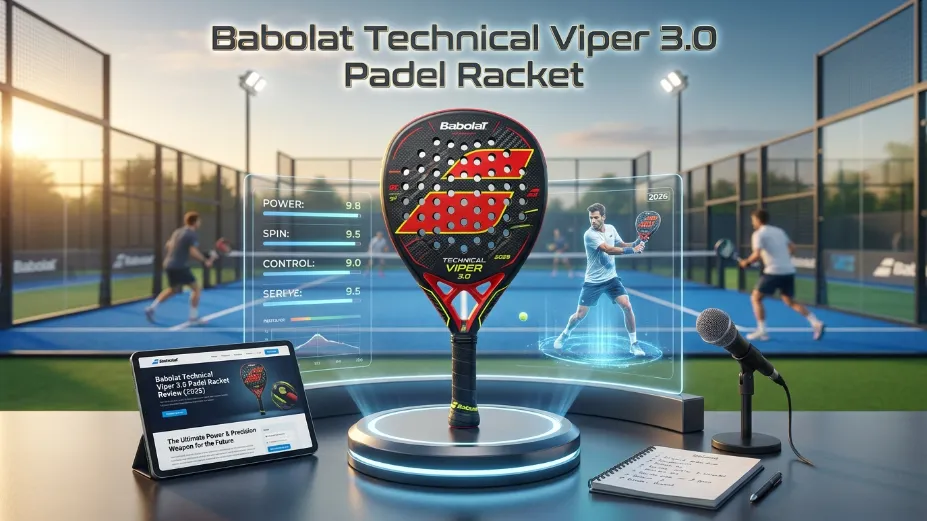
The modern padel court leaves absolutely no room for hesitation, and if your overheads are lacking that decisive, court-ending bite, the fault rarely lies in your ambition—it is often your gear. When Babolat dropped their latest heavy hitter, the Babolat Technical Viper 3.0 Padel Racket, the British padel community immediately wanted to know if this diamond-shaped beast actually delivers on its promise of surgical precision, or if it is just another rebranded power tool.
This isn’t a generic spec sheet review. We have taken this premium carbon weapon onto the court to dissect how its updated core adapts to fast-paced damp winter conditions in the UK, how it manages vibora mis-hits, and whether it genuinely justifies the investment for advanced attackers seeking uncompromising power.
Padel Racket Technical Specifications
Official specs & on-court performance impact
Babolat technical viper 3.0 padel racket reviews
When analyzing independent court feedback and long-term player assessments, Babolat technical viper 3.0 padel racket reviews consistently point to a massive paradigm shift in how premium power tools behave. Unlike generic power options that focus solely on raw stiffness, this 2026 flagship model focuses extensively on stability. Advanced players transitioning from softer platforms note that the structural feedback is incredibly direct, offering an honest evaluation of your technical execution. If your footwork is precise and you meet the ball out in front, the result is an explosive, court-ending trajectory that is nearly impossible to defend.
However, the real talking point across UK locker rooms is how the structural updates have minimised the harshness historically associated with a pure diamond padel racket. By engineering an intelligent layer matrix, the brand has managed to preserve high-velocity characteristics while smoothing out the minor vibrations that plague competitive players during intensive, multi-match weekend tournaments.
The Evolution of Structural Geometry: Frame and Handle Modifications
The architectural blueprint of the Babolat Technical Viper 3.0 2026 introduces a complete redesign of the geometric framework. Moving completely away from traditional rounded edges, the upper tip features an angular, polygonal profile designated as the Reinforcement Window. This specific mass redistribution alters the physics of the frame during high-speed swings:
- Torsional Resistance: By placing structural reinforcement at the outer boundaries of the frame tip, the racket resists twisting when meeting fast, off-centre shots, keeping the face perfectly aligned with your intended target.
- The Hammer Effect: The raised centre of gravity converts raw arm speed into massive downward kinetic force, making flat smashes exceptionally heavy and fast.
This structural modification has had a direct, cascading impact on handle ergonomics—a hidden angle that many generic online overviews completely ignore. To integrate the expanded bridge of the Dynamic Stability System, the handle length has been compressed to 12.7 cm, down from the 14.5 cm handles seen on older generations. For players who utilize a two-handed backhand or rely on maximum handle length to whip their wrists through a vibora padel stroke, hand placement will feel distinctly compressed. This modification alters the natural pivot point, demanding faster physical preparation and cleaner arm mechanics during high-speed net volleys.
The Material Science: Deconstructing the 3K vs. 12K Carbon Debate
A major misunderstanding deeply rooted in the amateur community is that a higher carbon filament count automatically translates to a stiffer, more powerful hitting surface. To understand the true babolat technical viper 3.0 padel racket specs, one must look at material thickness and resin interaction rather than simple numbers. While previous iterations of this flagship model relied on a dry, ultra-rigid 12K carbon weave, the 2026 version transitions to a specialized 3K carbon surface.
Where 12K carbon uses thin, tightly packed filaments that create a highly rigid, immediate response, the 3K carbon weave features thicker, marginally more flexible bands. This architectural change allows the hitting face to flex more progressively upon high-velocity impact. When paired with the internal Carbon Power Layer—a dedicated carbon sheet embedded directly inside the foam—the hitting face behaves like an explosive spring. It gives slightly to capture the incoming energy of the ball, then instantly snaps back into shape, propelled by the underlying foam matrix. This achieves maximum ball acceleration while expanding the usable sweet spot significantly beyond legacy versions.
Core Foam Breakdown: Standard 3.0 vs. Juan Lebrón Edition
An ongoing source of confusion across retail channels is the precise engineering difference between the standard model and the limited-edition version. Because both versions share identical cosmetic weight brackets and 3K carbon faces, many buyers assume they are purchasing the exact same tool under a different aesthetic skin. This is an information gap that requires clear, empirical separation based on the official data found on the official Babolat website.
- Standard Technical Viper 3.0: Utilises a triple-density X-EVA core built in a sandwich configuration. Two highly rigid outer layers provide crisp power on aggressive overheads, while a softer central foam layer provides crucial cushioning and depth on slower, defensive baseline strokes. This structural design makes it one of the best padel rackets for advanced players who still require a sensible margin for error during intensive matches.
- Technical Viper Juan Lebrón Edition: Completely abandons the multi-density approach, featuring a single-density Hard EVA core specified directly by the professional icon. This setup lacks any central cushioning layer, resulting in an exceptionally dry, rigid, and uncompromising response. Furthermore, its balance point is shifted even further toward the tip, maximizing raw power but offering zero automatic ball exit and absolutely no tolerance for timing errors.
Overcoming the Dead-Feel Illusion: The Structural Break-In Period
A common issue regularly highlighted across European player forums is that a brand-new Technical Viper 3.0 can feel remarkably stiff and hollow straight out of the plastic wrapping. This initial “dead feel” frequently leads consumers to believe they have received a manufacturing defect. In reality, this is a normal physical property of high-density polymers and peak resin tension.
When fresh from the factory, the internal polymer chains within the dense core are tightly bound, and the carbon resin matrix is at maximum tension. At this stage, the face actively resists micro-deformation during slow or medium-paced exchanges. To unlock the genuine potential of the racket, players must complete a structural break-in period of approximately 6 to 10 hours of active play. The repeated high-impact force of hitting padel balls slowly deforms the internal foam cells and relaxes the tight carbon matrix.
This increases the overall elasticity of the hitting zone, effectively opening up the sweet spot and delivering the premium tactile feedback promised in commercial technical sheets. Players must avoid using low-pressure or heavily worn balls during this phase, as they lack the mass required to properly compress the core and initiate this material relaxation.
Climatic Adaptability: Managing High Hardness in the UK Winter Climate
The overall performance of high-end carbon gear is deeply sensitive to environmental conditions, making climate adaptation a massive consideration for competitors across the United Kingdom. Typical UK playing environments—defined by sub-10°C temperatures, high relative humidity, and damp outdoor courts—directly alter the physical behaviour of thermoplastic polymers.
In low temperatures, the materials within a dense core contract, causing the foam to harden significantly. When this cold-weather stiffening interacts with a 3K carbon face, it creates two major performance challenges:
- Vibration and Joint Strain: Because a frozen core cannot deform to absorb raw impact energy, high-frequency shock loads travel directly up the frame into the handle. On outdoor courts, the ball felt absorbs surface moisture, increasing its overall weight. Striking a heavy, wet ball with a cold, rigid framework generates massive shock loads that can quickly accelerate joint fatigue, making it crucial to evaluate protection options discussed in our guide to the best padel rackets for tennis elbow.
- Defensive Ball Exit Deficit: The total lack of cold-weather elasticity reduces natural rebound. On defensive blocks or quick reactions against the glass, the ball often dies on the face, forcing the player to use an intensive, full-body physical swing to find sufficient baseline depth.
To successfully navigate the British season, advanced competitors should adopt strict practical strategies. Practising careful thermal care by keeping the racket inside an insulated cover in a heated room prevents polymer degradation. Additionally, employing a smart dual-racket seasonal strategy by switching to a more flexible model like the Babolat Technical Veron padel racket during the coldest winter blocks ensures you maintain depth and joint health before returning to the ultra-stiff Viper in the spring.
Head-to-Head: Babolat Technical Viper 3.0 vs. Premium Alternatives
Choosing your primary weapon requires a direct comparison against the closest market alternatives. The standard Technical Viper 3.0 stands out for its unique blend of power and structural stability, but it demands significantly more physical output than its immediate family members.
When placed next to the Technical Veron 3.0, the variance in surface engineering alters your entire baseline experience. The Veron utilizes a flexible carbon-fiberglass composite blend, offering effortless ball exit on slow defensive lobs. The Viper, with its 100% carbon construction, requires complete acceleration to unlock depth but rewards you with absolute precision at the net. Compared to softer alternatives within the 2026 catalogue, the standard Viper remains the definitive choice for players who want to hit heavy, skidding trajectories using the 3D Spin+ surface texture during a complex bandeja padel exchange.
On-Court Performance Mapping: Tactical Evaluation
From a tactical standpoint, the Technical Viper 3.0 is an elite offensive tool that rewards clean technique while punishing sloppy preparation. At the net, the high structural rigidity of the frame ensures that the racket remains perfectly stable, allowing you to block heavy drives and place deep, aggressive volleys with total confidence. On overhead smashes, the head-heavy balance acts as a massive force multiplier, allowing technically proficient players to kick the ball out of the court with explosive velocity.
Conversely, defending from the back of the court requires complete concentration. The racket provides no automatic assistance on slow or defensive shots. If your arm preparation is late or your footwork fails, the ball will leave the face short, leaving you exposed to a quick counter-attack. It is a highly specialized piece of engineering that turns into a lethal weapon in the hands of an advanced competitor, but remains an unforgiving platform for intermediate players still mastering their swing paths.
When budgeting for your next seasonal upgrade, tracking the actual babolat technical viper 3.0 padel racket price across UK retail channels is essential. While the official RRP is positioned at £320.00, proactive club players can regularly secure authorized stock between £279.99 and £285.00 through specialized padel distributors, representing exceptional value for a top-tier carbon weapon built for elite competitive performance.
Frequently Asked Questions (FAQ)
Does the UK market version of the Technical Viper 3.0 feature a replaceable wrist strap system?
Yes. The 2026 model incorporates Babolat’s official Smart Strap technology, allowing players to easily remove, wash, or exchange the safety wrist lanyard between intensive match blocks without needing specialist tools.
How often should a competitive player replace this racket to maintain peak performance?
For advanced players competing 3 to 4 times per week on high-intensity circuits, the structural resin matrix will begin to show natural micro-fatigue within 8 to 12 months. Replacing the racket annually ensures you maintain maximum power and structural stability.
Can the shorter 12.7 cm handle be extended safely using multiple overgrips?
While adding extra overgrips can increase the total volumetric thickness of the handle, it cannot alter the actual physical length of the internal carbon shaft. Players with large hands or two-handed backhands must adapt their hand placement to the compressed geometric profile.