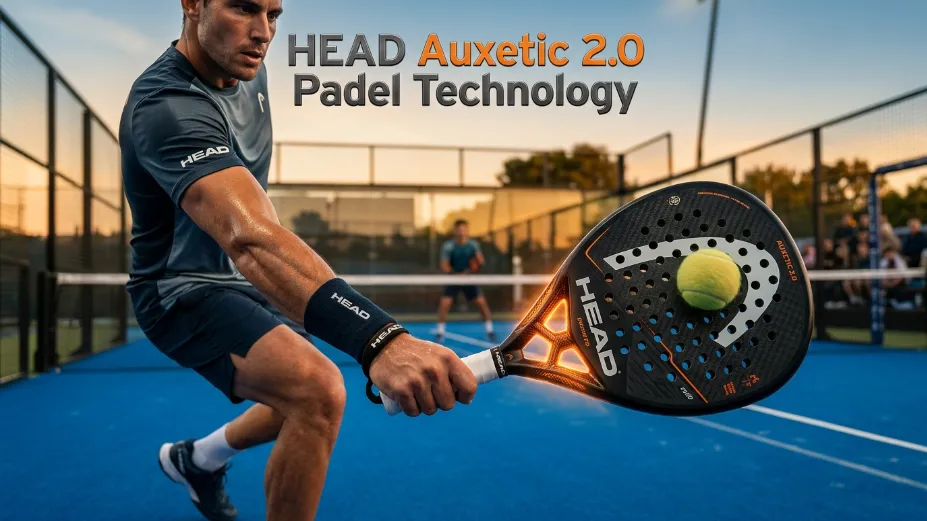
The split second a padel ball misbehaves on a freezing Tuesday evening court in Bristol, you realise that power without feedback is completely useless. Padel frame dynamics underwent a quiet revolution this season, moving away from rigid carbon walls toward adaptive responsive matrices. At the absolute centre of this shift is the HEAD Auxetic 2.0 Padel technology, a structural breakthrough engineered not just to damp vibrations, but to actively change its internal behaviour depending on exactly where the ball meets the sweet spot.
Whether you are aiming to replicate Arturo Coello’s ferocious overheads or searching for a shield against padel elbow, understanding how this updated carbon weave behaves is the definitive line between clinical precision on the court and an expensive mistake. Choosing the right HEAD padel racket is no longer just about aesthetic preference; it is an exercise in applied materials science.
HEAD Padel Rackets — 2026 UK Comparison
Core Tech · Vibration Reduction · Player Profile · UK RRP
What is HEAD Auxetic 2.0 and How Does it Change Your Game?
To fully comprehend why this specific layup design alters on-court execution, one must examine the fundamental physics of material deformation. Standard carbon-fibre matrices operate under a positive Poisson’s ratio, meaning that when the material is subjected to a longitudinal tensile strain, it naturally narrows in its transverse axis. When a high-velocity ball impacts a standard racket face, the localized area pushes outward, causing the surrounding margins to compress and thin out, reducing structural stability and shrinking the true sweet spot.
The introduction of HEAD Coello Extreme Pro Auxetic 2.0 engineering reverses this mechanical action. Auxetic materials possess a negative Poisson’s ratio (ν), mathematically defined as the negative ratio of transverse strain to axial strain:
When the padel ball collides with a frame reinforced with Auxetic 2.0, the pulling forces expand the internal carbon lattice outwards perpendicular to the strain. This instantaneous structural reaction densifies the matrix precisely at the point of contact, providing several direct competitive advantages for the player:
- Dynamic Torsional Stability: The frame actively resists twisting during high-speed off-centre hits, allowing defensive blocks to retain direct directional accuracy.
- Linear Energy Transfer: Instead of wasting kinetic energy through structural distortion, the dense matrix coordinates an immediate rebound effect, increasing exit velocity.
- Expanded Sweet Spot Consistency: By normalizing material behavior across erratic impact points, the racket minimizes the jarring drop-off in power typical of classical geometric frames.
Understanding these advanced mechanics helps intermediate and advanced competitors graduate from basic entry-level equipment options, such as those highlighted in our review of the Lidl padel racket vs premium brands, toward genuine technical engineering designed for tournament conditions.
HEAD Auxetic 1.0 vs Auxetic 2.0: Is it Worth the Upgrade in 2026?
The transition from the initial generational release to the current 2026 framework represents a significant redesign in internal architectural placement rather than a minor aesthetic update. When exploring the structural differences of HEAD Auxetic 1.0 vs 2.0 padel models, the primary change centers on the locations of the integrated responsive elements.
Under the legacy 1.0 architecture, the auxetic carbon weave was positioned exclusively within the yoke or bridge structure of the frame. While this effectively controlled twisting across the lower throat of the racket, high-frequency shock waves generated at the upper tip still traveled unimpeded down the solid carbon handle, reaching the player’s arm. The updated 2.0 layout introduces a dual-optimisation layout, embedding the reactive negative Poisson’s ratio elements into both the structural yoke and the internal middle bar of the handle assembly.
This dual positioning alters how structural feedback is processed. While players upgrading to the latest models experience unmatched hand protection, consumer forum analyses indicate a distinct split in subjective impressions among elite competitors. Touch-reliant players who depend on delicate drops and precise volleys occasionally note that the dual-absorbent system feels “too muted” or “disconnected,” as it filters out the high-frequency vibrations needed to judge exact ball depth. However, for the vast majority of players executing high-volume court schedules across competitive settings like Rocket Padel Bristol, the added security, frame predictability, and substantial muscle preservation make the upgrade a highly practical decision.
Shock Absorption & Elbow Protection: The Science Behind Auxetic 2.0
Playing padel on outdoor courts across the United Kingdom presents distinct physiological challenges. Chronic tendon strain, commonly diagnosed as lateral epicondylitis or “padel elbow,” is a major risk for club players. This condition is directly influenced by how a frame manages initial impact shock waves and subsequent muscle fatigue. Effectively mitigating this risk requires an integrated, multi-tiered approach to padel racket vibration reduction technology.
The shock-filtration pathway inside a premium HEAD frame combines active and passive components to protect the musculoskeletal structure:
- Active Layup Filtration: The Auxetic 2.0 handle matrix expands upon impact, absorbing high-frequency mechanical shock before it can travel into the wrist bones.
- Passive Damp Plus Insert: A specialised elastomer compound positioned directly in the throat barrier dampens harsh vibrations originating across the hitting face.
- Soft Cap+ / Soft Butt Cap 2.0: This dual-component thermoplastic element at the base of the handle dampens low-frequency vibrations that cause progressive muscle fatigue, while also minimizing handle twisting to prevent friction blisters during off-centre hits.
A frequent error among injured players is switching to an ultra-lightweight frame that features a highly rigid, dry-touch surface. While a lighter frame reduces initial muscle strain, its lack of mass means it cannot absorb kinetic shock effectively, transferring the impact energy straight into the forearm tendons. For players navigating existing joint issues, looking into the specialised designs found in our curated guide to the best padel rackets for tennis elbow is essential for choosing a layout that balances safe structural mass with proper cushioning.
Top HEAD Padel Rackets Featuring Auxetic 2.0 Technology
To preserve complete structural logic and prevent content cannibalisation across our platform, we will avoid repeating dense performance reviews of individual models that have been analyzed comprehensively in dedicated guides. Instead, players should utilize our direct technical resources to evaluate each specific profile:
- For an analytical breakdown of low-balance heavyweight mechanics, read our comprehensive HEAD Radical Pro padel racquet review.
- To evaluate the elite diamond-shaped power tools selected by the world number one, explore our technical breakdown of the HEAD Extreme Pro padel racket.
- For players requiring a more forgiving, flexible variant of the diamond shape, consult our structural analysis of the HEAD Extreme Team padel racquet.
- To analyze the all-round teardrop shapes engineered for maximum versatility, see our evaluation of the HEAD Speed One padel racquet and the ultra-premium HEAD Speed One x padel racquet.
These specific profiles ensure you can find the ideal balance of weight distribution, foam density, and surface materials for your style of play. If you are exploring options across different brands, evaluating our comparative technical review of the Slazenger Panther series vs HEAD Pro models provides valuable context on how different manufacturers approach frame rigidity and balance points.
Head-to-Head: HEAD Auxetic 2.0 vs. Industry Competitors
Choosing the best HEAD padel rackets 2026 requires analyzing how HEAD’s design approach compares to alternative philosophies in the current market. While HEAD focuses on adaptive, multi-location auxetic layouts paired with flexible core foams, competitors like Bullpadel and Babolat often use rigid, multi-layered full carbon faces to maximize raw power output.
For example, while a rigid carbon frame provides exceptional speed on clean, dead-centre overhead smashes, it offers minimal structural flex on off-centre hits, resulting in a harsh feel on cold days. HEAD’s use of the Auxetic 2.0 handle matrix provides a more forgiving, progressive feel that stabilizes the frame across a wider hitting area. This makes it an exceptionally reliable option for players navigating unpredictable outdoor court conditions across the UK. For players evaluating premium options, reviewing our detailed look at the structural properties of a cork padel racket shows how alternative natural materials are being used to manage vibration reduction.
Exposing the Competitor Gaps: Manufacturing Tolerances & UK Weather Physics
A notable limitation of standard commercial reviews and retail listings is the tendency to overlook manufacturing variances and environmental physics. Mainstream platforms routinely publish exact, rigid technical specs, ignoring the real-world variables that directly alter on-court playability.
The Weight Tolerance Gap
Premium padel frames are subject to standard manufacturing weight tolerances of ±10g to ±15g. This means a racket marketed at a nominal weight of 370g can leave the factory weighing 380g. Once a player adds a standard frame protector (approx. 5g), an overgrip (approx. 6g-8g), and plays in damp conditions, the total playing weight can quickly reach 395g. This unexpected mass significantly increases the racket’s swing weight, changing it from an agile, head-light control frame into a demanding heavyweight that can accelerate wrist and shoulder fatigue. Players with a history of joint injuries should have their rackets weighed precisely prior to purchase.
Atmospheric Adaptation on UK Outdoor Courts
Playing padel during late autumn or winter at venues like padel courts Wolverhampton introduces dramatic changes to equipment behavior:
- Carbon Polymer Stiffening: Cold ambient temperatures cause the internal resin matrix of the racket face to contract and harden, resulting in a significantly stiffer feel and increasing the vibration load transmitted to the arm.
- Increased Ball Density: Padel balls absorb ambient moisture from damp air and contract in the cold, making them heavier and denser. Striking a cold, moisture-heavy ball with a stiffened carbon frame significantly increases the kinetic shock delivered to the player’s elbow.
To maintain performance and minimize injury risks during colder seasons, UK club players should consider dropping their overgrip tension, switching to a softer core foam, or moving to structured training programs like those offered at a dedicated padel school to refine their striking mechanics.
HEAD Auxetic 2.0 Padel Technology – FAQ
How does the Auxetic 2.0 matrix behave differently if I hit the ball near the top edge of the frame?
Unlike standard structures that twist and cause a harsh drop-off in power, the Auxetic 2.0 layout in the handle responds to off-centre tension by densifying its internal structure. This dampens harsh feedback while maintaining enough frame stability to help return the ball safely over the net.
Will the dual-absorbent handle system mask technical errors in my striking technique?
It reduces the physical harshness of mis-hits, but it does not fix underlying mechanical errors. Advanced players can still monitor ball depth and launch angles to evaluate their contact precision, though the sensation is cleaner and less jarring than with older, un-dampened carbon frames.
Does cold UK winter weather permanently alter the performance of the foam core?
No. The stiffening of the foam core and carbon resin is a temporary physical reaction to low ambient temperatures. Once the racket returns to a heated indoor environment, the polymers regain their standard flexibility and performance metrics. However, storing your racket in a cold car boot should be avoided to prevent premature material degradation.