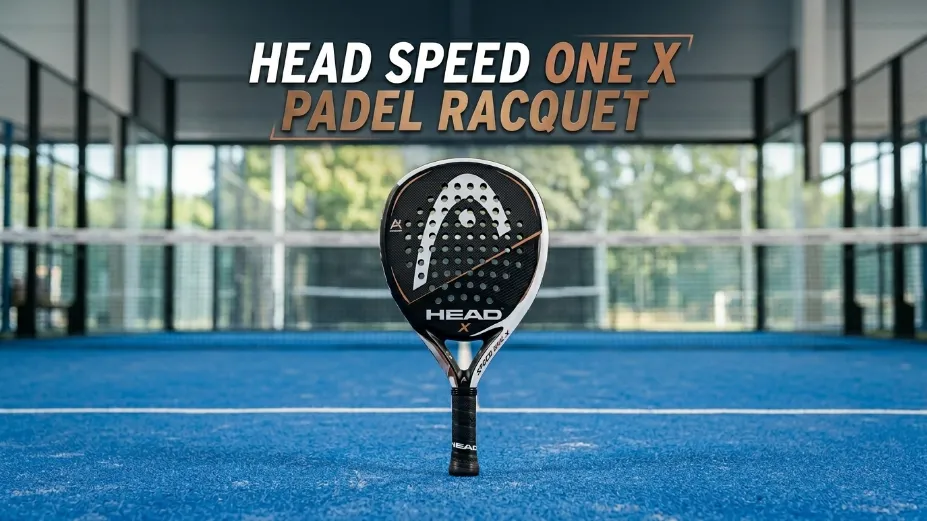
The UK padel scene is moving fast, and frankly, most single-material premium racquets cannot keep up with the tactical shift toward raw, unadulterated ball speed. HEAD aims to break that limitation with the HEAD Speed One X Padel Racquet, a frame engineered specifically for players who refuse to compromise between structural stiffness and explosive power. If your current setup feels sluggish during high-intensity volleys at your local club, what follows is the exact breakdown of how this specific teardrop powerhouse alters your overhead dynamics on the court.
Padel Racket — UK Technical Specifications
Official Data · Performance Impact · UK Market Context
Head speed one x review: Technical Anatomy and On-Court Performance
The engineering core of the HEAD Speed One X Padel Racquet centers upon its non-traditional single-hole structure. While legacy court frames rely on multiple drilled channels to dissipate drag, this design leverages a continuous, unbroken face area to fundamentally alter physical playability.
- The Single-Hole Face Dynamics: By utilising only a single opening at the bottom yoke region (the absolute minimum permitted under official FIP rules), the hitting surface acts as a pre-tensioned, uniform skin. This removes local flex discrepancies, expanding the usable sweet spot.
- The Auxetic 2.0 Yoke & Grip Integration: Strategically positioned in both the carbon bridge area and the central core of the handle, the Auxetic fibres actively adapt to load. Under aggressive hits, the structure locks to maximize rigidity; on soft drop shots, it remains compliant for superb hand feedback.
- Extreme Spin 3D Surface: A textured circular lacquer applied directly to the carbon face provides excellent grip. When executing slices, this rough decal bites the ball cleanly, forcing it to remain low off the back glass.
The face layer balances ultra-stiff structural yarns with the protective polymer cover. This shield prevents premature wear caused by contact with the court walls. For players analyzing options across the entire premium matrix, investigating the criteria for the best padel racquets for advanced players provides essential contextual background before finalising an upgrade.
Check How to Choose a Padel Racquet
HEAD Speed One X vs. HEAD Speed One: Selecting Your Single-Hole Frame
Navigating this product family requires a clear understanding of the mechanical differences between the heavy-duty X model and its lightweight sibling. Selecting your specific version dictates both your physical recovery cycles and your kinetic velocity on the court.
The Vibration-Dampening Variance
The Speed One X focuses extensively on high-speed stability and structural durability. It features the exclusive Damp Plus technology, a specialized elastomeric insert located in the yoke area that isolates high-frequency structural shock before it travels down the handle. Conversely, the standard Speed One model lacks this specific dampening insert, delivering a more direct, raw feedback profile that appeals to touch-focused players but offers less forearm protection during off-centre hits.
Weight and Commercial Discrepancies
The extreme density of the 12K carbon face on the X version introduces an undeniable weight penalty, pushing the static weight of the Head speed one x specs to roughly 365 grams. The standard Speed One drops this signature to a highly manoeuvrable 345 grams, offering a floating sensation for fast net exchanges. This variance is reflected clearly across UK commercial retail channels, where the premium X version carries a standard £250.00 RRP, while the standard model sits at £235.00 RRP, though both can be sourced with significant seasonal discounts.
If you are trying to find high-performance alternatives within a slightly lower price point, reviewing our independent evaluation of the cheap padel racquet market ensures you get maximum performance value without overspending.
The Critical Weight and Stability Guide: Maneuvering the 365g Profile
A major missing angle across commercial review spaces is the highly specific physics of handling a 365g head-heavy frame. When choosing this racquet, players must recognize that it behaves like a much heavier attacking tool due to its 270 mm balance point.
The frame is built around an aerodynamic, tubeless frame construction that maximizes the outer perimeter surface area. This streamlined shape is designed to stop drag during rapid swings, but the high-inertia profile can restrict players possessing weaker forearm muscles. The problem is amplified by the structural thickness of the face itself.
Because the 2D Carbon HS surface sits stiffer than generic multi-material variants, impact force is concentrated heavily on the wrist joint during quick, late defensive blocks at the baseline. If you fail to prepare your swing path early, this lack of maneuverability can force you into late contacts, leading to joint strain. To avoid these issues, advanced players often customize their grip setup with premium overgrips to optimize handle thickness and lower the balance point.
Exposing the Information Gaps: Real-World Durability Under the Microscope
While mainstream marketing materials highlight the premium aesthetic choices of this racquet, deep analysis across independent UK playing groups reveals distinct operational limitations and accelerated wear patterns under high-stress conditions.
- The Core Temperature Delamination Cycle: Because the single-hole face is completely sealed, the internal Power Foam core is housed inside an airtight cavity. When left inside a cold car boot during freezing British winters, the foam contracts, leaving micro-voids; when heated, it expands, causing internal delamination and creaking.
- Anti-Shock Skin Edge Peeling: The integrated polymer protection strip applied to the upper crown of the frame provides excellent scratch defense. However, under high-velocity impacts against court walls, the adhesive bond can lift, collecting abrasive court sand and causing localized paint chipping.
- Surface Decal Wear: The rough Extreme Spin 3D textured coating delivers superb ball bite on day one. However, after months of hitting heavy slice shots with abrasive, sand-covered balls, the circular texture pattern can wear smooth in the primary striking zone.
These structural details are vital for competitive club players who log more than three intense sessions per week. While the primary structural matrix remains incredibly resistant to face cracks, proper storage in a thermally insulated bag is essential to protect the internal foam core from moisture and extreme temperature fluctuations.
Performance on British Courts: Wet Balls, Sand, and Mondo Turf
Evaluating the playability of a single-hole racquet requires analyzing the highly variable, unpredictable court environments found throughout the United Kingdom. The 2D Carbon HS face behaves fundamentally differently based on court moisture levels.
On traditional, heavily sanded synthetic carpet courts, the head-heavy 270 mm balance is highly advantageous. When rain strikes and the balls absorb moisture, they become incredibly heavy; hitting these water-logged balls with a lightweight racquet risks severe wrist injury. The 365g mass of the Speed One X acts as a hammer, effortlessly driving the heavy balls deep into the corners without jarring your arm.
Additionally, because the continuous face lacks 60 drilled holes, it avoids boundary-layer micro-turbulence during high-speed overhead paths. Instead, air flows smoothly in a laminar state over the face, reducing aerodynamic drag and allowing you to generate explosive velocity. This makes executing the perfecting the bandeja shot highly predictable, even on slow, wet outdoor carpets.
Head-to-Head: HEAD Speed One X vs. Siux Electra Stupa Pro ST4
For players trying to choose between the premium Head speed one x review and Franco Stupaczuk’s iconic Siux Electra ST4 Pro, the choice comes down to a fundamental split in carbon engineering and vibration management.
The primary differences in on-court performance are detailed below:
- Comfort and Arm Safety: The HEAD model wins decisively on joint comfort due to its dual-layered dampening. The combination of the Damp Plus yoke insert and Soft Butt Cap 2.0 isolates high-frequency vibrations, making it one of the best padel racquets for tennis elbow. The Siux model features a stiffer, raw carbon face that transmits more shock directly to the forearm.
- Control and Rebound: The Siux ST4 Pro excels at aggressive topspin play due to its hybrid shape and high-rebound core. However, the HEAD Speed One X provides a more uniform, predictable “drum skin” bounce, making flat shots and defensive lobs significantly more precise and less prone to erratic hot spots.
- Build Quality and Longevity: While both racquets use premium carbon, the single-hole construction of the HEAD frame prevents the micro-fractures common around drilled holes. If you want a long-term investment that won’t crack under heavy smashing, the HEAD frame offers superior material integrity over standard multi-hole carbon layups.
If you are interested in exploring alternative artisan designs, reviewing the craftsmanship behind a premium cork padel racquet design will provide valuable context on how non-traditional materials compare to modern carbon composites.
Buying Advice in the UK: Prices, Retailers, and Value
Tracking down the flagship single-hole model across the United Kingdom involves navigating a mix of premium online specialty shops and physical regional showrooms. The standard retail pricing hovers around the £250.00 RRP, but competitive discounts are highly accessible.
Specialist retailers such as PadelHQ offer the frame at a promotional price of £175.50 with free standard UK delivery on orders over £75. Premium tennis houses like TennisNuts lead the market at £169.99, while Padelshack holds stock at £177.95 with flexible split-payment options. For those who value regional expertise, PDHSports offers the racquet at £184.99 alongside showroom collection in Derbyshire and free expert buying advice.
This competitive Head speed one x price range makes the model an exceptionally high-value investment. Because it is highly resistant to structural fatigue, the long-term cost-per-play is significantly lower than fragile multi-hole alternatives that require frequent seasonal replacement.
Verdict: Is the HEAD Speed One X Worth Your Money?
The final evaluation of this innovative single-hole frame depends entirely on your competitive level, your technique, and your physical condition.
- Who Should Buy: Advanced players and competitive league tournament competitors who have well-developed swing mechanics and require maximum power, high stability on blocks, and exceptional long-term structural durability.
- Who Should Avoid: Beginners or low-intermediate players who do not have the arm strength to swing a 365g head-heavy frame comfortably, and players who prefer ultra-lightweight, flexible glass-fibre faces.
Frequently Asked Questions (FAQ)
Are these court racquets constructed entirely within the UK?
No. While all conceptual engineering, prototyping, and material science research are managed at HEAD’s corporate headquarters in Kennelbach, Austria, the specialized composite layup and molding processes are handled by premium manufacturing partners in Asia, matching standard practices across the athletic industry.
Does playing with wet balls in damp UK conditions impact this single-hole model?
Yes. Wet balls carry double their standard weight, putting intense strain on the racquet face. The stiff 2D Carbon HS face and 365g weight of the Speed One X are highly effective at driving heavy balls cleanly, but playing in heavy rain can cause moisture to penetrate the frame over time if the racquet is not dried properly before storage.
Does the lack of traditional holes cause a trampoline effect at the net?
Advanced players note that the continuous, unbroken face behaves like a tensioned drum skin. This provides a very consistent, powerful rebound during high-energy smashes, but it requires a compact, controlled swing to prevent the ball from sailing long during soft, defensive transitions.