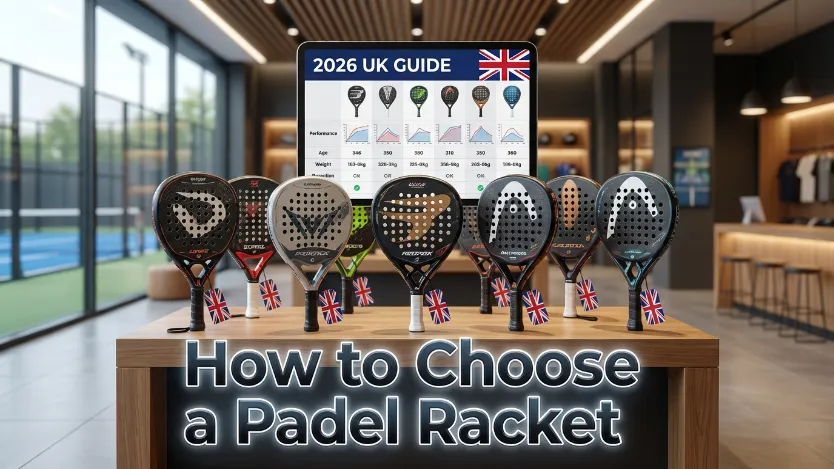
With over 900 courts now active across the country and numbers doubling annually, padel has officially moved from a niche curiosity to Britain’s fastest-growing sport. Yet, as thousands flock to local clubs, a silent epidemic is unfolding on the courts: the “Pro Racket Fallacy.” Too many newcomers are stepping onto the turf with £300 professional-grade diamond frames that are actively sabotaging their progress and straining their elbows. Understanding how to choose a padel racket isn’t just about matching your budget; it is a strategic decision that involves material science, biomechanics, and even the unpredictable British weather.
Racket Comparison: Selection Criteria at a Glance
| Feature | Round Shape | Teardrop Shape | Diamond Shape |
|---|---|---|---|
| Primary Focus | Control & Forgiveness | Power-Control Balance | Explosive Power |
| Sweet Spot | Wide & Centred | Medium & Elevated | Small & High |
| Manoeuvrability | High (Head Light) | Medium (Balanced) | Low (Head Heavy) |
| Best For | Beginners / Defenders | Intermediate / All-rounders | Advanced / Attackers |
The Engineering Behind the Frame: Materials and Performance
A padel racket is a sophisticated piece of equipment, unlike a tennis racket where the frame is static and only the strings are replaced. In padel, the entire racket is a consumable item that degrades with every hit. To know how to choose a good padel racket, you must first understand its three core components: the Frame, the Face, and the Core.
1. The Frame and Structural Integrity
Most modern frames are constructed from composite fibres. While entry-level models might use a higher percentage of fibreglass, premium options utilize a carbon fibre padel racket construction. Carbon provides the necessary rigidity to prevent the frame from twisting during high-speed impacts, ensuring that the energy from your swing is transferred directly to the ball rather than being lost in frame deformation.
2. The Core: EVA vs. Polyethylene
The “engine” of the racket is its core. The vast majority of rackets in the UK market use Ethylene Vinyl Acetate (EVA) foam. This foam is graded by density:
- Soft EVA: Provides a “trampoline effect,” helping beginners generate depth with slower swings.
- Hard EVA: Offers surgical precision and maximum power for those with fast swing speeds, but it is far less forgiving.
For players suffering from joint issues, some brands like Royal Padel use Polyethylene, which is softer and provides superior vibration dampening compared to standard EVA.
How to Choose a Padel Racket for Beginners: Prioritising Forgiveness
If you are within your first 12 months of play, your primary enemy is the “unforced error.” Choosing a racket that punishes off-centre hits will lead to frustration and slower technical development. When learning how to choose a padel racket beginner level players should look for a “forgiving” setup.
The Golden Specs for New Players
For those looking for the best padel racket for beginners, the formula is simple: Round Shape + Fibreglass Face + Soft EVA Core. The round shape ensures the sweet spot is as wide as possible, meaning if you don’t hit the ball perfectly in the centre, it will still cross the net.
Top Beginner Models to Consider
- Babolat Counter Origin: Widely regarded as the best “first racket” due to its incredible balance and low price point.
- Nox X-ONE: A classic all-rounder that uses a slightly more durable frame than standard entry models.
- Head Evo Speed: Perfect for those who want a bit more “pop” without sacrificing the control of a round head.
As a rule of thumb, how to choose a padel racket for beginners also involves looking at the weight. Stay within the 350g–365g range. Anything heavier will lead to early fatigue in your forearm, which is a leading cause of “Padel Elbow” among new starters in the UK.
The Intermediate Upgrade: Finding Your Playing Style
Once you can consistently sustain rallies and have begun to master the bandeja padel, you will likely find that your beginner racket feels “mushy” or lacks the power to finish points. This is the moment to research how to choose a padel racket for intermediate play.
Transitioning to Carbon and Hybrids
Intermediate players should look for a teardrop padel racket. This hybrid shape shifts the balance slightly higher toward the head, providing more leverage for overheads while retaining enough manoeuvrability for defensive play at the back of the court.
De-mystifying Carbon Ratings (3K, 12K, 18K)
This is where many players get confused. The “K” refers to the thousands of filaments in each carbon thread.
- 3K Carbon: Often feels stiffer and more “dry.” Excellent for precision.
- 12K Carbon: The “Goldilocks” zone for intermediates. It offers a great balance of power and feel.
- 18K Carbon: Extremely dense. In most brands, this creates a very hard-hitting surface that requires a high level of technical skill to control.
Recommended Intermediate Rackets
- Head Radical Team: A versatile performer that excels in both attack and defence.
- Bullpadel Axym: Known for its unique teardrop shape and comfortable response.
- Nox AT10 Genius (12K Version): The signature of Agustín Tapia, but in a version that is accessible to club players.
To determine whether you need a Teardrop racket for intermediates or a Round racket for beginners, you can refer to the LTA Padel Ratings Guide, which uses a numerical scale from 1.0 to 7.0 to categorise player levels across Britain.
The UK Climate Factor: Temperature and Humidity
One angle frequently missed by international guides is the impact of the British climate on equipment. Padel materials are thermoplastic, meaning their physical properties change with the temperature.
The Winter Stiffening Effect
In a cold UK winter (sub 10°C), the EVA foam in your racket will contract and harden. This makes the racket feel “dead” and significantly reduces the sweet spot. If you play outdoors in the UK during winter, a racket with a “Soft” core is actually a better choice to compensate for this natural stiffening. Conversely, in a heated indoor padium canary wharf environment, the foam will soften, giving you more power but less control.
The Humidity Trap
High humidity—a staple of British weather—makes the ball heavier as it absorbs moisture. Striking a heavy, wet ball with a lightweight fibreglass racket puts immense strain on the frame. If you primarily play on outdoor courts in the UK, investing in a carbon fibre padel racket with a padel racket protector is essential for longevity.
Biomechanics: Preventing the “Padel Elbow”
Health and safety should be at the forefront of your decision. Padel involves repetitive overhead movements that can quickly lead to lateral epicondylitis. The two biggest equipment-related culprits are vibration and grip size.
The One-Finger Rule
Many rackets come with a factory grip that is too thin for the average UK adult hand. If the padel racket grip is too small, you will naturally squeeze harder to prevent the racket from twisting, which creates tension in the forearm tendons. Rule: When holding the racket, there should be a gap the width of one finger between your fingertips and your palm. Most players achieve this by adding one or two overgrips.
Actual Playing Weight
Remember that the weight listed on the box is the “dry weight.” Once you add a padel racket protector (approx. 7g) and two overgrips (approx. 12g), a 365g racket becomes a 384g racket. This shift can drastically change the balance, moving it from “Neutral” to “Head Heavy.”
Strategic Buying in the UK: The Demo Strategy
Never buy a premium racket (£150+) based solely on an online review. The “feel” of a racket is entirely subjective. Fortunately, the UK has an excellent network of demo programmes. According to a recent report on UK padel testing, hands-on testing is the only way to ensure the balance matches your swing speed.
Where to Test in the UK
- Nick Rivett Sport: Offers a 7-day trial for up to two rackets.
- PDH Sports: Features an indoor demo court in Derby with a ball machine.
- PadelHQ: Provides a 10-day in-store demo service for rackets over £150.
Conclusion: The Verdict for UK Players
Choosing the right equipment is a journey, not a one-time purchase. If you are just starting, ignore the marketing hype surrounding professional players like Ale Galán or Juan Lebrón. Their rackets—typically a diamond padel racket with extreme stiffness—are designed for athletes who hit the sweet spot 99% of the time.
Instead, follow the logic of your current skill level. Start with a round, manoeuvrable frame to build your foundation. As your technique matures, move into the best padel racket for intermediate category with a teardrop shape. By prioritising control, arm health, and climate adaptation, you ensure that your investment into padel gear translates into more wins on the court and fewer visits to the physio.