The courts at Chelsea Harbour and Bristol Sustainable Padel are witnessing a tactical shift. Raw, uncontrollable power is no longer the definitive edge on the UK circuit; it is the marriage of explosive aggression with surgical comfort. Babolat has quietly re-engineered the paradigm of the attacking player. Enter the babolat technical viper soft 3.0—a racket engineered not just to dominate rallies, but to redefine how premium carbon tolerates off-centre strikes without punishing your elbow.
Padel Racket 2026 Specifications
Technical data & metrics
babolat technical viper soft 3.0 Review
The launch of the babolat technical viper soft 3.0 2026 marks a major engineering evolution within the highly competitive premium segment. Historically, competitive players seeking an aggressive diamond padel racket were forced to accept extreme structural stiffness that frequently caused joint fatigue. With the introduction of the babolat technical viper soft 3.0 2026 padel racket, the engineering framework shifts from pure, unyielding kinetic transmission to a more balanced, progressive energy return system that accommodates the physiological realities of advanced club players.
Core Engineering: Soft Carbon Twill & Black EVA Mechanics
The operational profile of the babolat technical viper soft 3.0 padel racket relies upon the structural interplay between its advanced face material and its internal elastomeric core. Unlike conventional plain-woven carbon laminates that demonstrate immediate, harsh bi-directional rigidity under physical loading, this frame incorporates a specialised Soft Carbon (Twill 3K) face weave. The architectural alignment of a twill pattern allows the diagonal carbon threads to slide micro-fractionally against one another under tension. This precise physical characteristic delivers several profound biomechanical benefits on court:
- Extended Dwell Time: The structural compliance increases the physical duration of ball contact against the face, giving technical players superior control over the exit trajectory.
- Progressive Elasticity: It smooths out the sudden, jarring impact peak that defines standard heavy carbon instruments, ensuring a highly predictable and linear response.
- Enhanced Spin Modulation: The added face compliance allows the integrated 3D Spin+ dual-textured surface to mechanical grip the ball felt more effectively on brushing shots.
Working in direct tandem with the soft carbon face is the low-density, elastic formulation of the Soft-Tuned Black EVA Core. This specific elastomeric compound acts like a micro-spring when compressed under load. During medium-speed defensive exchanges, the core deforms effortlessly to absorb incoming kinetic energy, rebounding rapidly to generate deep lobs without requiring extreme physical effort. When executing a high-velocity smash, the core compresses fully to engage the stiffer underlying carbon framework, thereby maintaining the high power ceiling required by competitive players.
Addressing the Naming Paradox: The True Hardness Index
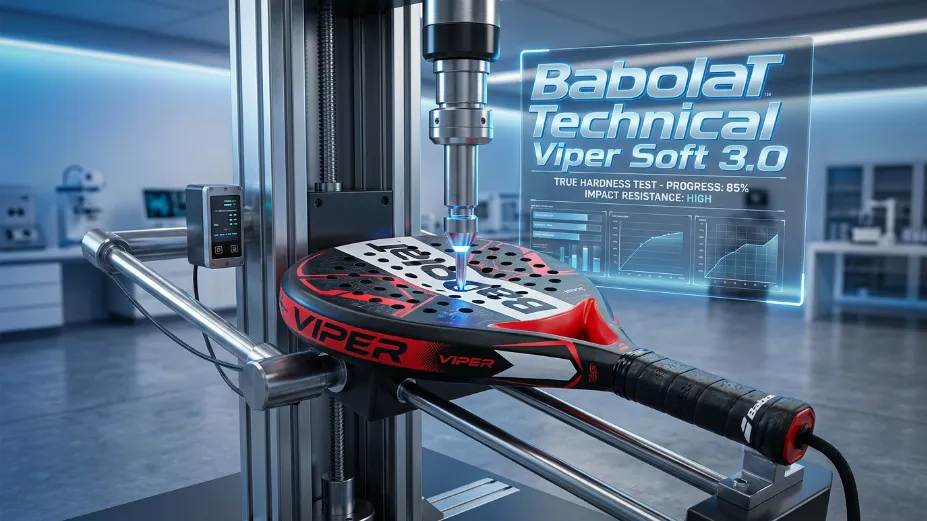
A prominent source of confusion within the UK padel community is the “Soft” nomenclature applied to the babolat technical viper 3.0 soft. Many retail descriptions incorrectly characterise this model as a plush, pillow-like tool built solely for defensive comfort. On-court testing and independent material assessments reveal a significant discrepancy between marketing narratives and structural reality: this frame is not a soft racket in the absolute sense.
When measured against the wider commercial landscape, its structural density sits firmly within the medium-firm to firm category. On an absolute hardness spectrum of 1 to 10—where 1 represents an ultra-elastic, flexible polyethylene core and 10 represents a completely unyielding solid block of dense carbon—the babolat technical viper soft 3.0 sits at a measured 7/10 rating. The “Soft” tag is strictly comparative within the brand’s premium performance tier, offering a noticeably less punishing contact sensation than the ultra-rigid standard variant or the exceptionally firm signature models. When compared directly to alternative power profiles, it remains a rigid, highly demanding instrument that values structural stability under load over deep trampoline-style deflection.
Head-to-Head Comparison: Power, Control, and Forgiveness
To provide clear buying clarity for advanced players, we must analyze the structural and performance trade-offs between the premier models currently dominating the UK circuit.
- vs. Babolat Technical Viper (Standard): The standard version utilizes an unyielding, high-density standard carbon layup and a hard EVA core. While it provides an absolute maximum power ceiling for elite players with flawless timing, it leaves no margin for error. The soft version trades away roughly 5% of that absolute maximum smash velocity in exchange for a 20% increase in sweet spot usability and highly superior comfort on off-centre hits.
- vs. Technical Veron 3.0: The Veron series utilizes a hybrid Carbon Flex face weave that blends carbon with fiberglass. This results in an incredibly forgiving feel and effortless depth accessibility. However, high-level competitive players will find that the Veron lacks the ultimate structural stability and absolute directional precision delivered by the full carbon architecture of the soft viper. The soft viper acts as the perfect upgrade path for players who have outgrown the Veron’s flexible face but aren’t physically ready for the standard viper.
- vs. Rigid Alternatives (Nox AT10 Attack / Adidas Metalbone Carbon): While the Adidas Metalbone series offers modular weight customization, it provides a different style of frame flex. The Babolat soft viper maintains a highly uniform, predictable diamond frame geometry that resists lateral frame twisting during high-speed net volleys, resulting in a more direct, laser-like trajectory control at the cost of immediate out-of-the-box plushness.
The Critical 6-to-10-Hour Break-In Period
An essential structural variable that is entirely omitted from commercial e-commerce product pages is the existence of a definitive molecular break-in period. Fresh out of the packaging, the carbon twill layers and the dense Black EVA polymer chains sit at their absolute maximum physical tension. During your initial two or three match sessions, the frame will feel exceptionally dry, rigid, and board-like, displaying a highly compact sweet spot and surprisingly limited ball depth during slow defensive wall recoveries.
Data shows that the racket requires between 6 to 10 hours of active play to open up and settle into its true performance profile. The continuous mechanical compression generated during intensive rallies micro-fractures the dense polymer matrix of the internal foam, expanding its elasticity. Simultaneously, the resin holding the carbon weave relaxes, widening the effective sweet spot area and transitioning the response from a punishing, stiff contact to a highly progressive, comfortable, and energetic strike. Players must not judge the playability or arm comfort of this frame based exclusively on its initial out-of-the-box feel.
Biomechanical Load, Joint Safety, and Injury Risks
For players managing chronic lateral epicondylitis or shoulder fatigue, selecting appropriate gear is an absolute physiological necessity. Marketing campaigns heavily promote the inclusion of the Vibrasorb System² Powered by SMAC, highlighting its ability to reduce joint strain. While the technology is incredibly effective at filtering out high-frequency shock waves—the sharp acoustic “sting” felt when hitting the ball outside the central hitting zone—vibration absorption is only one aspect of arm safety.
The distinct diamond geometry features a high balance point situated at 270 mm, creating a substantial lever arm. This head-heavy mass distribution drastically increases the rotational torque acting on the wrist and elbow joints during late acceleration phases. If a player exhibits flawed stroke mechanics, poor preparation, or inadequate forearm conditioning, the continuous physical effort needed to accelerate and decelerate this head-heavy mass will place a high tensile load on the tendons.
Therefore, while this model is significantly safer than its ultra-rigid standard sibling, it cannot be classified as a generic tool for injury prevention. Players requiring ultimate joint relief are much better served by exploring low-balanced frames, or examining the specialized engineering detailed in our comprehensive review of the best padel rackets for tennis elbow.
Real-World Weight vs. Dynamic Swingweight
While the nominal weight of this model is officially stated as 365 grams, standard manufacturing tolerances mean that factory units regular vary between 360 and 375 grams unstrung. In real matchplay scenarios, the static weight is far less important than the dynamic swingweight, which is dictated by how that mass is distributed along the frame.
Because the balance is pushed aggressively toward the tip, the physical effort required to reposition the frame during rapid, fast-paced net exchanges is exceptionally high. Adding a standard padel racket protector to the frame tip adds approximately 5 to 8 grams of mass directly to the longest point of the lever arm, shifting the balance even higher. Conversely, adding multiple overgrips using a high-quality padel racket grip increases handle weight, raising the total static weight past 380 grams while slightly lowering the balance point.
This high swingweight acts as a double-edged sword: it heavily penalizes late reactions and slow defensive positioning against the rear glass walls, but functions as a massive kinetic multiplier during offensive smashes, allowing players to generate explosive ball exit speeds with minimal shoulder strain once the swing arc is cleanly initiated.
Environmental Adaptability: Performance in UK Climates
A crucial performance factor that competitive players must consider is how the frame responds to the highly variable and cold climate conditions of the United Kingdom. The vast majority of product testing is conducted in warm, arid environments where EVA foams display maximum natural elasticity. When subjected to outdoor UK courts or unheated indoor conversion hubs during late autumn and winter—where temperatures regularly drop below 10°C—the physical properties of the materials shift dramatically:
- Thermal Core Contraction: Cold ambient air causes the Black EVA polymer chains to contract and harden. This thermal reaction reduces the core’s ability to compress, resulting in a noticeable drop in natural ball output on low-speed defensive blocks. The racket begins to behave exactly like the ultra-rigid standard variant.
- The Heavy Ball Variable: The damp, humid air common across the UK causes padel ball felt to rapidly absorb moisture, making the ball feel dead and heavy. Striking a cold, water-logged ball further shrinks the perceived sweet spot, forcing the player to swing significantly harder to achieve depth, which accelerates forearm fatigue.
- Feedback Muting: The aerospace-grade viscoelastic layers inside the shaft become stiffer in freezing conditions, muting the tactile feedback and making it harder for technical players to execute delicate drop shots or angled slices.
To preserve the intended playability of the racket, UK players must store their gear inside thermally insulated compartments and utilize high-pressure, speed-optimized balls to offset the loss of core elasticity during winter match schedules.
Tactical Suitability & The Intermediate Upgrade Path
Determining whether this model is appropriate for your current competitive level requires an honest, objective analysis of your technical development. Many intermediate players who have spent 12 to 18 months refining their strokes often look to upgrade their equipment to increase their power potential. However, making an immediate jump from an entry-level frame to an ultra-stiff carbon weapon is highly discouraged, as the compressed sweet spot will immediately punish technical flaws, leading to high unforced error rates.
The soft version provides a highly logical and accessible alternative path. Its progressive carbon weave and slightly more forgiving face structure give developing players the added tolerance needed to maintain depth while they continue to refine their core mechanics. However, true beginners and lower-intermediates must avoid this model due to its demanding head-heavy nature. For players who still require an easier, more elastic depth generator with an expanded hitting zone, selecting the hybrid Technical Veron 3.0 remains the most sensible intermediate step. The soft viper must be reserved strictly for high-intermediate and advanced players who possess consistent swing speeds and want a highly stable, premium offensive tool to elevate their competitive performance.
For more details on the complete specifications, official brand warranty options, and direct international purchasing, you can visit the official product page for the babolat technical viper soft 3.0.
Frequently Asked Questions (FAQ)
Does the Soft Carbon face eliminate the risk of frame cracking under intense play?
No. While the Carbon Twill 3K weave increases structural elasticity and face durability against aggressive ball impacts, the outer perimeter remains a 100% carbon tube structure. Direct, high-velocity contact with glass walls or metal mesh fencing will still cause structural cracks, making the use of a high-quality protective strip essential.
How does the performance of the soft viper change when playing with low-pressure tennis variants?
It is highly compromised. Using standard tennis balls instead of dedicated high-pressure padel balls forces the compressed Black EVA core to absorb excessive dead weight. This heavily reduces your depth generation, shrinks the functional sweet spot, and significantly increases the mechanical shock waves travelling into your forearm.
Can an intermediate player safely customize the frame balance by adding tungsten tape to the throat?
Yes. If you find the factory 270 mm head-heavy distribution too taxing during rapid net volleys, adding specialized weighted tape directly inside the central throat column or the reinforced bridge window will pull the balance point down, improving immediate manoeuvrability without altering the core density.