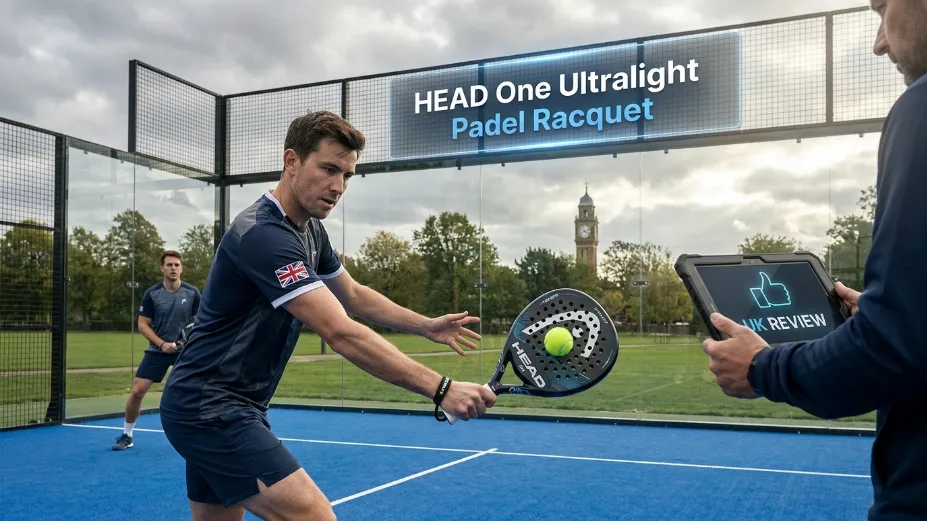
The obsession with power in the modern padel landscape has left a critical vulnerability in most players’ games: manoeuvrability. While traditional premium options heavily tax the elbow during damp, indoor British winter sessions, the newly engineered HEAD One Ultralight Padel Racquet shatters the convention that elite performance requires heavy carbon bulk. Weighing significantly less than standard court weapons, this 2026 release introduces a radical approach to defensive speed and clinical net re-directs. Whether you are navigating competitive local leagues or upgrading your tactical toolkit, understanding how this specific frame alters ball dynamics is crucial before investing your hard-earned Pounds in this comprehensive HEAD One Ultralight Review.
HEAD One Ultralight 2026 — Specifications
Weight · Beam · Core · Colour · UK Price
Comprehensive HEAD One Ultralight Review: Technical Anatomy
The engineering core of the Head One Ultralight review centers upon its non-traditional single-hole setup. While legacy racquet manufacturers relied primarily on drilling dozens of perforations across the hitting face to lower weight and manage air resistance, this silhouette bridges modern advanced material composite sciences with the rigorous structural needs of modern court sports.
- The Composite Matrix: Utilising premium woven 12K carbon fibre strands developed via specialized high-density carbon filament layouts, the primary hitting face offers exceptional structural integrity. Each woven bundle contains 12,000 individual filaments, engineered with a lower carbon density than the stiffer HEAD Extreme One to provide a highly forgiving, flexible feel for developing players.
- The Single-Hole Innovation: By leaving the face completely solid and placing exactly one strategic perforation near the throat, HEAD complies fully with Section II of the International Padel Federation (FIP) guidelines. This layout eliminates the micro-fissures and stress-concentration cracks common around traditional drilled holes, leading to unmatched frame longevity.
- Auxetic 2.0 & Graphene Inside: The structural frame response incorporates advanced Auxetic 2.0 elements embedded deeply into the bridge and handle grip. These elements expand under tensile load to deliver solid tactile feedback to the player’s hand, while Graphene Inside reinforces the perimeter hoop to prevent twisting during off-centre ball impacts.
The outer edge layout balances lightweight structural aerodynamics with an integrated, textured Spin Surface rough sand lacquer layer. This specialised finish mechanically grips the ball at impact, allowing players to generate precise spin profiles during delicate cut volleys. For players analysing options across the entire brand matrix, evaluating the dedicated structural differences outlined in our analytical look at the premier HEAD padel racket selection provides clear contextual background before buying.
Check Best Lightest Padel Rackets Guide
Black vs. White: Deciding on your HEAD One Ultralight 2026
Navigating the product family requires a clear understanding of the aesthetic and technical specifications that separate the dual variants in this high-performance line. Selecting your specific model version of the HEAD One Ultralight 2026 dictates both your visual presence on court and your technical equipment setup.
The Aesthetic Variance
The product family splits neatly between the stealthy HEAD One Ultralight Black edition and the crisp, minimalist Head One Ultralight White edition. Both iterations share the exact same structural footprint, but the lacquer application and graphic layouts offer distinct stylistic directions for modern players. The black version features matte accents designed for a sleek, contemporary look, while the white model offers high visual contrast that pops brilliantly against blue indoor court environments.
Weight and Commercial Discrepancies
A major point of confusion across international e-commerce sites is the weight listing for these two models. Some online retailers have mistakenly published data sheets claiming the black and white editions weigh 345g and contain a rigid Power Foam core. This is a copy-paste clerical error from alternative product lines; both adult models are verified at an ultra-lightweight 300 grams with a soft Comfort Foam core. This technical profile reflects clearly across UK commercial retail channels, where the average head one ultralight padel racquet price stays stable between £109.99 and £129.99, representing a highly accessible entry point for premium carbon craftsmanship.
If you are a developing competitor looking to match an ultra-lightweight frame with specialized joint safety, exploring the definitive structural mechanics detailed in our guide to the best padel rackets for tennis elbow will ensure your entire equipment choice functions in perfect technical alignment.
The Critical Player Guide: Deciphering the Head One Ultralight Padel Racquet Specs
A major missing angle across major commercial e-commerce review spaces is the highly specific volumetric performance profile of the racket face. When choosing based on the official head one ultralight padel racquet specs, evaluating the interaction between a solid 12K carbon face and an ultra-low weight signature is vital.
The racket is built around a distinct, round head geometry that positions the sweet spot lower down the face, closer to the hand. This streamlined layout is designed to maximize defensive control and retrieval capability, but it alters the traditional trampoline effect found in heavily perforated models. The solid face creates a highly uniform surface flex, completely eliminating the structural “dead zones” that occur near the edge holes of conventional frames.
Because the Comfort Foam core sits enclosed within a solid carbon wrapper, the vertical ball exit speed during low-velocity strokes is exceptionally lively and bouncy. The ball rebounds quickly from the face without requiring immense physical force from the player’s wrist. During rapid, reactive defensive exchanges at the back glass, this structural layout helps players guide deep lobs safely to the baseline, even when compressed into awkward spatial positions on court.
To avoid performance limitations, players must adjust their technical execution metrics. It is highly recommended to rely on a clean, smooth swing path rather than jerky, hyper-aggressive wrist snaps. For intermediate players or female competitors looking for a manageable, high-performance option, cross-referencing this model with the tailored selections in our index of the best lightweight padel rackets for women provides deep strategic insight before final purchase.
Exposing the Information Gaps: Real-World Durability Under the Microscope
While mainstream marketing materials highlight the premium aerodynamic properties and sleek aesthetics of the single-hole collection, deep analysis across independent UK playing groups reveals distinct functional performance trade-offs and physical limitations under high-stress match conditions.
- The Off-Centre Torsional Twisting Phenomenon: Because the total mass is limited to 300 grams, the frame lacks heavy perimeter mass blocks. When facing advanced opponents who deliver high-velocity, heavy balls, off-centre impacts outside the core sweet spot cause the racket to twist noticeably in the player’s hand, requiring a firm grip and precise timing.
- Lower Passive Energy Absorption: The low static mass means the frame cannot rely on raw weight to absorb the momentum of incoming balls. During aggressive, high-speed blocks at the net, players must use more physical effort and maintaining proper technique is essential to prevent the racket from being pushed back by the ball.
- Aerodynamic Drag Misconceptions: While the solid face raises theoretical concerns regarding the “paddle effect” through the air, real-world track testing confirms that the 17% reduction in total mass completely compensates for the absence of traditional airflow holes, allowing players to maintain excellent swing velocity.
These persistent performance boundaries mean the racket functions beautifully as a specialized control and recovery tool, but it is not built for aggressive, power-focused styles. Understanding these technical trade-offs is crucial for budget-conscious buyers who want to ensure their equipment matches their personal on-court tactical goals.
Performance on British Courts: Wet, Sand, and Covered Turf
Evaluating the 12K Carbon solid face requires analyzing the highly variable, unpredictable court environments found throughout the United Kingdom. The material behaviour changes fundamentally based on humidity levels and the specific turf layout of your local club.
On traditional, heavily sanded synthetic carpet courts, the round head shape and low-density core work beautifully together. The balanced handling allows for clean, reactive pick-ups off the low-rebounding glass, managing sand-filled court variations with maximum control. However, when playing during typical damp, cold British winter sessions on un-covered outdoor courts, the high relative humidity can cause surface moisture to settle on the solid face, slightly reducing the mechanical grip of the sand lacquer texture until wiped dry.
Modern premium venues increasingly implement low-sand covered layouts, which deliver high natural ball speed and consistent bounce characteristics. When swinging across these premium indoor courts, the ultra-lightweight profile allows players to react instantly to hyper-fast volleys. The extended 13.5cm handle length is highly beneficial in these fast scenarios, providing extra leverage for double-handed backhands and reducing hand slippage during intense rallies.
Head-to-Head: HEAD One Ultralight vs. Alternative Lightweight Models
For players trying to choose between the revolutionary single-hole layout and traditional lightweight models, the choice comes down to a fundamental split in materials philosophy. Both paths occupy prominent placement across UK tennis outlets but approach player comfort from completely opposing engineering angles.
The primary technical and playability differences are detailed in the structural comparison below:
- Material Composition and Durability: The HEAD model wins decisively on structural longevity, pairing a premium 12K carbon face with a single-hole layout that prevents frame cracking. Competitors like the Nox AT10 Genius Junior or HEAD Zephyr UL rely on highly flexible but less durable glass fibre composites, which show structural fatigue faster under heavy court impact logs.
- Static Weight Signature: This frame dominates the weight category, entering the court at a precise 300 grams. Traditional lightweight adult rackets typically sit much higher, between 340g and 345g, meaning the One Ultralight provides an unmatched reduction in static muscle load for players managing wrist fatigue.
- Power Output and Offensive Depth: Traditional 345g layouts utilize their extra physical mass to drive through the ball naturally during overhead smashes. The 300g single-hole design sacrifices raw momentum, requiring players to accelerate the frame with significant physical arm speed to achieve deep, point-ending power.
For a complete, comprehensive overview of alternative lightweight options currently occupying the competitive landscape across British clubs, take a moment to read our detailed breakdown of the premier lightest padel rackets index to select your ideal structural match.
Buying Advice in the UK: Prices, Retailers, and Selection
Tracking down this flagship silhouette across the United Kingdom involves navigating specialized court speciality operations and major digital distribution networks. The official Recommended Retail Price (RRP) sits firmly at £165.00, but careful shoppers can regularly source competitive street pricing across premium domestic channels.
Major international padel suppliers keep steady seasonal stock of both the monochrome variations, while boutique regional retailers cater directly to club players with bespoke demo services. Average street prices consistently hover between £109.99 and £129.99, representing outstanding market value for an advanced frame that incorporates Auxetic 2.0 and premium 12K carbon composites without forcing players into the £250+ ultra-premium price bracket.
The model availability remains highly accessible across the UK market, arriving in specialized adult formats that cater beautifully to casual enthusiasts, intermediate control players, and athletes recovering from joint fatigue. Sourcing your gear from verified domestic operations guarantees full warranty protection and ensures your equipment setup aligns perfectly with official UK playing regulations.
HEAD One Ultralight Review: On-Court Performance & Technical Verdict
The final technical evaluation of this high-performance single-hole frame depends entirely on your personal playing profile, physical joint history, and strategic approach to on-court execution.
- Who Should Buy: Entry-level beginners and casual club players who prioritize unmatched handling ease, injury-prone competitors recovering from tennis elbow, and tactical players who rely on reactive defensive control and rapid net exchanges.
- Who Should Avoid: Advanced, highly aggressive tournament players who demand maximum mass-driven power for overhead smashes, and competitors who play a heavy, smash-focused baseline game against hard-hitting opponents.
Frequently Asked Questions (FAQ)
Are these court racquets constructed entirely within the UK?
No. While all primary conceptual design, structural prototyping, and technical athletic testing are managed at HEAD’s international corporate engineering hubs, material production and advanced carbon composite assembly are handled by primary manufacturing partners in Asia, matching standard practices across the premium sporting goods industry.
Can I safely utilize heavy overgrips without altering the baseline balance of the frame?
It is discouraged if you wish to preserve the factory feel. Because the frame features a lightweight 300g design with a 265mm even-to-head-light balance point, adding multiple thick overgrips will shift the balance significantly towards the handle, altering the intentional swing physics and reducing ball exit speed.
How does the single-hole layout impact the sweet spot compared to traditional drilled frames?
The inclusion of a solid 12K carbon face creates a highly uniform surface flex across the hitting zone. This design removes the inconsistent “dead zones” commonly found near the perimeter holes of standard drilled rackets, resulting in a predictable and forgiving response across the entire hitting face.