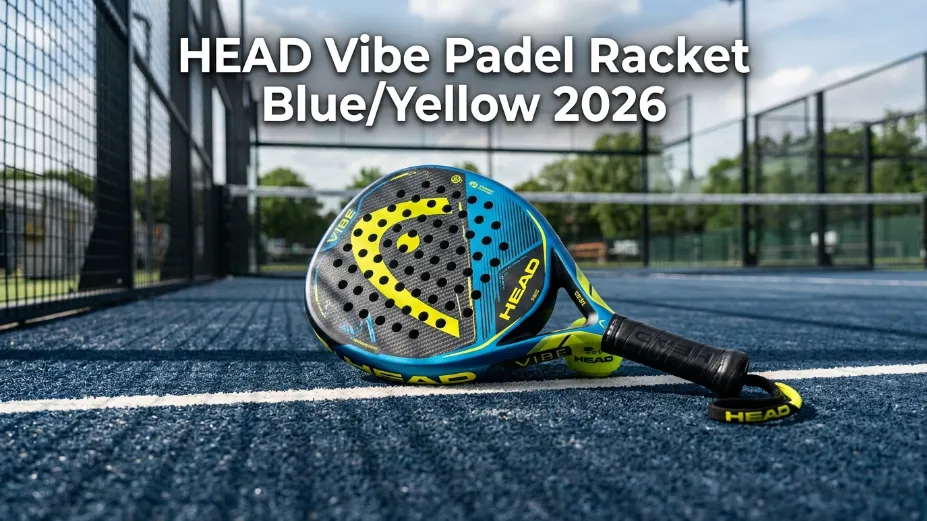
The UK padel scene moves too fast for mediocre gear, and courts from London to Edinburgh are seeing a massive shift towards custom-tuned control. Entering the courts with an undeniable cosmetic flair and a promise of re-engineered stability, the Head Vibe Padel Racket Blue Yellow 2026 aims to be the defining mid-balance stick of the season. If you are tracking down UK stockists or weighing up whether this vibrant update justifies its price tag, you need raw court data, not marketing fluff. Let’s break down how this frame handles crisp volleys and dampens vibration when the winter condensation hits the glass.
Padel Racket — 2026 UK Specifications
Weight · Balance · Shape · Core · Frame · UK RRP
The fast-paced growth of the club infrastructure across the United Kingdom has completely transformed player expectations regarding specialized gear. Standard entry-level rackets no longer satisfy club players who face damp outdoor glass walls and heavy balls in non-temperate climates. With technical frameworks arriving at local clubs, evaluating the exact material compositions and mechanical thresholds of your frame becomes vital to maintaining execution and avoiding chronic injuries.
Head vibe blue yellow padel racket reviews: Technical Anatomy
Deep-dive independent Head vibe blue yellow padel racket reviews demonstrate that the structural core of this model is specifically engineered to bridge the gap between recreational comfort and structural reliability. While legacy fiberglass frameworks often feel hollow or twist under load, this update uses a tubeless frame configuration where the internal foam core expands directly to the outer carbon matrix boundary.
- The Elastic Modulus of Fibreglass: By selecting a woven glass fibre hitting surface instead of high-modulus carbon composites, the face exhibits greater mechanical deflection upon impact. This material choice yields a high “ball output” (salida de bola), allowing low-intermediate players to secure deep baseline returns without executing aggressive, high-velocity swing paths.
- Innegra™ Vibration Reduction: Integrated directly into the frame perimeter, this low-density polyolefin fibre forms an advanced hybrid matrix with carbon. Upon high-impact ball contact, the structural shockwaves are dissipated through the polyolefin strands, limiting vibration transmission to the forearm by up to 17% compared to standard fiberglass-only alternatives. This is an essential mechanical asset for individuals researching the best padel rackets for tennis elbow.
- The Power Foam Core Matrix: The interior uses a highly elastic, open-cell polyurethane-based foam designed to rebound instantly. This delivers “easy power” on slow-to-medium strokes, though it reaches a physical limitation under maximum swing speeds where the material can bottom out completely.
The external protective layer features the Integrated Protector System (IPS), a pre-moulded carbon bumper directly embedded into the frame’s outer mold during manufacturing. This layout acts as a shield against scratches, structural chips, and frame delamination from persistent wall contact. For players assessing cost-effective performance options across the entire market, checking the comparative profiles listed in our guide to the best padel rackets under 100 provides wide contextual support before making a definitive purchase.
Check Best Padel Rackets Guide
Head-to-Head: Head Vibe 2026 vs. Brand Alternatives
Navigating the product hierarchy requires a clear understanding of the mechanical variations between the standard Vibe layout and its immediate stablemates. Selecting your specific model dictates your dynamic kinetic velocity and mechanical stability during high-intensity club matches.
The Structural and Power Variance
The standard Head Vibe 2026 Padel racket focuses extensively on lightweight manoeuvrability and defensive response. Its 350-gram static mass and 265 mm even balance allow for instantaneous adjustments at the net. Conversely, the Head Bolt Red/Black 2026 implements a noticeably heavier weight distribution (360g to 370g), shifting the dynamic mass towards the head to provide more raw physical power for players transitioning from tennis who possess established, heavy stroke mechanics.
The Tactile Feedback Discrepancy
The premium Head Coello Vibe 2026 stands as a higher-end option within the brand matrix. It implements a medium-high, head-heavy balance configuration paired with integrated Auxetic 2.0 technology inside the throat bridge. This carbon matrix contracts when pulled and expands when squeezed, providing significantly clearer tactile feedback and precise control at impact than the smooth fibreglass face of the standard Vibe. For players tracking alternative paths, the Head Evo Speed padel racket employs simpler Soft Foam, resulting in a lower energy return profile that prioritises basic comfort over dynamic depth.
If you are an intermediate level club competitor trying to match your physical progression with specialized equipment choices, reviewing the precise engineering profiles detailed in our analysis of the best padel racket for intermediate will help ensure your gear aligns perfectly with your style of play.
The Critical Balance Guide: Understanding the Swingweight Equation
A major missing angle across commercial retail review platforms is the application of mechanical physics to real-world court performance. When evaluating the Head Vibe 2026 Padel racket, players often conflate its static weight with its dynamic resistance on court.
In classical mechanics, the resistance to angular acceleration—which the player experiences as swingweight—is modeled as the moment of inertia (I) about the grip pivot point:
I = ∑ mi ri2 ≈ m · d2
Where m represents the static mass of 350 grams and d is the distance from the butt cap to the balance point at 265 mm. Because both of these structural variables are kept low by design, the dynamic resistance of the racket is exceptionally minimal, allowing for rapid net reactions and immediate wrist adjustments during fast net exchanges.
However, this low moment of inertia creates distinct mechanical boundaries when facing heavy, fast-paced baseline drives from advanced opponents. Because the racket lacks sufficient head mass, the frame can twist slightly upon off-centre contact, absorbing kinetic energy and causing inconsistent depth control on defensive blocks. To resolve this performance limit, players can add 3 to 5 grams of adhesive lead or tungsten tape to the very top of the frame to shift the balance point higher, effectively tuning the swingweight as their technique improves.
Exposing the Information Gaps: Real-World UK Court Playability
While mainstream marketing portfolios describe the racket as an all-round powerhouse, field evaluations across outdoor UK club environments expose specific environmental limitations and performance boundaries that buyers must recognise.
- The Condensation Slippage Phenomenon: The face of the racket utilizes a completely smooth fibreglass finish. When playing on un-covered British courts during autumn or winter, the slightest presence of surface moisture or condensation causes the ball to slide off the face instantly, making it difficult to execute cut volleys or advanced spin-heavy bandeja variations.
- Overhead Smash Compression: Under high swing speeds, such as flat, aggressive smashes, the soft fibreglass face and Power Foam core compress fully. This over-compression absorbs structural energy rather than repelling it, often causing powerful overheads to drop short of their intended targets.
- The Aftermarket Protective Cover Deficit: The manufacturing package does not include a protective cover bag. Because the soft fibreglass face is highly susceptible to minor scratches and structural blemishes during transit in your kit bag, players must budget for an aftermarket cover to ensure long-term face integrity.
These architectural details make the frame an exceptional option for tactical, placement-focused indoor players, but a challenging tool for power hitters operating in cold, damp outdoor environments. Recognising these boundaries ensures you avoid premature replacement cycles and choose gear tailored to your climate.
UK Retail Landscape: Smart Procurement and Basket Optimisation
Securing the best Head vibe blue yellow padel racket price across United Kingdom commercial channels requires navigating specific retail pricing structures and delivery thresholds. While the official UK recommended retail price (RRP) is fixed at £85.00, major online specialist distributors regularly list the racket between £63.75 and £67.99.
This competitive street price creates a unique procurement hurdle for UK buyers. Most major padel merchants implement a free shipping threshold set at exactly £75.00. Because the standalone cost of the racket sits just below this trigger point, purchasing the frame alone forces you to pay standard delivery fees ranging from £4.95 to £4.99, erasing a portion of your online discount.
To circumvent this shipping fee, smart club players can utilize a basket optimisation strategy. By bundling necessary court consumables—such as a tube of premium Head Padel Pro S+ balls (∞£6.99) or a multi-pack of high-tack overgrips (∞£6.90)—the total order value safely crosses the £75.00 free delivery mark. This strategy waives the shipping fee entirely, ensuring maximum financial efficiency while providing essential accessories for your upcoming club matches.
Verdict: Should You Choose the Head Vibe 2026?
The final technical assessment of this striking frame depends entirely on your current skill level, injury history, and strategic approach to technical development.
- Who Should Buy: Recreational and low-intermediate club players who want an arm-friendly, highly manoeuvrable frame that excels in baseline defence and rapid net exchanges without breaking the bank.
- Who Should Avoid: High-level advanced competitors who require rigid carbon construction for high-velocity flat smashes, or players with wide hands who refuse to implement double overgrips to alter the narrow factory handle profile.
For players who eventually outgrow the flexible performance limits of a fiberglass face and begin hitting the sweet spot consistently, transitioning to a stiffer, advanced carbon model is recommended. Exploring the detailed structural layout found in our independent Nox AT10 Genius 18K Alum 2026 review will guide you smoothly toward your next long-term equipment upgrade.
Head Vibe Padel Racket Blue Yellow 2026 – FAQ
Are these court rackets constructed entirely within the UK?
No. While all primary conceptual research, structural engineering, and initial prototyping are managed at corporate design centres in Europe, the actual physical assembly and component moulding are handled by specialised manufacturing partners in Asia, matching standard practices across the sports equipment industry.
Can I safely utilize a standard washing machine cycle to clean the upper mesh?
It is highly discouraged. The intense heat, persistent moisture, and mechanical agitation of a domestic washing machine will compromise the core material properties and degrade the adhesives holding the integrated carbon bumper, leading to premature frame delamination. Cleaning the face manually with cold water and a soft cloth is recommended.
How does the overall stack height impact response speed compared to generic tennis variants?
The implementation of the oversized teardrop geometry and 38 mm standard profile width raises your hitting surface area significantly. While this adds unmatched defensive tolerance and expands the sweet spot, it trades away a small amount of minimalist aerodynamic speed compared to ultra-light, low-profile alternative variants.