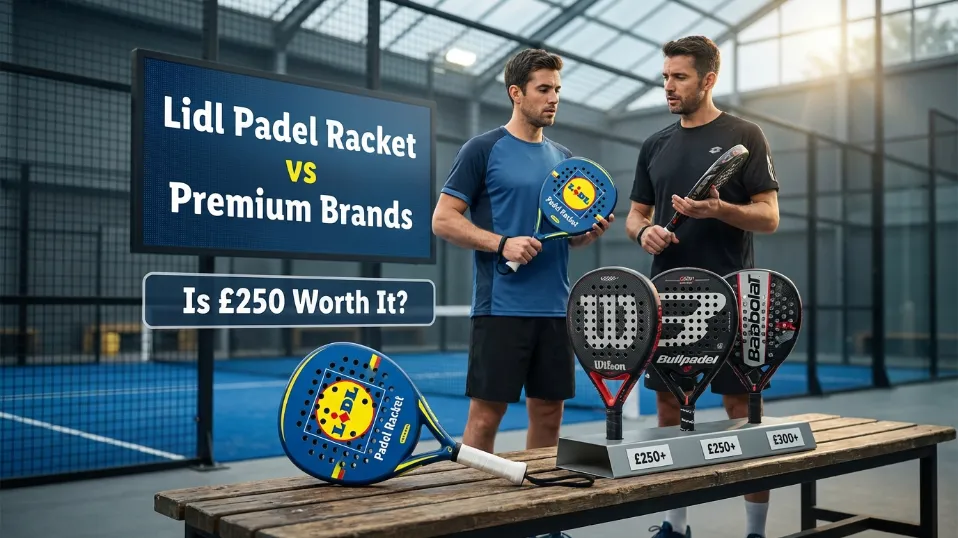
Walking onto the court with a £25 supermarket find while your opponents casually unpack £250 carbon-fibre masterpieces can feel slightly intimidating. The whispers of “gear makes the player” usually start before the first serve. But when we look at a Lidl padel racket vs premium brands like Babolat or Adidas, the reality on the court often tells a different story.
Dropping a small fortune on a top-tier frame will not magically fix a sloppy bandeja, yet a dirt-cheap racket might severely hold back your progression once you master the basics. The real question is not just about the price tag; it is about figuring out exactly when that massive price jump translates to actual performance, and when it is simply a vanity tax.
| Feature | The Budget Supermarket | The Mid-Range Premium | The High-End Premium |
|---|---|---|---|
| Model | Lidl Crivit Padel Racket | Babolat Technical Vertuo | Adidas Metalbone 3.3 |
| Average Price | ~£25.00 | ~£110.00 | ~£280.00 |
| Frame Material | Fibreglass / Plastic blend | Soft Fibreglass | Carbon Aluminized 2 to 1 |
| Core (Foam) | Standard EVA foam | Black EVA | EVA Soft Performance |
| Vibration Control | Minimal | Good (Vibrabsorb System) | Excellent (Octagonal Structure) |
| Best Suited For | Absolute Beginners / Casuals | Intermediate Attacking Players | Advanced / Professional Players |
The Short Answer: If you play occasionally and are just learning the rules, the £25 Lidl padel racket offers unbeatable value to get you started. However, if you play weekly and want to generate serious power, control, or spin, the price difference is absolutely worth it. Premium brands like Babolat and Adidas utilise advanced materials like carbon fibre and varying EVA rubber densities that drastically reduce arm vibrations and improve ball output—technological advantages that a basic supermarket frame simply cannot replicate.
The Science of Materials: Lidl Padel Racket vs Premium Brands
The most significant difference between a budget vs premium padel racket lies in the chemical and physical composition of the frame and face. Supermarket models, such as the Lidl Crivit vs Babolat padel entry-level lines, rely almost exclusively on fibreglass. While fibreglass is highly flexible and provides a comfortable “trampoline effect” that helps beginners return balls with minimal effort, it lacks the structural integrity of carbon. In the technical world of padel, carbon fibre is the gold standard for its strength-to-weight ratio.
Carbon Weaves Decoded: 3K vs 12K vs 18K
When you step into the premium market, you will encounter the “K” rating, which refers to the number of carbon filaments per bundle.
- 3K Carbon: A tighter, stiffer weave (3,000 filaments) that offers a “dry” hit and maximum control. It is often found in rackets designed for precise, tactical players.
- 12K Carbon: The versatile middle ground (12,000 filaments). It provides a balance between stiffness and flex, making it ideal for the “all-round” British club player who defends and attacks in equal measure.
- 18K Carbon: A denser, more elastic weave (18,000 filaments). Contrary to popular belief, more “K” does not always mean harder. In many high-end frames like the nox padel racket series, 18K provides a softer, more explosive feel because the fibres can deform more under heavy impact.
Budget rackets simply cannot compete here; their fibreglass faces absorb energy rather than returning it, leading to a “dead” feel after just a few months of regular play.
The Humidity Trap: Why UK Weather Wrecks Budget Frames
A “missing angle” often ignored by global reviewers is the specific impact of the British climate. Padel is increasingly played in outdoor or semi-covered courts across the UK. Fibreglass is more porous and susceptible to moisture absorption than high-grade carbon. In a damp London winter, a cheap vs expensive padel racket UK comparison becomes a matter of longevity. Budget frames can become heavy and “soggy” as the internal foam and external glass-fibre layers hold moisture, whereas carbon remains relatively inert and consistent in its performance.
Is an Expensive Padel Racket Worth It? The Biomechanical Truth
Many players ask, is an expensive padel racket worth it if they aren’t playing at a professional level? The answer often lies not in your shot quality, but in your physical health. Premium brands invest heavily in vibration damping technology. Brands like Babolat padel racket designers use “Vibrabsorb” systems, which integrate elastomers into the handle and heart of the racket to filter out high-frequency vibrations before they reach your tendons.
Lidl Crivit rackets and other cheap padel rackets often lack these sophisticated damping systems. When you strike the ball off-centre—a common occurrence for beginners—the shock travels directly up the handle. Over time, this is a primary driver of “Padel Elbow” (lateral epicondylitis). Investing in a premium frame is often less about the “vanity” of the brand and more about a long-term investment in injury prevention. If you already suffer from joint issues, choosing from the best padel rackets for tennis elbow is a necessity rather than a luxury.
Performance Comparison: Lidl Crivit vs Babolat Padel
The Lidl Crivit vs Babolat padel debate is effectively a battle of the “Sweet Spot.” A budget racket has a very small, inconsistent sweet spot. If the ball hits even slightly outside the centre, the racket twists in your hand, leading to a loss of both power and direction. Premium models, specifically those with a round shape like the best padel rackets for beginners, are engineered to have an “oversized” sweet spot that forgives technical errors.
Furthermore, the Lidl Crivit weighs approximately 325g. In the UK padel community, this is considered extremely lightweight—often too light for most adults. A racket that is too light requires the player to swing much faster to generate the same power as a 360g frame. This results in poor swing mechanics and increased fatigue. Premium brands carefully balance their rackets (Head-light, Even, or Head-heavy) to ensure the weight works with your stroke rather than against it.
Before you convince yourself to spend over £200 on an Adidas or Babolat frame, you need to understand exactly how the baseline option performs. Read our comprehensive Lidl Padel Racket Review: Waste of Money or Hidden Gem? to see our deep dive into the Crivit’s sweet spot, durability, and court performance.
Economic Analysis: Cheap vs Expensive Padel Racket UK Market Longevity
When considering cheap vs expensive padel racket UK prices, the “cost per match” is the only metric that truly matters. A £25 Lidl racket is built for the “Middle of Lidl” casual buyer who might play three times a year. If you use it twice a week, the internal EVA foam will likely lose its “rebound” memory within 3–4 months. Once the core goes “dead,” the racket is effectively useless.
In contrast, a mid-range carbon-hybrid frame costing £80–£120, such as a Babolat or Adidas padel racket, can easily last 18–24 months of consistent play.
- Lidl (£25): Replaced every 4 months = £150 over 2 years.
- Premium (£120): Lasts 2 years = £120 over 2 years.
Ironically, the expensive option is often the budget choice for anyone committed to the sport. Additionally, premium rackets hold their value. You can easily sell a used Adidas Metalbone on the second-hand market for 50% of its original price; a used Lidl racket has zero resale value.
The Information Gap: Shared Factories and Quality Control
A secret the big brands won’t tell you is that many rackets—from the cheap padel racket category to mid-tier “pro” models—are manufactured in the same clusters in China or Pakistan. However, the difference lies in Quality Control (QC). A premium brand like Babolat Technical Viper involves rigorous testing for weight distribution, balance points, and resin consistency. Budget retailers accept much wider tolerances, meaning two “identical” Lidl rackets might feel completely different on the court.
Furthermore, premium rackets use multi-density EVA foam. The core features a softer inner layer for control on slow shots and a harder outer layer for power on smashes. Supermarket rackets use a single, uniform slab of low-grade foam that provides no tactical versatility.
Strategic Timing: When to Upgrade Padel Racket
Knowing when to upgrade padel racket is the key to consistent improvement. If you started with a Lidl Crivit, you should consider moving up when you notice the following:
- Lack of Power on Smashes: If you are swinging hard but the ball isn’t reaching the back glass, your fibreglass frame is likely “bottoming out.”
- Persistent Arm Aches: This is the first sign the materials are failing to absorb impact.
- Skill Plateau: If your bandeja feels technically correct but the ball lacks “bite” or spin, you need a carbon face with 3D texture.
For more guidance on official UK padel progression, visit the LTA Padel Guide for coaching and competition standards.
Frequently Asked Questions
Is the Lidl padel racket good for a total beginner?
Yes. For your first five matches, it is perfectly adequate. It allows you to learn the rules without a major financial commitment. However, it lacks the weight and materials needed for long-term development.
Can I use a tennis racket for padel in the UK?
Absolutely not. Padel rackets are solid, perforated, and shorter. Using a tennis racket is dangerous and will likely break upon impact with a padel ball.
Why is the Babolat Vertuo better than the Lidl Crivit?
The Lidl Crivit vs Babolat padel comparison comes down to the core. The Babolat uses high-quality Black EVA and a superior vibration-damping handle, making it safer for your arm and more powerful for your shots.
Does a 2000-word deep dive into gear really matter?
Understanding the budget vs premium padel racket landscape ensures you don’t overpay for “vanity” while also protecting your body from the physical strain of low-quality equipment.
In summary, while the “Middle of Lidl” might tempt you with a bargain, the UK padel scene rewards those who invest in quality. Whether you choose a mid-range hybrid or a high-end carbon masterpiece, the goal is to find equipment that matches your dedication level. Don’t be “all the gear and no idea,” but don’t let a £25 frame be the reason you’re nursing a sore elbow instead of celebrating a win.