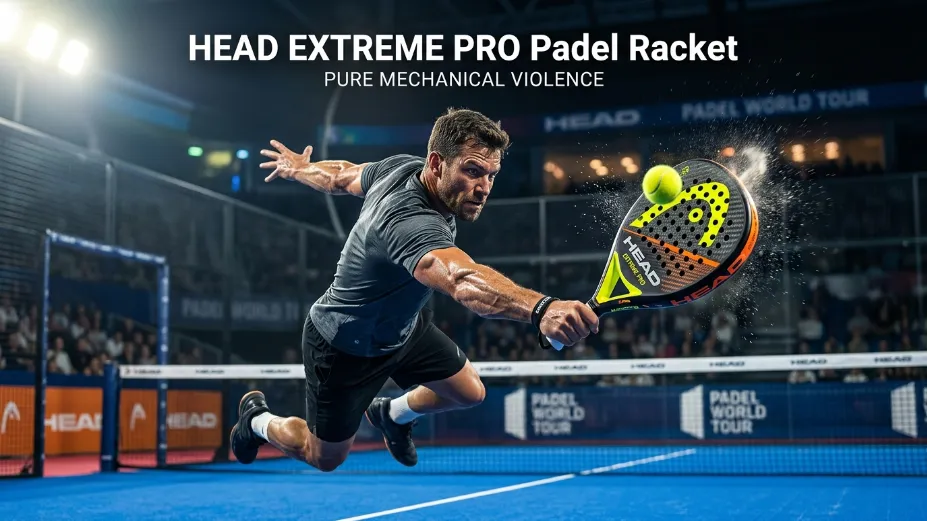
The courts at your local UK club are getting faster, the rallies shorter, and your current shovel just isn’t punishing short lobs the way it used to. Power in padel is no longer about swinging harder; it’s about mechanical violence blended with absolute stability. Enter the HEAD EXTREME PRO Padel Racket, a weapon engineered specifically for those who refuse to play defense. If you are looking to transition from a tactical counter-puncher to an absolute court dictator, the latest flagship from HEAD promises to redefine your overhead game. But does it actually deliver on damp, heavy winter courts in London, or is it just clever marketing? Let’s dissect the cold, hard data.
HEAD Extreme Motion 2026
Technical Specifications & On-Court Benefits · UK Context
Head Extreme Pro Padel Racket Review: Mechanical Evolution or Cosmetic Update?
The rapid expansion of the competitive club scene across the United Kingdom has fundamentally altered player expectations regarding specialized offensive equipment. In an era where generic fitness training advice is being replaced by forensic biomechanical analysis, players frequently debate whether annual racket iterations are genuine structural evolutions or merely clever cosmetic re-skins. To uncover the truth behind the Head Extreme Pro padel racket review, we must trace its genetic lineage directly back to its predecessor: the legacy HEAD Delta Pro line.
The transition from the legacy Delta Pro to the modern Extreme Pro series represents a massive structural departure in frame aerodynamics. The legacy Delta Pro was characterised by exceptionally sharp, highly angular frame lines and a highly concentrated, lofty balance point. While this layout generated undeniable flat smash velocity, it suffered from immense physical drag coefficients during rapid, multi-axis swing arcs. When defending fast baseline exchanges at local clubs, the racket felt uncomfortably sluggish.
To eliminate this performance bottleneck, HEAD engineers completely redesigned the structural geometry of the frame. The modern Extreme Pro mould features significantly flatter side beams coupled with elevated, rounded shoulders. This sophisticated geometrical modification drastically improves aerodynamic flow, allowing advanced players to cut through the air with reduced physical drag during high-speed overhead animations. This makes the racket feel noticeably faster through the air, even though the total static weight remains fixed at an authoritative 370 grams.
Beyond external frame geometry, the most impactful engineering upgrades are found within the interior material composite layup. Where older historical variants relied on an uncompromisingly rigid 100% carbon configuration that offered a tight, punishingly small sweet spot, the 2026 iteration introduces the Carbon Hybrid Hitting Surface (HS). By seamlessly blending premium structural carbon threads with high-elasticity fibreglass woven elements, HEAD has unlocked a deeper flex profile. This advanced face configuration can be comprehensively researched in our dedicated guide to the modern carbon fibre padel racket market.
Crucially, this hybrid face is reinforced by the inclusion of Auxetic 2.0 metamaterial technology, structurally embedded within both the racket yoke and the internal handle base. This unique material expands and contracts in real-time under load, acting as an active filtration matrix that stabilizes the frame on off-centre strikes while sending crystal-clear, readable feedback directly to the player’s palm. The result is a highly evolved, stable offensive tool that retains its aggressive pedigree while remaining accessible during high-pressure defensive scenarios.
Head Extreme Pro Padel Racket Specs & The Mathematics of Power
To understand exactly how this premium frame dictates ball behavior during high-tempo matches, we must look past marketing jargon and analyze the precise engineering metrics. The technical blueprint of the Head extreme pro padel racket specs highlights a calculated effort to manage high swingweight without sacrificing the raw kinetic energy transfer required to execute clean, point-ending smashes. The rotational resistance of the frame can be mathematically modeled using the parallel axis theorem for the moment of inertia ($I$):
I = Icm + m · d2
Within this classical physics equation, Icm represents the intrinsic moment of inertia about the racket’s exact centre of mass, m is the static weight of 370 grams (0.370 kg), and d2 represents the physical distance from the pivot point at the player’s hand to the racket’s balance point. When we analyze the physical evolution of the product line, we see how HEAD has manipulated these variables across sequential production cycles:
- The 2023 Generation Baseline: Featuring a high measured balance point of 277 mm from the cap, the physical distance ($d$) was highly elevated. This generated exceptional, bone-crushing leverage for flat smashes but caused substantial muscle strain during prolonged defensive sets.
- The 2025 Refinement: HEAD responded by shifting the internal weight distribution downward, bringing the measured balance point down to a tighter 270 mm to prioritize maneuverability.
- The 2026 Optimised Blueprint: The current model strikes a masterclass compromise at a measured 272 mm balance point. By subtly fine-tuning this metric, HEAD has minimized rotational resistance without decreasing the static mass ($m$) needed to drive through heavy balls.
The frame preserves its professional 38 mm beam thickness but couples it with a highly advanced Stiff Power Foam core. This dense, high-reactivity visco-elastic core provides an incredibly firm structural foundation. When matched with the variable 65-hole drilling pattern, the sweet spot is effectively expanded into the upper third of the diamond face. If you are uncertain whether a high-balance diamond shape aligns with your technical level, take a moment to read our comprehensive resource on how to choose a padel racket for a complete strategic breakdown.
On-Court Performance: Net Dominance vs. Baseline Deficits
Operating a high-balance diamond frame on court reveals a clear, highly focused performance profile: it is a tool designed to dominate the net, requiring high technical precision when trapped at the back of the court. At the net, the 370 g static weight and head-heavy bias deliver unparalleled stability. When defending against high-speed body volleys from your opponents, the frame completely resists lateral twisting. You can effortlessly block powerful shots and redirect them deep into the opposition’s corners with pinpoint accuracy.
The firm combination of the Stiff Power Foam and the Carbon Hybrid face ensures an incredibly crisp feel with zero unpredictable trampoline effect. This dry feedback allows advanced players to execute devastating, biting volleys that die before reaching the glass. When transitioning into the overhead phase to hit deep bandeja padel shots or aggressive viboras, the head-heavy mass distribution works beautifully. The racket’s natural top-heavy momentum accelerates smoothly through the hitting arc, allowing you to hit heavy, penetrating transition shots that stay incredibly low off the back wall.
Conversely, deep baseline defense is undeniably the most demanding aspect of the Extreme Pro. Generating soft, controlled, and deeply looping defensive lobs out of low, awkward glass corners is highly challenging due to the racket’s low native ball output and substantial swingweight. Passive defensive blocks often fall short, leaving easy sitters in the middle of the kitchen for your opponents to attack. To achieve consistent depth from defensive positions, players must use an active, complete swing with early preparation and immaculate technique.
Rushed, late contacts are severely punished. Because the diamond geometry concentrates the sweet spot strictly toward the upper third of the face, there is very little margin for error when retrieving low balls near the synthetic turf. If your game relies heavily on defensive retrieval and tactical manipulation rather than raw athletic aggression, checking out our expert analysis on the best womens padel racket options on the market can provide excellent alternative options featuring wider, low-balance sweet spots.
The Spin Equation: Revised Drilling Patterns and Contact Duration
The updated engineering of the 2026 model has sparked intense discussion among analytical club players regarding its capability to generate heavy ball rotation. The racket features an entirely redesigned, variable hole placement strategy that noticeably increases the density of the holes across the upper section of the face. This specific modification was implemented to widen the effective hitting area, making the upper face significantly more forgiving during off-centre strikes near the frame edge.
However, this dense drilling configuration changes the structural flexibility of the hitting surface. Independent technical testing shows that while the 3D Extreme Spin surface texture is visually distinct, the overall spin generation on specific shots like the kick smash feels less pronounced compared to older, sand-blasted models. This change in spin dynamics is directly tied to ball contact duration. The stiffer Carbon Hybrid HS face, combined with the dense hole pattern, limits lateral face flex, causing the padel ball to explode off the face almost instantly.
While this rapid, crisp response improves control and velocity during flat, direct smashes, it places a higher demand on the player’s biomechanics. To generate the heavy, biting sidespin required to execute elite-level viboras that slide along the floor, players can no longer rely on the racket’s surface texture alone; instead, they must generate rapid, precise wrist acceleration at the exact moment of impact. For players who prefer a softer face that grips the ball longer to generate easy spin, exploring alternative premium line-ups like the nox equation padel racket might be a wiser technical choice.
The UK Climate Factor: Managing Power Foam in the Cold
A major missing angle across mainstream e-commerce review platforms is how specialized gear adapts to the distinct and challenging climate conditions found throughout the United Kingdom. Padel players across the UK frequently contend with cold, damp, and unheated outdoor court environments, particularly during autumn and winter sessions. These low temperatures—frequently dropping below 10°C—directly alter the physical properties of the racket’s internal Stiff Power Foam core.
The Power Foam core is fundamentally a visco-elastic polymer designed to absorb, store, and release kinetic energy. In cold weather, this polymer experiences thermal contraction, causing the internal cell structures to stiffen dramatically. This physical transformation has several major impacts on performance:
- Loss of the Trampoline Effect: The cold, hardened core does not compress easily upon impact. This heavily limits the native rebound speed and depth generated during slower, defensive swing speeds.
- Shift to a Stiff, Forbidding Touch: The racket’s overall feel becomes exceptionally rigid and dry, making it incredibly difficult to execute delicate, touch-based shots like short drop shots or precise slow lobs.
- Accelerated Muscle and Tendon Fatigue: Because the cold core loses its ability to absorb impact forces, harmful kinetic vibrations are transferred directly up the frame and into the handle grip.
To maintain consistent ball depth on heavy baseline shots during a damp British winter, players are forced to swing with much greater physical effort. This can rapidly accelerate muscle and tendon fatigue across the forearm. To successfully mitigate these cold-weather challenges, players must focus on clean, active technique and consider switching to lower-density, high-elasticity balls to help restore adequate touch and rebound. For an independent look at how alternative brands handle these climate strains, read our comparison on slazenger panther series vs head pro rackets.
Ergonomics and Injury Prevention: Countering Epicondylitis
The physical demands of operating a 370 g racket with a high-balance diamond shape present genuine risks of muscle strain and joint issues, particularly epicondylitis, commonly known as tennis elbow. To actively safeguard the player’s arm, HEAD has integrated two primary vibration-dampening technologies. The first is the updated Auxetic 2.0 framework within the yoke, which filters out erratic frequencies before they travel down the shaft. The second is the innovative Soft Cap+ system located at the very base of the handle.
The Soft Cap+ utilizes a specialized, two-component soft material base designed to absorb high-frequency shockwaves upon ball impact. However, while these technologies are highly effective at dampening micro-vibrations, they do not alter the racket’s heavy swingweight. The physical effort required to continuously move, accelerate, and decelerate a head-heavy 370 g frame over a two-hour match remains highly demanding. If a player’s preparation is late or their technique is inconsistent, the physical stress placed on the forearm tendons remains substantial.
To improve maneuverability and lower the effective balance point, advanced players frequently utilize strategic aftermarket modifications. Adding an ergonomic aftermarket grip, such as a Hesacore grip, or applying multiple thick overgrips is highly effective. This customization adds useful static mass directly to the handle, shifting the racket’s centre of mass closer to the hand. This layout significantly reduces the leverage force exerted on the wrist and elbow, making the frame safer for players prone to joint strain. If you are currently struggling with chronic arm pain, exploring our dedicated medical guide on the best padel rackets for tennis elbow is essential to protect your longevity on court.
Head-to-Head: Extreme Pro 2026 vs. Coello Pro 2026 vs. Extreme Motion
Choosing the correct model within HEAD’s premium offensive lineup requires a precise understanding of how each frame’s physical specifications translate to on-court performance. Selecting the wrong model can severely limit your technical development and cause unnecessary muscle fatigue. Below, we break down the definitive differences across the flagship range:
HEAD Extreme Pro 2026 vs. HEAD Coello Pro 2026
The HEAD Coello Pro 2026 is an elite, uncompromising power tool built for tournament-level players. Weighing an intimidating 375 grams with a very high balance bias and a dense red Power Foam core, it functions like a heavy sledgehammer, offering maximum power for explosive flat smashes. In contrast, the Extreme Pro 2026 offers a more stable alternative. Often compared to an “Audi R8” alongside the Coello Pro’s “Ferrari,” the Extreme Pro features a slightly lighter weight (370 g) and a drier, more controlled touch, providing superior stability and precision during rapid net volleys and block shots.
HEAD Extreme Pro 2026 vs. HEAD Extreme Motion 2026
The Extreme Motion 2026 is a lighter model (360 g) engineered to prioritize maneuverability and speed. While it shares the aggressive diamond shape and head-heavy bias of the Pro, its reduced static mass significantly lowers its swingweight. In fast net exchanges and quick defensive recoveries, the Extreme Motion is much easier to swing and control. While the heavier Extreme Pro delivers more devastating, mass-driven smashes, the Extreme Motion allows players to generate rapid racket-tip acceleration, making it an exceptional choice for intermediate-to-advanced players who find 370 g frames physically tiring over long, intensive matches.
Head Extreme Pro Padel Racket Price and UK Market Value Proposition
Navigating the UK retail market for a premium power frame requires comparing current pricing trends and older model cycles to identify the absolute best value for your money. The standard commercial footprint of the Head extreme pro padel racket price shows a highly competitive strategy from HEAD, positioning this flagship well below the aggressive pricing models of its primary premium competitors.
While the original manufacturer suggested retail price (MSRP) for the current 2026 generation sits at £244.99, typical UK street prices across major specialized online stockists—including Padel Market, Nine Padel, and Keepadel—consistently hover between £174.99 and £190.00. This price point makes the Extreme Pro an incredibly compelling alternative to rival high-balance models like the Bullpadel Vertex 05 or the NOX AT10 series, which regularly retail across the UK for between £220 and £280.
Furthermore, the release of the 2026 model has created exceptional clearance value opportunities across older production stocks. The legacy 2023 edition can currently be sourced on clearance for approximately £129.99 across select regional distributors. This represents a highly cost-effective option for competitive club players who want an elite, stiff carbon-face racket without paying current-season retail premiums. If you are operating on a strict budget and want to explore the wider market for affordable gear, feel free to check out our independent review of the best padel rackets under 100 pounds.
To ensure your premium investment is fully protected during travel to and from your local club, matching your frame with a dedicated, thermally insulated kit bag is highly recommended. You can browse our comprehensive evaluation of the latest head padel bag options to complete your setup. For verified technical insights, specifications, and design updates directly from the brand’s engineering headquarters, you can visit the HEAD Official Website.
Frequently Asked Questions (FAQ)
Is the HEAD Extreme Pro suitable for a beginner padel player in the UK?
No. The high-balance point, diamond geometry, and stiff Power Foam core concentrate the sweet spot into the upper third of the face, making it highly unforgiving for beginners. New players should look for low-balance, round frames that offer a larger, more centered sweet spot.
How often should I replace my HEAD Extreme Pro when playing regularly on outdoor UK courts?
If you play 2 to 3 times per week on damp, unheated outdoor UK courts, the visco-elastic core will typically begin to lose its elasticity and structural rebound within 8 to 12 months. Regular exposure to moisture and cold temperatures accelerates foam degradation, leading to a noticeable drop in power.
Can I safely add protective tape to the frame without ruining the racket’s balance?
Yes, but it will impact the physics. Adding a standard 10-gram frame protector to the apex of the racket head will increase the distance ($d$) in the swingweight equation. This will make the racket feel noticeably more head-heavy and slightly harder to maneuver during quick net exchanges.