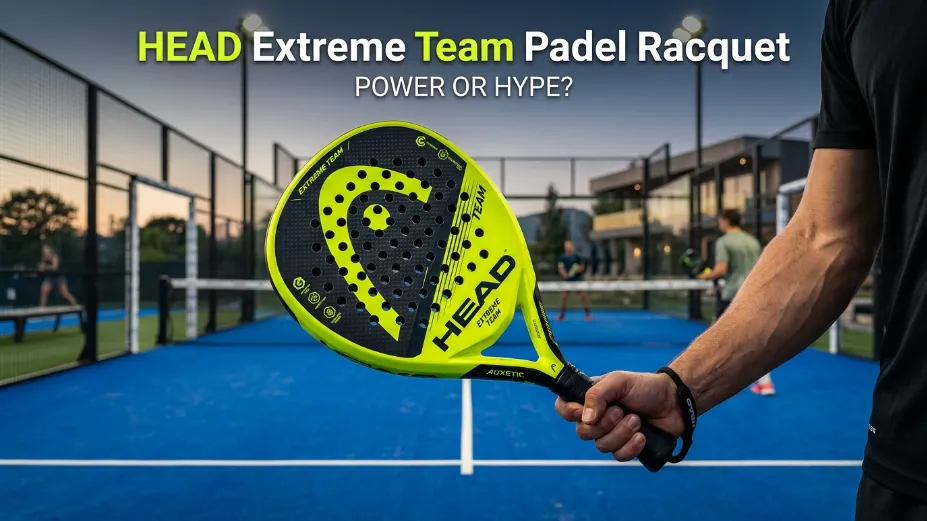
Choosing a padel weapon shouldn’t feel like a gamble, yet many UK players end up swinging a racket that actively fights against their progress. The newly dropped HEAD Extreme Team Padel Racquet shatters the myth that diamond-shaped power is reserved solely for elite pros, offering club players across Britain a genuine shortcut to controlled aggression. If you are looking to injection heavy spin into your overheads without sacrificing that crucial sweet spot comfort on damp winter courts, this 2026 edition demands your attention. Let’s dissect how it actually performs where it matters most: behind the glass.
Padel Racket (Diamond) — Full Spec Breakdown
Shape · Weight · Balance · Core · Surface · Beam · Technology
Comprehensive HEAD Extreme Team Padel Racquet Review: Technical Anatomy
The engineering core of the HEAD Extreme Team Padel Racquet review centers upon its non-traditional material layout. While legacy attack tools relied primarily on rigid multi-layered carbon weaves, this silhouette bridges maximum modern structural frame strength with highly flexible face materials tailored for emerging intermediate players.
- The Graphene Frame Matrix: Utilising structural carbon reinforced with the brand’s proprietary Graphene Inside technology, the frame offers exceptional resistance against torsional twisting. When blocking high-speed groundstrokes from advanced opponents, the frame handles heavy impacts beautifully, redirecting kinetic energy cleanly.
- The Fibre Glass Face Boundary: Because full carbon surfaces are naturally unforgiving and stiff for developing muscles, an elastic alternative is used. The face incorporates premium woven flexible fibre glass, widening the effective landing zone and softening the contact feel during quick reflex exchanges.
- Core Material Mechanics: The internal Power Foam formulation serves as a highly responsive energy engine. This open-cell foam compound is specifically calibrated to expand the speed parameters of the ball, allowing intermediate UK competitors to maintain deep depth without executing long, exhausting technical strokes.
The external profile is engineered smoothly to maintain clean airflow, maximizing dynamic velocity through high air resistance zones. For players analyzing options across the entire premium brand matrix, evaluating the dedicated structural differences outlined in our analytical look at the comprehensive HEAD padel rackets catalogue provides clear contextual background before finalizing your upgrade paths.
Team vs. Elite vs. Motion: Deciding Your HEAD Extreme Team Padel Racquet 2026 Model
Navigating this high-powered product family requires a clear understanding of the mechanical differences between the flexible Team setup and its premium siblings. Selecting your specific version of the HEAD Extreme Team Padel Racquet 2026 dictates both your physical recovery cycles and your overall tactical execution on court.
The Cushioning Variance
The Extreme Team layout focuses extensively on massive trampoline energy return and structural joint safety. The completely flexible fibre glass surface works harmoniously with the inner core to maximize comfort. Conversely, the Extreme Motion version employs a rigid, unyielding single-direction UD Carbon face designed for surgical placement and maximum structural stiffness. This gives advanced athletes a sharper sense of control but demands absolute physical precision during off-centre hits to avoid arm stress.
Weight and Balance Discrepancies
The specific distribution of structural material introduces a unique physical signature across the range. While the Extreme Team balances its 360g static mass across a 265mm to 270mm head-heavy location, it ensures high dynamic assistance on air attacks. The more demanding models shift this profile slightly, offering diverse options for rapid network play. This design philosophy reflects clearly across retail channels, where the forgiving Team version sits comfortably below its carbon counterparts, providing incredible entry value for growing club players.
If you are a developing competitor seeking to master the mechanical fundamentals of the sport before purchasing heavy pro tools, taking the time to understand how to choose a padel racket safely will safeguard your developmental path from costly, over-spec mistakes.
The Critical Balance Guide: Why You Must Adapt to Head-Heavy Diamond Moulds
A major missing angle across major commercial e-commerce review spaces is the highly specific volumetric performance transition of the frame. When choosing the HEAD Extreme Team Padel Racquet, expecting a standard round profile handling experience will lead to immediate tactical frustration during early matches.
The frame is built around a distinct, aggressive diamond mould that concentrates its main hitting mass higher toward the tip. This geometric profile is engineered to stop weak ball returns by increasing the lever length of your swing, but it changes the baseline response speed for players moving away from control shapes. The issue is amplified by the specific physics of low-rebound court scenarios.
Because the balance point sits higher, the weight signature when preparing fast defensive blocks near the floor feels considerably heavier than it appears on paper. The racket requires early muscular preparation in the wrist and forearm. During long three-set battles on outdoor courts, this high balance demands clean, compact preparation to prevent the head from lagging behind the ball, ensuring your volleys consistently clear the net tape cleanly.
To master these performance parameters, players must adjust their physical mechanics. It is highly recommended to maintain a stable, short backswing when defending deep glass angles. For players transitioning from lighter variants, exploring modern options such as the diamond-shaped padel rackets index will explain how to utilise this top-heavy leverage to generate effortless depth without overloading delicate shoulder joints.
Exposing the Information Gaps: Real-World Durability Under the Microscope
While mainstream marketing materials highlight the explosive power parameters of the frame, deep analysis across independent UK playing groups reveals distinct manufacturing limitations and accelerated wear patterns under wet conditions.
- The Fibre Glass Softening Cycle: The premium flexible fibre glass used on the face offers beautiful, soft feel but is naturally reactive to continuous moisture shifts. Under persistent exposure to heavy UK rain-soaked balls, the micro-fibres undergo mechanical fatigue faster than pure carbon, reducing the optimal structural rebound signature after 12 to 18 months of intensive club play.
- The Smooth Finish Spin Decay: The face features a completely smooth finish with no integrated physical roughness or pattern. While the extended ball dwell time allows players to execute a slicing padel Bandeja shot beautifully through friction alone, the lack of raised surface patterns means spin generation relies completely on clean arm technique when the ball face becomes wet.
- Bumper Guard Friction Limits: The integrated frame protection systems cover primary edge impacts well, but the top-heavy swing weight increases the likelihood of scraping walls during low corner recoveries. Adding a heavy secondary padel racquet frame protector will safeguard your investment but will shift the balance even further toward the tip.
These persistent technical realities mean dedicated competitors who log multiple competitive club sessions per week must handle their equipment carefully. While the structural core remains safe from sudden shattering, managing the cosmetic and face wear cycles is crucial to maintaining consistent power response over multiple playing seasons.
Performance on British Courts: Wet, Sand, and Outdoor Realities
Evaluating the hybrid frame structure requires analyzing the highly variable, unpredictable court environments found throughout the United Kingdom. The material combination behaves fundamentally differently based on the moisture levels and specific turf configuration of your local venue.
On traditional, outdoor courts during typical British winter months, padel balls absorb atmospheric water rapidly, increasing their static weight and making them feel like heavy stones. This is where the low elastic modulus of the fibre glass face shines brilliantly. The trampoline effect kicks in automatically, helping players push heavy balls deep into the opponent’s territory without risking muscle tears.
Furthermore, the increased ball dwell time prevents the slick, wet ball from sliding randomly off the face, a common issue on stiff carbon models. However, when playing on modern, dry indoor premium tracks, this soft surface interaction trades away a small amount of instantaneous crisp response, meaning players must swing with smooth acceleration to maximize the built-in power capabilities of the internal foam engine.
Head-to-Head: HEAD Extreme Team Padel Racquet vs. Slazenger Challenge No. 1
For UK club players trying to choose between the premium HEAD Extreme Team Padel Racquet and iconic heritage models like those found in the Slazenger padel racquet range, the choice comes down to a fundamental split in tactical engineering philosophy.
The primary performance variances are highly distinct:
- Power Accessibility: The Extreme Team utilizes its diamond mass distribution to generate massive swing assistance, making overhead power accessible to lower intermediate players. Classic models like the Slazenger Challenge often feature more centralized sweet spots that require precise center-face striking to unlock deep acceleration.
- Shock Absorption and Arm Safety: HEAD takes the lead regarding joint protection through its active multi-material dampening matrix. The combination of fibre glass and soft handle components filters out high-frequency shock effectively, rendering it a top recommendation within our curated best padel rackets for tennis elbow guide.
- Defensive Versatility: The Slazenger range often provides excellent, neutral manoeuvrability inside tight rear-glass corners due to lower balance setups. The top-heavy design of the Extreme Team demands greater physical adaptation but rewards the player with unmatched, effortless depth on defensive lobs.
Buying Advice in the UK: Prices, Retailers, and Selection
Tracking down this model across the United Kingdom involves navigating a mix of traditional tennis retail houses and specialized court specialty operations. The standard baseline recommended retail price hovers consistently around the £180.00 RRP threshold, but careful shoppers can regularly source promotional exceptions down to approximately £115.49 online.
Before purchasing, checking verified independent physical dimensions from the official HEAD Padel platform ensures you receive genuine current-generation stock featuring the latest internal material treatments. Be sure to avoid un-vetted grey-market listings that may offer legacy 2024 layouts instead of the optimized 2026 geometric update.
Verdict: Is the HEAD Extreme Team Worth Your Money?
The final evaluation of this high-performance offensive tool depends entirely on your personal playing profile, structural injury history, and financial approach to seasonal gear replacement.
- Who Should Buy: Intermediate players seeking accessible power without arm strain, competitors playing on cold, unheated outdoor UK courts, and individuals who rely heavily on deep lobs to reset fast rallies.
- Who Should Avoid: Advanced tournament players who demand maximum surface stiffness for ultra-fast pace control, and pure control players who dislike head-heavy swing profiles.
Frequently Asked Questions (FAQ)
Does this racquet use a full carbon hitting surface?
No. The hitting face is constructed entirely from premium flexible fibre glass to maximize comfort and expand the sweet spot, while the outer frame uses 100% carbon to maintain torsional stability.
Can the Soft Cap+ technology completely prevent tennis elbow?
While the integrated elastomer element reduces high-frequency vibrations significantly, it works best when paired with correct stroke technique, appropriate grip sizes, and fresh overgrips.
How does UK winter weather affect the internal Power Foam core?
Cold temperatures make foam compounds feel slightly stiffer. However, the elastic fibre glass face offsets this effect beautifully, maintaining excellent ball exit even during freezing morning sessions.