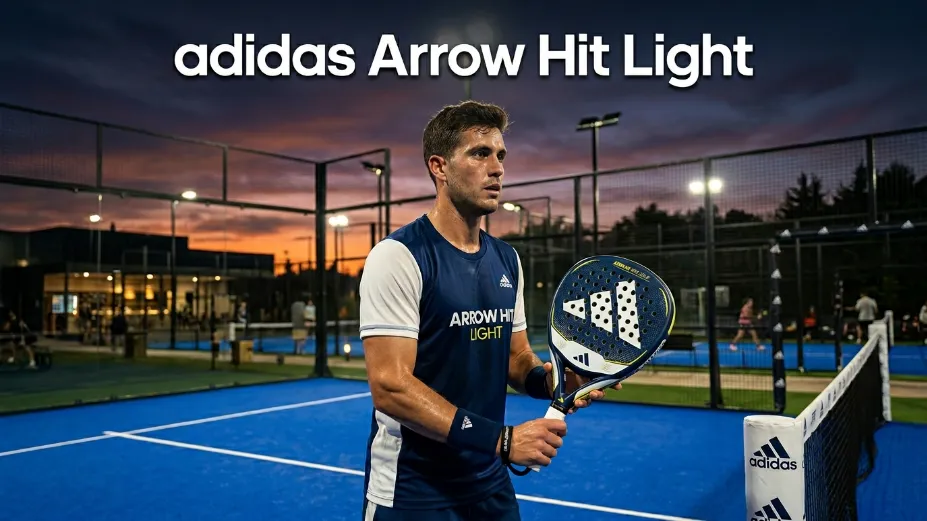
Chasing the perfect balance between lightning-fast reflex volleys and clinical overhead control often feels like an expensive trial on the UK padel circuits. Finding a racket that slashes weight without compromising on structural stability is where most intermediate players hit a wall. Enter the adidas Arrow Hit Light 2026—a frame designed to redefine structural manoeuvrability for players who refuse to let arm fatigue dictate their defensive game. Whether you are trading high-intensity rallies at your local indoor club or looking to master your transition play, decoding how this specific model behaves under pressure is the only way to justify upgrading your kit bag this season.
Adidas Arrow Hit Light 2026 — Ari Sánchez Edition
Frame · Core · Weight · Balance · UK Price
The total overhaul of the premium German-engineered catalogue has fundamentally altered player expectations regarding specialised weapons. Generic round control shapes or heavy, unyielding power frames no longer suffice on the modern, high-speed indoor carpets across the United Kingdom. With highly technical customisation systems arriving on the retail scene, decoding the exact mechanical anatomy beneath the cosmetics becomes paramount to maintaining technical execution, avoiding chronic joint inflammation, and maximizing your commercial investment.
adidas Arrow Hit Light review: Technical Anatomy
The structural core of this comprehensive adidas Arrow Hit Light review centers upon its innovative structural layout. While legacy premium ranges relied heavily on the fixed Dual eXoskeleton system—double-height carbon nerves that provided immense structural rigidity but frequently compromised playing comfort—this newly engineered family balances frame stiffness with dynamic user customisation.
- The Core Matrix: Incorporating a low-density Soft Performance EVA core wrapped in an advanced Adidas Smart Composition (ASC) Carbon face, the racket offers an incredibly direct ball response. When blocking heavy incoming balls at the net, the composite surface prevents unwanted absorption, ensuring the ball hits target depths cleanly.
- The Muscle Power System: To protect the frame against high torsional forces without adding excess static weight, a series of structural carbon ribs cross horizontally through the throat. This architecture keeps the face perfectly square during high-impact off-centre hits, translating into superior directional accuracy.
- Intelligent Balance Mechanics: Diverging from the discrete weight screws found in the Metalbone line, this layout integrates two continuous metal tracks directly into the lateral sides of the frame. Two 9-gram weights slide along these rails, secured tightly via an Allen key, altering the physical characteristics of the swing in real time.
“The physical displacement of these weights can be modeled using the classical equation for the moment of inertia (I) relative to the player’s wrist pivot axis:
Where mi represents the mass of the sliding components and ri represents the distance from the handle pivot. Sliding the weights to the upper limits increases r, raising the balance point and converting the racket into an aggressive, head-heavy tool with elevated dynamic swing weight. Conversely, dropping the weights toward the throat reduces the overall moment of inertia, making it incredibly agile during rapid net exchanges. For players seeking an extensive evaluation of alternative lightweight profiles, examining our comprehensive guide on the lightest padel rackets provides valuable context.
Arrow Hit vs. Arrow Hit Carbon: Deciding on your adidas Arrow Hit Light 2026
Navigating the updated high-performance tier requires an accurate assessment of the physical differences between the customizable flagship and its fixed-weight counter-options. Selecting your preferred version of the adidas Arrow Hit Light 2026 dictates your overall physical recovery cycles and baseline court management.
The Weight and Mass Variance
The standard, non-customizable adidas Arrow Hit 2026 Carbon model arrives with a fixed static weight of approximately 361 to 375 grams and a fixed high balance point of 265mm. This heavier setup delivers tremendous natural kinetic energy during flat overhead smashes, provided the player possesses the arm strength to generate high raw swing speeds. In contrast, the lighter profile of the flagship model drops the static foundation to 345–360 grams, allowing players to significantly increase their angular velocity:
This increased aerodynamic speed helps offset the reduction in static mass, allowing intermediate players to produce deep, high-velocity offensive drives with far less structural strain on their shoulder and elbow joints.
Commercial and Retail Discrepancies
The complex engineering required to integrate continuous lateral metal tracks into a lightweight carbon frame naturally impacts the financial positioning across UK retail channels. The premium, customizable flagship commands a substantial adidas Arrow Hit Light price ranging from £250.00 to £270.00. Meanwhile, the intermediate, non-customizable adidas Arrow Hit Light Carbon variant enters the UK market at an accessible £150.00 to £165.00 price bracket, making it an attractive option for budget-conscious players who prefer a fixed, head-heavy attacking setup without the premium price tag.
The Critical Fit and Shape Guide: The Sweet Spot Paradox
A major missing angle across mainstream e-commerce review platforms is a realistic analysis of the interior sweet spot geometry of this racket. While promotional literature frequently lists the model as highly forgiving due to its soft core composition, real-world testing tells a completely different story on the court.
The racket is engineered with an aggressive diamond geometry that automatically places the sweet spot near the upper edge of the frame. This layout works beautifully for clean, high-contact overhead strikes, but it results in a narrow, unforgiving effective hitting zone during rushed defensive scenarios. Off-centre hits striking close to the outer carbon walls result in a noticeable drop in power and transfer harsh vibrations directly down the shaft into the player’s forearm.
Because the vertical clearance of the sweet spot is highly compressed, players shifting from traditional round control frames often struggle with depth control during the initial weeks of play. To avoid these performance limitations, intermediate players must possess highly consistent contact metrics. For individuals requiring an explicitly forgiving structural sweet spot layout, exploring our dedicated review of the nox equation padel racket offers an alternative solution tailored for maximum defensive compliance.
Exposing the Information Gaps: Real-World Durability Under the Microscope
While official marketing materials focus heavily on the protective structural benefits of the horizontal Muscle Power System, deep independent analysis among UK playing groups reveals specific manufacturing vulnerabilities and long-term durability risks under high-stress competitive play.
- The Track-Adjacent Frame Crack Phenomenon: The primary area of mechanical concern is frame cracking along the lateral tracks of the customisable system. Milling the carbon frame to accommodate the continuous metal rails creates localized stress concentration points. Because the model features a thinned-out carbon wall profile to achieve its 345–360g weight, high torsional loads during flat smashes can exceed the shear strength of the carbon weave, resulting in rapid structural failure.
- Vibration Transfer and Legacy Faults: This structural vulnerability closely mirrors the mechanical issues observed in previous customisable Adipower models, where frames frequently fractured near the weight inserts under heavy impact. Off-centre hits near the rails accelerate micro-cracking, causing a complete loss of structural rebound within months of regular competitive play.
- Internal Core Pack-Out: Under high-temperature indoor court conditions, the soft performance EVA core can experience localized compression failure. Players logging more than three high-intensity sessions per week have reported a noticeable softening of the upper hitting surface, leading to inconsistent ball launch angles during critical defensive lobs.
These persistent structural concerns create a continuous cycle of warranty evaluations for dedicated players. While the functional customisation system offers exceptional versatility, the structural risks associated with the thinned carbon walls mean that buying through authorized UK retail channels is essential to ensure full warranty protection. For women or players seeking specialized structural alternatives without track-based vulnerabilities, referencing our curated list of the best lightweight padel rackets for women is highly recommended.
Performance on British Courts: Wet, Sand, and Indoor Arenas
Evaluating the ASC Carbon face requires analyzing the highly variable, unpredictable court environments found throughout the United Kingdom. The face material and core composition behave fundamentally differently based on moisture levels and the specific turf setup of your local club.
On traditional, heavily sanded outdoor courts, the stiff surface response of the ASC Carbon works exceptionally well. The material completely dampens the erratic “trampoline effect” common in highly elastic models like the Metalbone CTRL, giving players direct control over ball depth during high-speed exchanges. However, because the frame lacks any specialized moisture-wicking surface textures, playing on damp, uncovered British courts during autumn or winter causes surface water to sit directly on the face, drastically reducing ball grip and causing lobs to slip unpredictably into the back glass walls.
Modern premium indoor venues across the UK increasingly implement low-sand Mondo turf layouts, which deliver incredibly high natural dry friction. When executing rapid, close-range volleys on these premium carpets, the ultra-light handling allows for instantaneous adjustments, letting you block incoming power shots cleanly. For players searching for an elite, high-durability option capable of handling diverse UK court environments without losing structural integrity, checking out the premium cork padel racket range provides an intriguing structural contrast.
Head-to-Head: adidas Arrow Hit Light 2026 vs. adidas Cross It Light
For players trying to choose between the premium customizable flagship and the highly regarded Cross It Light model, the choice comes down to a fundamental split in playing philosophy and material engineering. Both models occupy top-tier status across UK retail outlets but approach court performance from completely opposing angles.
The primary performance variances are detailed in the comparison breakdown below:
- Geometry and Balance Dynamics: The Ari Sánchez model features an aggressive diamond shape with a customisable head-heavy balance point, engineered explicitly for transitional attackers. The Cross It Light (co-signed by Marta Ortega) utilizes an even balance with a streamlined frame geometry designed for pure baseline defensive speed.
- Core and Face Materials: While both utilize soft core compounds, the Cross It Light wraps its core in a highly flexible 24K Aluminized Carbon face, providing a significantly softer touch and a linear, springy ball output. The flagship model employs ASC Carbon, delivering a noticeably crisper, stiffer surface response that excels at dampening heavy incoming power shots.
- Injury Prevention and Comfort: The Cross It Light wins decisively regarding joint protection. Its even balance and forgiving sweet spot transmit minimal shock down the arm. The diamond shape and compact sweet spot of the customizable model place notable stress on the elbow joint, meaning players recovering from chronic joint injuries should evaluate options carefully via our guide on the best padel rackets for tennis elbow before purchasing.
Buying Advice in the UK: Prices, Retailers, and Co-Signature Confusion
Sourcing this premium customizable model across the United Kingdom requires navigating significant e-commerce description errors. A notable source of confusion across major online retail platforms is the incorrect labelling of the model as the “Arrow Hit Light by Marta Ortega.” UK consumers must be explicitly aware that this is a retail error; Marta Ortega’s designated model for the season is the Cross It Light, whereas the customizable diamond model is designed in direct collaboration with world champion Ari Sánchez.
The standard retail price hovers consistently within the £250.00 to £270.00 RRP bracket across authorized specialist distributors. Major regional operations like The Lawn Tennis Association (LTA) official partner channels maintain verified stocks, while boutique operations cater to competitive tournament players. For intermediate competitors looking to maximize their development without making an elite financial commitment, checking our detailed look at the best padel racket for intermediate players ensures you secure an optimal balance of cost and performance.
Verdict: Is the adidas Arrow Hit Light Worth Your Money?
The final evaluation of this high-performance customizable frame depends entirely on your personal playing profile, structural injury history, and tactical approach to transition play.
- Who Should Buy: Highly accurate players who prioritize rapid head speed, competitive tournament players who require on-the-fly balance customisation, and tactical attackers who play predominantly in indoor arenas.
- Who Should Avoid: Broad-swinging beginners who require a large, forgiving sweet spot, budget-focused players who expect a lightweight frame to survive years of punishing outdoor court contact, and individuals recovering from active wrist or elbow injuries.
Frequently Asked Questions (FAQ)
Are these premium customizable rackets manufactured entirely within the UK?
No. While conceptual development, mechanical testing, and professional player prototyping are managed at corporate engineering hubs, all primary carbon manufacturing, track milling, and component assembly are handled by specialized production partners in Asia, matching industry standards for high-performance carbon composites.
Can I safely adjust the lateral track weights using standard workshop tools?
It is highly discouraged. The lateral weights are designed to be adjusted exclusively using the high-precision Allen key provided in the official retail packaging. Utilizing unverified or oversized tools can easily strip the specialized locking screws, permanently freezing the weights in place and voiding your manufacturer warranty.
How does removing the sliding weights completely impact the structural stability of the frame?
Removing both 9-gram weights drops the racket to its ultra-light baseline static weight of 345 to 360 grams, significantly increasing manoeuvrability. However, physical testing demonstrates that completely removing the mass reduces structural stability, increasing frame vibration and requiring significantly more muscular effort from the player’s arm to generate competitive ball speed.