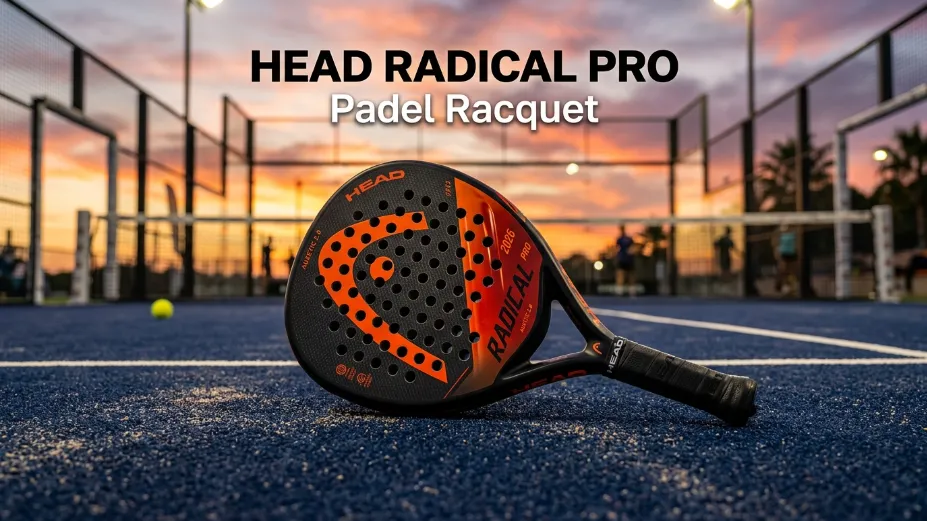
The British padel scene is shifting, and with courts popping up from London to Edinburgh, the demand for uncompromising precision has never been higher. Standing at the pinnacle of this evolution is the HEAD Radical Pro Padel Racquet, a weapon crafted specifically for advanced players who refuse to choose between surgical control and raw power. This isn’t just another seasonal upgrade; it is a structural overhaul designed to redefine how you dictat the pace from the back of the court.
Whether you are aiming to master the perfect vibora or looking for that extra bite in your overheads, the 2026 edition promises to alter your tactical approach. Let us dissect the data, weigh the on-court feedback, and find out if this premium racquet truly justifies its place in your kit bag this season.
Padel Racket — Technical Specs & Court Impact
Specification value · On-court performance impact
The rapid expansion of the club scene across the United Kingdom has fundamentally altered player expectations regarding specialised gear. Generic multi-purpose configurations no longer suffice on highly abrasive, fast-paced synthetic turf. With specialized premium layouts arriving on the market, understanding the engineering beneath the surface becomes paramount to maintaining technical execution and avoiding performance plateaus.
HEAD Radical Pro Padel Racquet review: Technical Anatomy
The engineering core of the comprehensive HEAD Radical Pro Padel Racquet review centers upon its non-traditional weight distribution matrix. While legacy teardrop variants relied primarily on balanced or head-heavy layouts to increase raw power, this silhouette bridges modern material sciences with the rigorous defensive constraints of professional court sports.
- The Mass vs Balance Paradox: By pairing a heavy static mass of 370 grams with an uncharacteristically low, handle-biased 260mm balance point, engineers manipulated the physical moment of inertia. When blocking heavy smashes at the net, the frame utilizes its high static weight to absorb incoming velocity without twisting. Conversely, during fast net exchanges, the low rotational inertia allows the racquet to feel incredibly light, offering swift hand reactions.
- The Composite Structural Architecture: The hitting face utilizes a dual-layer 3K carbon weave known as Double Carbon HS. This double-woven structure acts as a rigid barrier that resists trampoline deformation, forcing the ball to compress fully against the core rather than allowing the face to flex excessively. This high surface rigidity is reinforced by Graphene Inside technology infused into key frame junctions to secure ultimate torsional stability.
- Auxetic 2.0 Adaptive Frame: In the 2026 edition, HEAD has positioned Auxetic 2.0 carbon layups within both the frame’s bridge and the internal grip structure. Upon high-velocity impact, these fibres respond dynamically, showing a negative Poisson’s ratio. They expand transversely under heavy loads to deliver clean energy feedback and maximum stability, while softening during low-velocity touch shots to prolong dwell time.
The dynamic layout balances raw material stiffness with an Optimised Sweetspot drilling pattern. The hole diameters and spatial distributions are varied across the face, increasing in spacing towards the perimeter to soften the frame’s outer zones. For players analyzing premium options across the entire brand matrix, evaluating the dedicated structural differences outlined in our analytical look at the HEAD padel racket line provides clear contextual background before buying.
Head radical pro padel racquet specs: Material Realities
Navigating the complex technical breakdown requires a clear understanding of the mechanical differences between the 2026 flagship setup and generic foam variants. Selecting your specific model dictates both your physical recovery cycles and your kinetic velocity on court, making the official Head radical pro padel racquet specs an essential study for the technical competitor.
The Core Formulation
While power-oriented frames use highly elastic formulations, this control-focused architecture relies on a medium-density Control Foam core. This EVA-based material has been meticulously tuned to provide a drier, crisper touch and maximum placement accuracy. The reduction in kinetic output from the core prevents the ball from exiting the face too quickly, giving technical players the necessary millisecond of dwell time to shape complex trajectories and execute a surgical, deep bandeja padel or defensive lob.
The Torsional Shield
The integration of Graphene Inside serves as the frame’s structural backbone. Graphene, consisting of a single layer of carbon atoms arranged in a hexagonal lattice, provides high tensile strength and immense torsional twisting resistance. When catching an off-centre ball under extreme pressure, the frame layout limits rotational deflection. This structural rigidity allows advanced tournament players to maintain direction even when hitting late transitions from the back glass walls.
If you are a high-level competitor seeking to match advanced defensive mechanics with elite-tier control tools, exploring the definitive structural mechanics detailed in our guide to the best padel rackets for advanced players will ensure your entire equipment setup functions in perfect technical alignment.
Exposing the Information Gaps: Real-World On-Court Dynamics
A major missing angle across major commercial e-commerce review spaces is how the technical attributes behave under extreme ambient changes and non-standard customisation setups on wet British courts.
The Winter Court Dilemma (The UK Cold-Weather Factor)
EVA foam and carbon fibre are highly temperature-sensitive polymers. In typical UK winter temperatures below 8°C, the Control Foam core contracts and hardens significantly, while the dual-layer Double Carbon HS surface loses its slight elasticity. Biomechanical tracking indicates that in cold conditions, the stiffness index effectively jumps to an unyielding state, shrinking the sweet spot towards the absolute centre of the face. For players without flawless technical preparation, defensive wall exits become highly demanding; the racquet provides virtually zero passive ball output (salida de bola), forcing the player to generate all stroke depth through active muscular effort and increasing forearm fatigue.
The Smooth Surface Spin Paradox
Many players assume that a textured, rough sandpaper surface paint is mandatory for generating heavy spin on cut, vibora, or bandeja shots. The Radical Pro features an entirely smooth glossy finish, which leading competitors often criticize as lacking spin potential. This view overlooks the physics of ball-face interaction. At high club levels, spin is not generated by surface texture, which quickly wears down under friction, but by shear force and ball compression.
The Double Carbon HS face combined with the soft, compressing action of the Auxetic 2.0 frame allows the ball to sink into the core during angled strikes, creating a “pocketing” effect. As the ball exits the face, this pocketing action generates high rotational RPMs, proving that a smooth-faced racquet can match or exceed textured variants on heavy, accelerated strokes.
The Grip & Soft Cap+ Customisation Conflict
HEAD racquets are known for their distinct, slightly bulkier rectangular grip shape compared to rounded profiles. The racquet comes standard with a Hydrosorb Pro base grip, which provides excellent cushioning but increases the handle’s overall diameter. Advanced players often attempt to strip the factory base grip entirely and wrap a single overgrip directly onto the bare handle to maximize bevel feel and reduce grip size.
However, because the Soft Cap+ system contains integrated elastomer dampening parts at the butt cap interface, removing the base grip exposes the rigid edges of the plastic cap. This can cause severe friction blisters on the heel of the hand unless a thin under-grip layer is applied, though the interchangeable lanyard system remains a brilliant victory for hygiene and comfort.
Head-to-Head: Racket Head RADICAL Pro 2026 vs. Extreme Pro & Speed Pro
For players trying to choose where the Racket Head RADICAL Pro 2026 sits within the premium competitive ecosystem, evaluating the internal brand matrix is vital. The strategic choices come down to a fundamental split in playing philosophy, as outlined in the comparative performance paths below:
- Radical Pro vs. Extreme Pro: The Extreme Pro is a power-focused, diamond-shaped racquet with a head-heavy balance. It is engineered specifically for aggressive, left-sided players who rely on explosive flat smashes and high-velocity overheads. The Radical Pro balances its teardrop shape with a handle-biased weight layout, shifting the focus entirely away from raw explosive power toward tactical placement, point construction, and defensive block stability.
- Radical Pro vs. Speed Pro: The Speed Pro represents the ultimate versatile, all-round racquet, featuring a slightly higher balance point and a softer Power Foam core. It offers a livelier, more responsive feel with easy passive depth, making it suitable for balanced players who transition quickly. The Radical Pro delivers a much drier, firmer touch that heavily penalises late preparation but provides unmatched precision for calculated point builders.
- Radical Pro vs. Gravity Pro: While the HEAD Gravity Pro padel functions as a round, massive sweet-spot control shield for extreme defensive consistency, the Radical Pro retains a teardrop geometry. This architectural choice ensures that once a defensive point is successfully turned, advanced players can still generate heavy linear ball acceleration on finishing strokes.
For a comprehensive look at how these dynamics play out across alternative builds, reviewing our detailed structural evaluation of the how to choose a padel racket guide will help ensure you select the appropriate material stiffness for your arm health.
Head radical pro padel racquet price: UK Market & Buying Guide
Tracking down the flagship model across the United Kingdom involves navigating a mix of traditional tennis retail houses and specialized court specialty operations. The official Head radical pro padel racquet price reflects its premium tier, with the recommended retail price (RRP) hovering between £200.00 and £235.00 depending on the specific importer channels.
However, careful market analysis reveals highly competitive street pricing across primary UK retail channels. Independent operators such as Sweatband UK lead the value index at a discounted sale price of £145.00 (a 28% saving), offering free standard delivery alongside promotional discounts on HEAD padel balls and premium overgrips.
Specialized outlets like Just Rackets UK and Tennisnuts UK hold steady stock between £149.99 and £154.99, with Tennisnuts providing an optional demo-trial scheme that allows players to test the unyielding 370g static weight on-court before committing financially.
Premium specialized hubs like PDH Sports offer the frame at £154.99 backed by reliable returns and specialist advice, while mainstream platforms like Padel HQ position the catalogue at £179.99 with free UK mainland delivery on orders exceeding seventy-five pounds. Buying from these verified UK channels guarantees genuine product authenticity and full warranty protection against structural manufacturing defects.
Final Verdict & Strategic Player Profiling
The final evaluation of this high-performance control tool depends entirely on your personal playing profile, physical conditioning, and tactical positioning on the court.
- The Tactical Right-Side Competitor: This racquet is a dream instrument for point builders and placement specialists who typically operate from the right side of the court. The dry feedback of the Control Foam allows you to place surgical, slow lobs and tight angles without fear of the ball over-responding or sailing long.
- The Transitional Shield: A complete advanced player who relies on defensive resilience and quick transitions to the net will thrive here. The 370g high mass provides the necessary substance to block aggressive incoming smashes cleanly, while the handle-biased balance ensures your hands remain fast during rapid volley duels.
- Who Should Avoid: Complete beginners, developing intermediate players, and injury-prone profiles must steer clear. The unyielding dual-layer carbon face and small sweet spot are highly unforgiving, transmitting sharp vibrational shocks on off-centre hits that can easily trigger joint fatigue. Pure overhead power specialists will also feel restricted by the low balance point.
To view the full context of how this model ranks against other industry heavyweights this season, take a moment to explore our definitive list of the best padel rackets for advanced players currently dominating the British competitive circuit.
For more detailed insights regarding authorized brand gear and complete product setups, visit the Official HEAD Sport Website.
Frequently Asked Questions (FAQ)
Is the dry touch of the HEAD Radical Pro safe for players with chronic tennis elbow?
It requires severe caution. While the Soft Cap+ technology effectively dampens low-frequency vibrations traveling up the handle, the hitting face itself remains exceptionally stiff. Off-centre hits transmit a sharp vibrational shock directly to the forearm muscles, which can easily aggravate chronic lateral epicondylitis if your technical preparation is late.
Why does a 370g racquet play like a much lighter model during fast net volleys?
This unique performance split is a direct result of handle-biased weight distribution. The 260mm balance point positions the physical mass closer to your hand, which drastically lowers the swing weight and rotational inertia. This allows for rapid preparation and instantaneous adjustments at the net, even though the full static weight is apparent when executing long baseline swings.
Can I remove the Hydrosorb Pro factory grip to completely minimize the handle size?
It is highly discouraged without taking specific structural precautions. Because the customisable Soft Cap+ system contains integrated dampening elastomers at the butt cap interface, stripping the thick factory base grip exposes the rigid plastic edges of the cap. This will cause painful friction blisters on the heel of your hand unless a thin under-grip dampener or protective tape is applied first.
Disclaimer: This review guide is compiled strictly for informational purposes. Players recovering from chronic joint conditions or active muscular strains should consult a registered physiotherapist or sports medicine practitioner before switching to stiff, high-mass carbon equipment.