Step onto any court from the burgeoning clubs of London to the rain-resistant canopies of Manchester, and you will immediately notice the distinctive sideways shuffle and high-handed preparation of the bandeja padel shot. While modern power-hitters often hunt for the spectacular smash, the bandeja remains the undisputed “Standard” of the intelligent game in the United Kingdom.
It is the tactical bridge between defence and attack, serving as the benchmark against which a player’s court maturity is measured. However, for the dedicated British player, there is more to this shot than just waiting for a lob. To truly master your game, you need to understand the biomechanical precision, environmental adaptations for the UK climate, and the “invisible failures” that most padel bandeja guides simply overlook.
The Cultural Dominance of the Bandeja in the UK Game
The dominance of the bandeja padel shot in the United Kingdom isn’t merely a result of following Spanish coaching trends; it’s a result of necessity. In a sport where court surfaces are often slower due to moisture and balls grow heavy, players crave consistency. The bandeja in padel became the “Goldilocks” of the aerial game—not as high-risk as a flat smash, yet significantly more defensive than a high volley.
This balanced profile has led to a state of “tactical standardization” where failing to possess a reliable bandeja often results in being pinned at the back of the court by savvy opponents. In the UK, where many players transition from tennis, the bandeja serves as the “unlearning” point—the moment a player stops trying to win every point with power and starts winning through positioning. For those looking to refine their overall approach, our padel tips provide a broader foundation for match play.
Engineering the “Perfect” Slice: Biomechanics and Cues
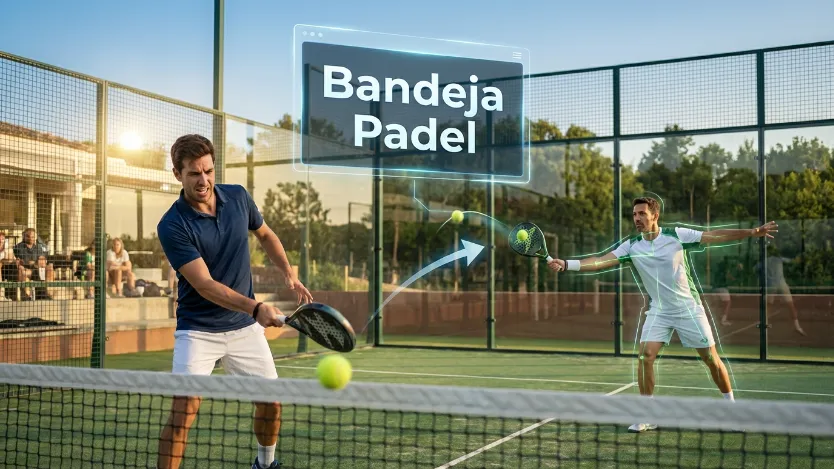
The performance of a padel bandeja shot is rooted in its preparation. Unlike the vertical extension of a tennis smash, the bandeja utilizes a lateral “tray” motion. This creates a controlled, descending flight path that eliminates the high-bounce weak points often found in amateur overheads. To ensure you meet the standards of high-level play, you must adhere to a strict technical profile:
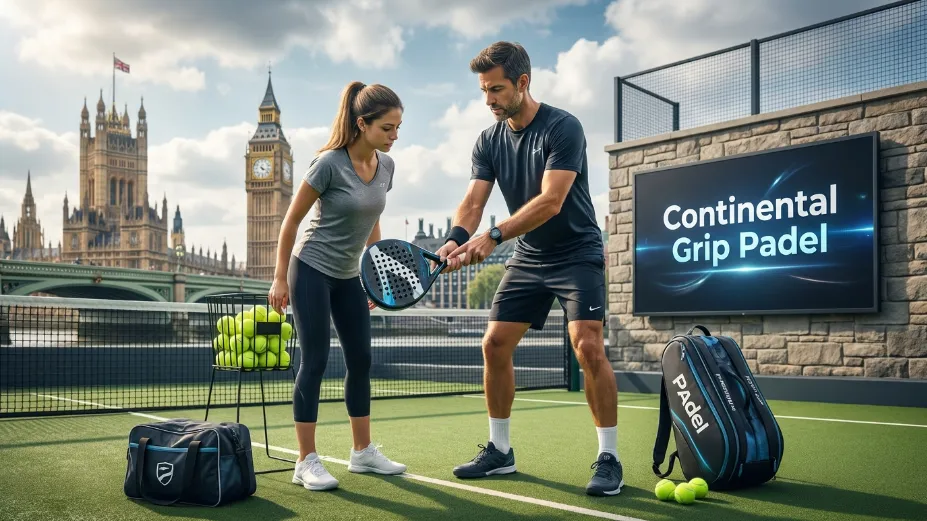
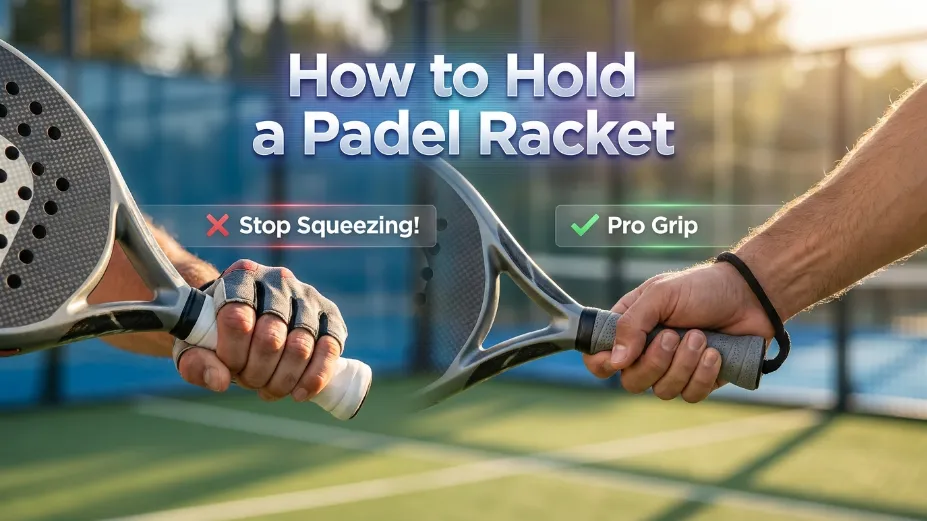
- The Grip: Strictly a Continental grip. This allows the wrist to remain flexible enough to “brush” the ball rather than hitting through it.
- Preparation: The racket is held high, level with the temple, with the face open to the sky—resembling a waiter carrying a drinks tray.
- Footwork: Lateral shuffle steps are vital. Running backwards is the fastest way to lose balance and misjudge the contact point.
- The Contact Point: Precisely at “3 o’clock” (for right-handers), ideally at eye or forehead level. This ensures you can push the ball forward and down.
When choosing equipment for these technical demands, it’s vital to have a racket that offers high manoeuvrability. For a deeper look at how to execute these movements properly, see our guide on how to play padel effectively.
The UK Variable: Humidity and the “Winter Bandeja”
One of the “missing angles” in standard international reviews is the shot’s extreme sensitivity to the British climate. The physics of a padel bandeja change drastically depending on ambient moisture and temperature, leading to performance failures known to seasoned local pros.
1. The “Heavy Ball” Effect (Wet Conditions)
When humidity is high or you are playing on outdoor courts in autumn, the felt of the ball absorbs moisture, increasing its weight. In these conditions, the bandeja padel shot becomes significantly harder to spin. Physics dictates that a wet ball won’t “grip” the racket face, leading to a “mushy” impact. From a tactical standpoint, players should switch to a “Winter Bandeja”—a flatter shot with less slice, focusing entirely on depth and placement rather than trying to force spin that won’t take. Using high-quality balls like adidas speed rx padel balls can help maintain some consistency in these damp environments.
2. The “Sliding” Glass Threshold
Conversely, when condensation forms on the glass walls, the ball’s behaviour after the bounce changes. Instead of a predictable rebound, the ball will often “skid” or drop vertically off the wet glass. A smart player uses the padel bandeja to target the side glass specifically in these conditions, forcing the defender to dig out a ball that refuses to bounce. This requires deeper knee flexion and a more compact swing to avoid unforced errors.
The “Invisible Failure”: Why Your Bandeja is Too Bouncy
A critical gap in the average player’s understanding of the bandeja padel shot is the cause of the “Bouncy Bandeja.” Independent coaching analysis from The Padel School has shown that many intermediate players hit a shot that looks like a bandeja but behaves like a setup for the opponent. If the ball bounces high off the back glass, the shot has “died.”
There are four technical reasons for this structural decay of the shot:
- Contacting Behind the Body: This forces the racket to move upwards at impact, increasing the bounce angle.
- High Contact Point: Hitting at full arm extension (tennis style) prevents the “knife-like” slice required to keep the ball low.
- Excessive Power: Hitting the ball at 90% power usually results in a massive rebound off the glass. Control should be limited to 50-60%.
- Flat Swing Path: Failing to move the racket from high-to-low prevents the backspin that makes the ball “die” after the bounce.
To maintain a competitive edge, players should seek padel coaching to record and analyse their elbow height during the take-back phase.
Positional Nuances: Right Side vs. Left Side Bandejas
Due to the tactical structure of padel, the padel bandeja is not a “one size fits all” shot. Its execution changes based on which side of the court you occupy.
The Drive (Right Side) Strategy:
- The Objective: Consistency and point construction. The right-side player usually receives lobs over their left shoulder, making it harder to move “around” the ball.
- The Technical Fix: Hitting with a slightly more open stance and a higher contact point to cover the middle gap quickly.
The Revés (Left Side) Strategy:
- The Objective: Pressure and aggression. The left-side player has more space to move away from the ball, allowing for a more aggressive vibora or a “Rulo” towards the side fence.
- The Modern Trend: High-level left-side players are increasingly using the “Bandevibora”—a hybrid shot that uses bandeja preparation with vibora acceleration to disguise intent.
Transitioning from Tennis: The “Smash Instinct” Problem
Many UK players enter padel from a strong tennis background. While this helps with volleys, it often creates a “plateau” in their bandeja padel development. In tennis, a high ball is an invitation to end the point; in padel, it is an invitation to reset the point.
Ambitious players will quickly find their skill level stalling because they treat every lob as a smash. The transition requires a mental shift: viewing the glass as a friend that grants you time, rather than a wall that ends the point. If you are struggling with footwork or lateral stability during this transition, investing in proper padel shoes is a necessary step to prevent injury and improve movement efficiency.
Internal Cracking: Identifying a “Dead” Shot Before It Happens
Advanced players have learned to identify a failing bandeja before they even hit the ball. This is the “Aha!” moment of court awareness. If you find yourself “ball watching” or failing to turn your shoulders the instant the opponent’s racket touches the ball, the shot is already compromised. Most failed bandejas are the result of late preparation, leading to a “snatched” contact point behind the body axis.
If you and your partner find yourselves losing the net position consistently after an overhead, stop the match and check your recovery speed. A bandeja is only effective if you are back at the net before the ball reaches the opponent’s racket. If you hit and stay back, you have turned an offensive position into a defensive scramble.
Expert Tips for Practice and Consistency
To get the most out of your training for the bandeja padel shot, follow these UK pro-level tips:
- The 50-Ball Basket: Do not practice smashes. Feed 50 consecutive lobs and focus solely on hitting the side glass. If the ball hits the glass before the floor, it’s a fail.
- The “Up and Down” Drill: Start at the net, retreat for a bandeja, and sprint back to touch the net before the next ball. This builds the specific fitness required for British tournament play.
- The “Scarf” Finish: Ensure your follow-through ends with the racket wrapped across your opposite shoulder, like putting on a scarf. This ensures the correct “high-to-low” path.
bandeja padel-Frequently Asked Questions (FAQ)
Should I jump when hitting a bandeja padel shot?
For most club and intermediate players, staying grounded is better for balance and consistency. Professional players jump to contact the ball earlier and maintain forward momentum, but doing this without perfect timing usually leads to a “bouncy” shot that is easy to counter.
What is the main difference between a bandeja and a víbora?
The padel bandeja is hit from underneath the ball with backspin (slice) for control and safety. The víbora is hit from the side of the ball with aggressive side-spin to create a “venomous” low bounce that shoots off the glass. Think of the bandeja as defensive/neutralising and the víbora as attacking.
Is the bandeja useful on outdoor courts in the UK wind?
Absolutely. The bandeja in padel is the safest overhead for windy conditions because the short, compact swing path is less affected by the ball “shifting” in the air compared to a full-power smash. Aim for larger target areas in the centre of the court when the wind is gusting.
How can I stop my bandeja from being attacked?
Focus on depth and speed control. If your shot is too fast, it will rebound off the glass and give the opponent an easy ball. If it is too slow and short, they will rush the net and volley it. Aim for the ball to bounce near the service line so the second bounce is as close to the back glass as possible.
Conclusion: The Verdict on the Ultimate Padel Shot
The bandeja padel shot remains the backbone of the British scene for a reason. Its blend of safety, tactical depth, and adaptability to our unique weather makes it the safest bet for players of all levels. However, as the sport matures in the UK, so must our understanding of technical precision. By recognising the 4 causes of a bouncy bounce, adapting your swing for “Winter Padel,” and mastering the lateral shuffle, you ensure your game never plateaus.
Whether you are investing in padel coaching to break old tennis habits or simply trying to hold the net more effectively in your local league, remember that the bandeja is a mindset. It is the shot of the patient, disciplined player who knows that in padel, the one who makes the fewer errors—not the one who hits the hardest—is the one who leaves the court victorious. Treat the bandeja with the respect it deserves, and your win rate will thank you.
You May Also Like