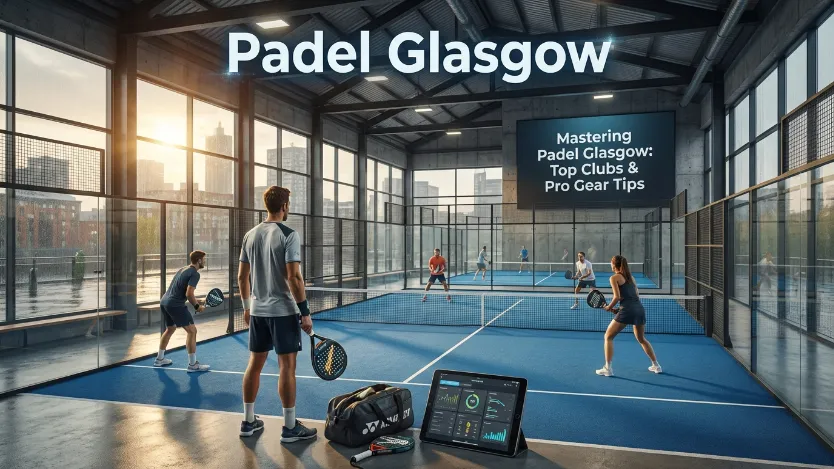
Walk into any converted industrial warehouse from the docks of Govan to the leafy suburbs of Rouken Glen, and you will immediately hear it: the rhythmic, hollow “thwack” of a carbon fibre racket meeting a low-compression ball.
While traditional lawn tennis has long been the summer staple of the city, padel glasgow has exploded from a niche curiosity into a full-blown cultural phenomenon.
It is the sport that has turned former shipyards and retail units into high-energy social hubs, serving as the new benchmark for urban recreation.
However, for the dedicated player, there is more to the game than just showing up and swinging.
To truly master the court, you need to understand the material science of the turf, the impact of Scottish humidity on glass walls, and the technical nuances of the what is padel revolution that most surface-level guides simply overlook.
The Cultural Dominance of Padel Tennis Glasgow
The dominance of padel tennis glasgow in the Scottish sporting landscape isn’t merely a result of a global trend; it’s a result of accessibility.
In a city where the weather can ruin a match in minutes, players crave the reliability of the “indoor revolution.”
The rise of the padel court glasgow scene has created a new social “standardisation” where Friday night sessions have replaced the traditional pub visit for thousands of Glaswegians.
This balanced profile—part squash, part tennis—has led to a state of high demand where booking a slot at 7:00 pm on a Tuesday feels like securing a front-row ticket at the Hydro.
This popularity is underpinned by the fact that padel rules are designed for long, strategic rallies rather than the “ace-and-done” nature of lawn tennis, making it the perfect “Goldilocks” sport for the city’s competitive regulars.
Engineering the “Perfect” Facility: Padel Barn Glasgow and Infrastructure
The performance of a world-class venue like padel barn glasgow (Racket Barn) is rooted in its architectural specifications.
Unlike outdoor courts that suffer from the elements, a dedicated padel barn glasgow utilizes massive warehouse heights—often exceeding 10 metres—to allow for the “perfect lob.”
To ensure they meet LTA approved standards, premium Glasgow facilities adhere to a strict engineering profile:
- Turf Quality: Most elite courts now use Mondo Supercourt XN, a texturised monofilament turf that requires minimal sand, ensuring a more consistent bounce and reducing the risk of “skidding.”
- Glass Thickness: 12mm tempered safety glass is the industry standard for padel courts glasgow, providing the necessary rebound energy for advanced “off-the-wall” shots.
- Court Dimensions: Precisely 20m x 10m. For a detailed breakdown of the geometry, see our guide on padel tennis court size.
- Lighting: LED floodlights mounted on 6-metre poles, angled to prevent glare during high-intensity overhead smashes.
When choosing where to play, it is vital to distinguish between a “covered” court and a “fully indoor” facility.
In Glasgow, the latter is essential for maintaining the Van der Waals forces in the ball’s rubber core, which we will explore in the technical sections below.
The Humidity Threshold: Condensation and Glass Mechanics
One of the “missing angles” in standard padel courts glasgow reviews is the impact of the city’s notorious humidity.
The molecular interaction between a felt-covered ball and a damp glass wall changes the game’s physics entirely.
In Glasgow, temperature drops lead to two distinct performance failures known to seasoned pros:
1. The “Heavy Ball” Effect (Above 80% Humidity)
When moisture levels rise, the felt on the ball absorbs microscopic water droplets.
This makes the ball significantly heavier, causing it to “die” on the glass.
Players using the Adidas Speed RX padel balls often prefer them in these conditions because their high-density core maintains “pop” even when the felt is damp.
Without this technical adjustment, your lobs will fall short, and your smashes will lose 15-20% of their rebound height.
2. The “Slippery Wall” Syndrome (Below 5°C)
In unheated covered courts, condensation forms a thin film on the glass.
This eliminates the friction needed for the ball to “climb” the wall during a slice shot.
If you are playing in these conditions, you must adjust your tactics to a flatter game, as spin becomes virtually irrelevant.
This is why facilities like Pure Padel Glasgow invest heavily in climate control to keep the glass “dry” year-round.
The “Invisible Failure”: 15% Racket Power Loss per Month
A critical gap in the market’s understanding of gear is the rate of structural decay in the EVA (Ethylene Vinyl Acetate) foam core of a racket.
Independent testing suggests that a high-performance racket loses roughly 15% of its elastic memory for every 20 hours of aggressive play.
Because the racket looks fine on the outside, many players in padel glasgow clubs continue using “dead” rackets.
By the third month of regular use, the internal polymer lattice often develops micro-fractures.
This leads to erratic vibrations and a loss of the “sweet spot.”
To maintain a competitive edge, players should consider rotating their gear or using a padel racket protector to shield the frame from the abrasive silica sand used on some padel court glasgow surfaces.
The Counterfeit Problem: Spotting Fake Rackets in Glasgow
Due to the massive demand in the UK, counterfeit rackets—particularly models like the Babolat Technical Viper and Head Gravity Pro—have become a rampant issue on grey-market platforms.
Fakes are often made using cheap injection-moulded plastic rather than layered carbon fibre.
The Authenticity Checklist:
- The Balance Test: A genuine Babolat padel racket has a specific weight distribution (e.g., 270mm balance). Fakes are often “head-heavy” due to poor quality foam.
- The Sound Test: Strike the racket with your palm. A real carbon frame produces a crisp, metallic “ping,” while a fake sounds dull and “thuddy.”
- The Hologram: Always check for the unique serial number near the grip, which can be verified on the manufacturer’s website.
Head-to-Head: The Glasgow Gear Guide (Brands and Models)
The “Padel Barn” and other pro-shops in the city are now stocking the 2026 lineups. Here is how the top “Glasgow favourites” stack up:
- Babolat Technical Viper (The Powerhouse): The choice for aggressive players. It features a diamond shape and a 12K carbon face. It is unforgiving but devastating for those with a high-speed swing.
- Head Gravity Pro (The All-Rounder): A massive hit at padel tennis glasgow social nights. Its circular shape and lower balance provide incredible control, perfect for the “soft-touch” game required on damp courts.
- Nox AT10 Genius (The Technical Choice): Known for its 18K Alum carbon, this racket handles the vibration of cold-weather play better than almost any other model. Explore our review of the Nox AT10 Genius 18K Alum 2026 for more.
- Adidas Metalbone HRD (The Customiser): Featured at many padel courts glasgow demo days, this allows you to adjust the weight and balance using removable screws—ideal if you want to switch between a “power” and “control” setup mid-match. Check the Adidas Metalbone HRD 2026 review.
Beginner Gear: The Essential Glasgow Starter Kit
Many UK players enter the sport by renting gear, but ambitious improvers quickly find their skill level “plateauing” with heavy rental bats.
A proper starter kit is the only way to progress from “beginner” to “intermediate” (Playtomic level 2.5+).
Footwear is the most important investment.
Running shoes are a safety hazard on padel courts glasgow because they lack lateral support.
You need padel shoes with a Herringbone (zig-zag) sole to handle the sand.
For a complete guide on what to buy, browse our list of the best padel racket for beginners.
Expert Tips for Maintenance and Storage in Scotland
To get the most out of your padel glasgow experience, follow these pro storage tips:
- Avoid the Boot: Never leave your racket in a cold car boot overnight in Glasgow. The sub-zero temperatures can cause the EVA foam to contract and lose its “bounce” permanently.
- The Grip Check: Change your padel racket grip every 4-5 games. Humidity in Glasgow makes grips “slick” very quickly, leading to “elbow strain” as you over-tighten your hand.
- Ball Pressurisers: Since are padel balls the same as tennis balls is a common question, remember they lose pressure faster. Using a pressurised tube can extend their life by 300%.
Padel Glasgow-Frequently Asked Questions (FAQ)
Can I play padel singles in Glasgow?
While padel is predominantly a doubles sport, some venues offer coaching on full-sized courts for two people. However, for a true singles experience on a dedicated narrow court, you may need to travel to Gleneagles which features a specific singles academy court.
How much does it cost to book a padel court in Glasgow?
Prices typically range from £28 to £44 per hour. Peak times (evenings and weekends) are more expensive. Splitting the cost between four players makes it roughly £7-£11 per person, which is comparable to a gym class.
Do I need my own racket to play at Racket Barn Glasgow?
No, almost all padel courts glasgow venues offer racket hire for around £3-£5. This is a great way to try different weights before committing to a purchase.
What happens if it rains on an outdoor “covered” court?
In most Glasgow facilities with “canopy” roofs, play continues. However, be aware of “side-spray” if it’s windy. For guaranteed dry play, always book a fully indoor centre like IT’S PADEL or The Court.
How do I find people to play with in Glasgow?
The best way is to join the WhatsApp groups managed by the clubs or use the Playtomic app’s “Open Match” feature, which pairs you with players of a similar skill level.
location
Ready to Play?
Join the Court Today
Whether you’re brand new or a seasoned player — there’s always a spot for you.
✓ No experience needed · ✓ All skill levels welcome
Conclusion: The Verdict on Glasgow’s Padel Revolution
The padel glasgow scene is no longer a trend; it is the new backbone of the city’s social sports culture.
Its blend of durability, predictable indoor flight, and massive social availability makes it the safest bet for players of all levels.
By recognising the 15% monthly power loss in rackets, avoiding the “cold boot” storage trap, and investing in proper padel coaching, you can ensure your performance matches your passion.
Whether you are visiting padel barn glasgow for a social “Americano” or preparing for a tournament at Pure Padel, remember that your gear and your technique are two sides of the same coin.
Treat the sport with the scientific respect it deserves, and your game will thank you on the court.