
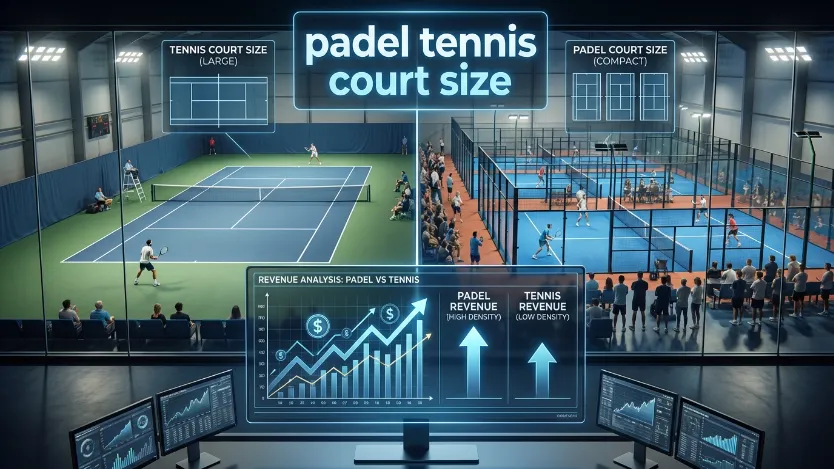
Imagine replacing a single, underused tennis court with three high-revenue playing areas that stay booked from 6:00 AM until 10:00 PM. This is the “3-for-1” reality driving the sport’s explosive growth across the United Kingdom. However, successfully navigating this transition requires more than just enthusiasm; it demands a surgical understanding of padel tennis court size and the complex technical requirements set by the LTA Padel Guidance.
Whether you are a club owner in Manchester or a developer looking at warehouse conversions in London, understanding the padel court size vs tennis court footprint is the first step toward a profitable facility. This guide delves into the precise millimetres of court construction, the “hidden” space requirements for inclusive access, and the acoustic challenges that often determine whether a planning application succeeds or fails in a British residential area.
1. The Blueprint: Official Padel Tennis Court Size and Markings
According to the International Padel Federation (FIP) and the LTA, the internal playing area of a standard doubles padel court is exactly 20 metres long by 10 metres wide. This creates a total playing surface of 200 square metres. While the footprint seems straightforward, the technical precision required for professional play is rigorous.
- The Net: The net must be 10 metres long, spanning the full width of the court. It stands 0.88 metres high at the centre and rises to 0.92 metres at the lateral posts.
- Service Lines: These are positioned 6.95 metres from the net. For those wondering about the padel serve rules, the ball must land within the diagonal service box defined by these lines.
- Line Width: All markings must be 5cm wide, typically in white or yellow to contrast with the synthetic turf.
- Centres: The centre service line extends 10cm beyond the service line to assist with visual officiating.
If you are exploring space-saving options, you might ask, can you play padel singles? While doubles is the standard, singles padel courts do exist, measuring 20 metres by 6 metres. These are ideal for narrow urban plots where a full 10m width is unavailable.
2. Padel Court Size vs Tennis Court: The Efficiency Audit
The most compelling argument for padel is its spatial efficiency. When comparing padel court size vs tennis court dimensions, the difference in the required “total footprint” is staggering. A standard tennis court requires a total area (including run-offs) of approximately 36.6m x 18.3m (669.78m²). In contrast, a padel court, including its structural foundations and safety zones, requires roughly 21m x 11m (231m²).
This means that in the space occupied by one traditional tennis court, a facility can comfortably fit three padel courts. This triples the number of players (from 4 to 12) in the same square meterage, significantly increasing the revenue potential for clubs like S3 Padel Brent Cross.
Doubles format · Key differences
| Feature | Padel (Doubles) | Tennis (Doubles) |
|---|---|---|
| Internal Area | ||
| Total Footprint Needed | ~231 m² | ~660 m² |
| Wall Integration | Integral part of play | None (Open play) |
3. The Vertical Dimension: Ceiling Heights and Warehouse Conversions
In the UK, the conversion of industrial warehouses into indoor padel centres is a massive trend. However, the height clearance is often the biggest technical hurdle. While the FIP minimum is 6 metres, this is considered highly restrictive for competitive play. High lobs are a tactical staple for top 10 padel players, and a low ceiling effectively kills that strategy.
- Recommended Height: A clear height of 8 metres is strongly recommended for new builds in the UK.
- Obstructions: When assessing a warehouse, you must account for roof beams, lighting rigs, and ventilation ducts. A 7-metre ceiling often becomes a 6-metre playing height once lights are installed.
- Performance Impact: Lower heights increase glare risk and force players to hit flatter, fundamentally changing the nature of the game.
4. Structural Nuances: The “Missing Angles” of Court Design
Most basic guides omit the structural engineering details that ensure a court is safe and compliant with British Standards.
The Shared Wall Debate
In an effort to save space, some developers consider “shared wall” construction where two adjacent courts share a central pillar. While this saves roughly 20-40cm of width, it is technically problematic. Vibration transfer is the primary issue; when a 4-ton glass panel on Court A is hit by a player, the vibration can rattle the glass on Court B, disrupting play and potentially compromising structural seals over time. The LTA generally recommends a 1.5-metre gap between courts for maintenance and structural independence.
The 1.2m Wheelchair Access Rule
Inclusivity is a pillar of the UK sports strategy. To comply with LTA accessibility standards, the spacing between the net post and the enclosure must be a minimum of 1.2 metres on either side of the court to allow a wheelchair to pass safely. This often extends the required width of the facility beyond the 10m internal playing area.
12mm Toughened Glass for British Weather
Indoor courts in Spain often use 10mm glass, but for outdoor padel tennis court size builds in the UK, 12mm toughened glass is the essential standard. This provides the necessary wind-load resistance to withstand British gales and ensures safety if a player collisions with the wall at high speed.
5. Planning Permission: The Acoustic “Gunfire” Challenge
The biggest barrier to building a padel court in the UK is planning permission, specifically regarding noise impact. Padel has a distinct acoustic profile—a sharp, percussive “crack” when the ball hits the solid bat and the glass walls. Residents often describe this as a “gunfire-like” sound.
Local authorities often require a Noise Impact Assessment (NIA) following BS 4142. If your proposed site is within 30-100 metres of residential homes, you will likely need mitigation strategies:
- Acoustic Fencing: 3-metre high timber barriers with a minimum mass density of 10-25 kg/m².
- Orientation: Positioning court openings away from the quietest residential facades.
- Absorptive Materials: Using acoustic backing behind the glass or within the warehouse envelope to reduce reverberation.
6. Winter Management and UK Climate Adaptations
The UK’s damp climate introduces a unique problem: glass condensation. When moisture forms on the glass, the ball “slides” instead of bouncing, making play nearly impossible. Indoor centres must invest in mechanical ventilation and dehumidification systems to maintain a stable environment.
For outdoor play, choosing the right equipment is vital. In winter, standard balls become heavy and waterlogged. UK players frequently switch to “Speed” balls, such as HEAD padel balls (specifically the Pro S+), which have higher pressure and shorter felt to remain “lively” in cold, damp conditions.
Recommended Maintenance Schedule
- Monthly: Check and tighten all bolts and fasteners. Vibration from ball impacts can loosen the steel frame over time.
- Quarterly: Clean the glass with neutral detergents and redistribute the silica sand to ensure an even bounce.
- Annually: Professional deep clean to remove moss and algae, which can make the synthetic turf dangerously slippery in the British winter.
Frequently Asked Questions
Everything you need to know about padel court construction, sizing, and equipment in the UK.
01
What is the total land area required for one padel court?
While the playing area is 200m², you should budget for a total footprint of 231m² to 250m² to include foundations (the ring beam), safety run-offs, and maintenance access.
02
Is padel court size vs tennis court efficiency really that different?
Yes. You can fit approximately three padel courts into the space of one standard LTA-compliant tennis court, making it much more profitable per square metre.
03
Do I need a specific floor for an indoor padel court?
Indoor warehouses require a 20cm reinforced concrete slab. Unlike outdoor courts, these must be perfectly level with no drainage slope, as there is no rainwater to runoff.
04
Can I use a tennis racket for padel if the court is smaller?
No. Padel requires a solid, stringless racket. Beginners should look for the Bullpadel Vertex 05 or the Nox AT10 Genius for the best control on these compact courts.
05
What is the “Performance Height” for a padel court?
While the minimum is 6m, 8 metres is the benchmark for high-quality play. Anything lower will likely receive complaints from advanced players during competitive matches.
Summary: Future-Proofing Your Facility
The success of a padel project in the UK hinges on getting the padel tennis court size right from the start. By adhering to LTA recommendations for 8m ceiling heights, 12mm toughened glass, and inclusive 1.2m access gaps, developers can create a high-performance environment that stands out from low-spec competitors. As the padel court size vs tennis debate continues, the efficiency and social density of padel suggest it will remain the cornerstone of UK racquet sport development for the next decade.