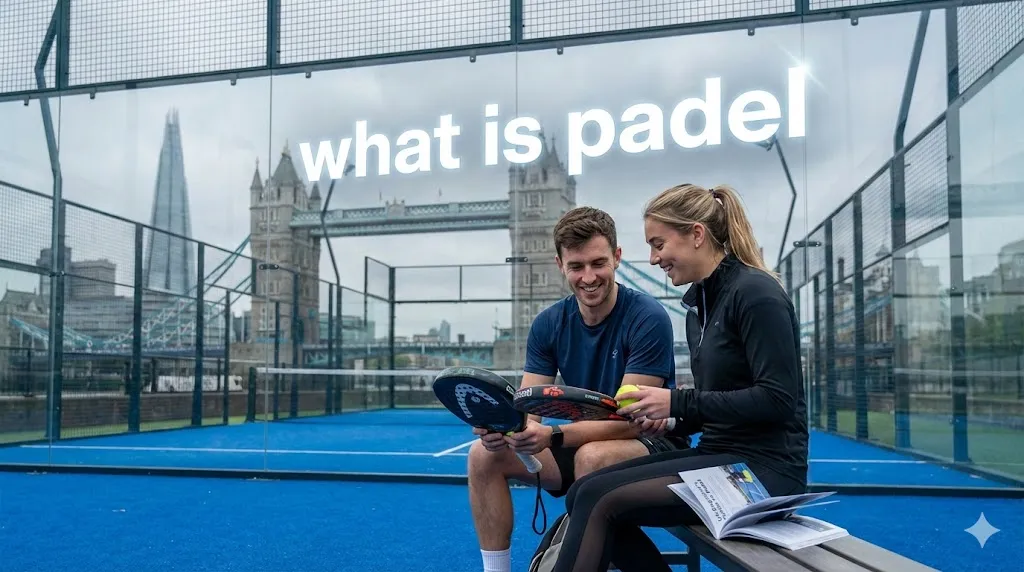
Have you noticed enclosed, glass-walled courts popping up in parks and leisure centres from London to Manchester? You aren’t alone. Padel is currently the fastest-growing sport in the United Kingdom, captivating everyone from tennis pros to absolute beginners who have never held a racket in their lives.
But what is padel exactly? Is it just “mini tennis,” or is there more to it?
In short, Padel (sometimes referred to as Padel Tennis) is a fun, fast-paced racquet sport that combines the best elements of tennis and squash. It is almost always played in doubles on an enclosed court where the ball can bounce off the glass walls, keeping the game alive and the rallies long. Whether you are looking to improve your fitness or just want a new way of socialising, understanding the basics is your first step to joining The Padel Gang and the wider community.
In this comprehensive guide, we will cover everything you need to know: from the unique rules and court dimensions to why it has become a sensation across Great Britain.
The Basics: What Exactly is Padel Tennis?
While it might seem like a modern trend, Padel was actually invented in Mexico in 1969 by Enrique Corcuera. However, it wasn’t until recently that it exploded in popularity across Europe, and now, the UK.
So, what is padel tennis in terms of gameplay? Think of it as the “fun cousin” of tennis. It requires less technical skill to start enjoying than tennis, but offers more tactical depth than you might expect. The learning curve is incredibly gentle; most beginners can sustain a rally within the first 20 minutes of stepping onto the court. This accessibility is the primary reason why clubs across the UK are converting old tennis courts into thriving Padel hubs.
Padel vs. Tennis vs. Squash: What’s the Difference?
To truly understand the sport, it helps to compare it to its older siblings. Here is how Padel stands out:
- The Walls: Like Squash, Padel is played in an enclosed area. The ball remains in play even after it hits the glass walls (though not the wire fence), allowing for strategic “boasts” and recovery shots that aren’t possible in tennis.
- The Serve: Unlike the overhead power serves seen at Wimbledon, the Padel serve must be underarm and hit at or below waist height. This neutralises the “power advantage” and puts the focus on strategy rather than brute force.
- The Vibe: Padel is strictly a doubles game. This makes it inherently more social. The smaller court size means you are closer to your partner and your opponents, fostering a friendly (yet competitive) atmosphere.
The Padel Court: Dimensions & Layout
One of the most common questions beginners ask is: what is a padel court and how big is it?
A standard Padel court is 20 metres long and 10 metres wide. To put that into perspective, a Padel court is roughly 25% smaller than a standard tennis court. In fact, you can fit nearly three Padel courts into the space of a single tennis court, which is a major reason why UK leisure centres are so keen to install them.
Key Features of the Court:
- The Walls: The back walls and the corners are made of toughened glass (usually 3 metres high), allowing players to rebound the ball.
- The Mesh: The sides are partly made of a metal mesh (wire fence). If the ball hits the mesh on a serve, it is a fault. If it hits the mesh during a rally, the bounce is unpredictable, adding an element of chaos to the game.
- The Surface: Most UK courts use artificial turf sprinkled with silica sand. This sand is crucial—it allows players to slide slightly while turning and protects the carpet from wear, but it also means you need the right footwear to avoid slipping.
How to Play: 5 Essential Rules for Beginners
Before you book your first session, it is vital to grasp the basic rules. While the official regulations are maintained by the LTA Padel Guide (the governing body for Padel in Britain), here is a simplified breakdown to get you started:
1. The Scoring is Familiar
If you know tennis scoring, you know Padel scoring. Points follow the standard 15, 30, 40, Game format. Matches are usually the best of three sets, with six games winning a set.
2. The Underarm Serve
All points start with a serve. The server must bounce the ball behind the service line and hit it below waist height diagonally into the opponent’s service box.
3. The “Bounce” Rule
In general play, the ball must bounce on the ground before it hits any structure (glass or fence). If an opponent hits the ball and it slams directly into your back wall without bouncing on the ground first, the point is yours (“Out”).
4. Playing off the Glass
Once the ball has bounced on your side, and it hits the glass wall, it is still alive. You can wait for it to rebound off the glass and then hit it back over the net. You can even hit the ball against your own glass wall to get it over the net (though this is an advanced move!).
5. No Mesh Rebounds
While you can use the glass walls to help you, you cannot hit the ball against the wire fence on your own side to return it. The fence is strictly an obstacle.
Equipment: What Do You Need to Start?
You don’t need a cupboard full of gear to start playing, but there are two essentials you cannot ignore.
The Padel Racket (The Pala)
Unlike a tennis racket, a Padel racket is solid with no strings. It is typically made of EVA foam covered in carbon fibre or fibreglass and perforated with holes to reduce air resistance. It is shorter (maximum 45.5cm) and easier to control. Crucially, all Padel rackets come with a safety strap (wrist cord)—you must wear this during play to prevent the racket from flying out of your hand and injuring another player.
The Balls
Can you use tennis balls for Padel? Technically, yes, but you shouldn’t. Padel balls look identical to tennis balls but have slightly lower pressure. This results in a slightly slower bounce, which complements the smaller court size and keeps rallies going longer.
Playing Padel in the UK: Weather & Costs
The UK padel scene is booming, but as a British player, there are local factors to consider.
Can You Play Padel in the Rain?
Given the British weather, this is a top concern. Padel can be played in light drizzle, especially on courts with plenty of sand which aids grip. However, once the glass walls get wet, the ball will slide down them rather than bouncing off, changing the game physics entirely. Heavy rain also makes the surface slippery and dangerous. Luckily, many new clubs are building canopies or fully indoor centres.
Do I Need a Membership?
Unlike traditional tennis clubs which often require hefty annual fees, the Padel culture in the UK is largely “Pay and Play.” You can use apps like Playtomic to find courts near you and split the cost with friends. Prices typically range from £20 to £40 per hour for the court (which is only £5-£10 per person).
Frequently Asked Questions (FAQ)
Is Padel harder than Tennis?
No, most people find Padel much easier to learn. The racket is closer to your hand (easier hand-eye coordination), the serve is underarm, and the walls give you a second chance to hit the ball. It is less physically demanding in terms of power, but relies more on reflexes.
Is Padel the same as Pickleball?
No. While both are growing fast, Pickleball is played on a court similar to badminton with a plastic “wiffle” ball and no walls. Padel is played with a pressurised ball and uses glass walls as part of the game.
Can you play singles in Padel?
Standard Padel is strictly a doubles sport (2 vs 2). While “Singles Padel Courts” do exist (they are slightly narrower, 6m wide instead of 10m), they are rare in the UK. The game is designed for four players.
Why is there sand on a Padel court?
The sand is essential for three reasons: it holds the artificial turf in place, it prevents the fibres from flattening out, and it provides the necessary friction for players to slide safely without getting their shoes stuck in the turf.
Conclusion: Ready to Hit the Court?
Padel is more than just a passing trend; it is a sport that perfectly fits the modern lifestyle. It’s quick to play, highly social, and incredibly addictive. Whether you are in London, Birmingham, or Edinburgh, there is likely a court opening near you soon.
Now that you know the answer to “what is padel,” the only thing left to do is grab a racket, find three friends, and experience the fun for yourself. See you on the court!