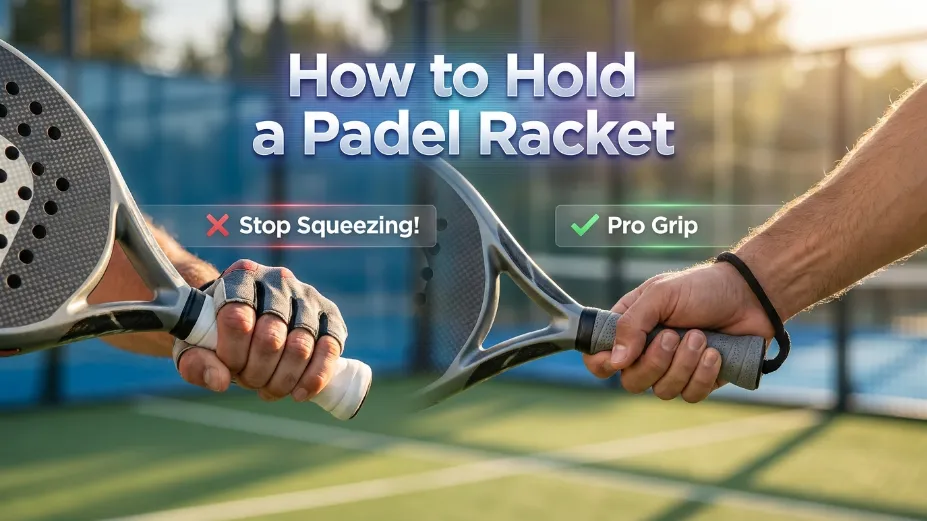
The difference between a crisp, smashing bandeja and a ball that flies straight into the back glass often comes down to mere millimetres in your palm. If you are stepping onto the court treating your padel gear like a tennis racquet—or worse, a frying pan—you are actively sabotaging your control and inviting painful tennis elbow before the first set concludes. Mastering how to hold a padel racket isn’t just a basic box for beginners to tick; it is the foundational shift that transitions your game from casual swinging to clinical court dominance. Let’s rectify your grip before your next match.
UK Padel Club Court Rates
Peak & off-peak pricing · Booking platforms
For players prioritising budget without sacrificing quality, S3 Padel Brent Cross offers the best value at £20 off-peak. However, for a premium corporate networking environment, Padium Canary Wharf remains the gold standard, while The Padel Hub Reading provides the most consistent regional balance for high-level training.
The Anatomy of the Handle: Understanding the Octagonal Bevels
To master how to hold padel racket, you must first understand the topography of the tool in your hand. Unlike a rounded handle, a padel racket features an octagonal (eight-sided) grip. These flat surfaces, or “bevels,” serve as tactile maps for your hand placement.
For most players, the base of the index finger knuckle should rest firmly on Bevel 2. This creates the “Continental Grip,” the absolute foundation for 90% of padel shots.
Head to Head: Continental vs. Eastern Forehand
A frequent point of confusion for those transitioning from tennis is the choice between these two dominant grips. Let’s look at them Head to Head:
- Continental Grip (The Hammer): Offers unmatched versatility. It allows you to switch between forehand and backhand volleys instantly at the net without changing hand position. It is essential for generating Slice, the most common effect in padel.
- Eastern Forehand Grip: While it provides more raw power for baseline drives, it is a liability at the net. It leaves your backhand face too open, making defensive blocks nearly impossible.
The Verdict: Unless you are an elite player looking for extreme topspin on a specific groundstroke, the Continental grip is your primary weapon for padel how to hold racket effectively.
The “Missing Angle” in Competitive Blogs: Sensory Finger Pressure
Most guides focus on where to put your hand, but they miss how to use your fingers as sensors. Advanced padel how to hold racket mechanics involve a non-uniform distribution of pressure.
The 3-Finger Anchor
Stability comes from your bottom three fingers (pinky, ring, and middle). These fingers should provide the majority of the “load-bearing” grip. By anchoring the racket with these fingers, you leave your wrist free to manoeuvre.
The Trigger Finger Hack
A “missing angle” used by pros like Ale Galán is the “Trigger Finger” placement. By leaving a slight gap between your index and middle finger, you increase the tactile feedback (feel) from the racket face. This index finger acts as a guide, allowing for those delicate Drop Volleys that die in the corner.
Dynamic Leverage: Why “Choking Up” and “Down” Matters
There is no one-size-fits-all height for how to hold the padel racket. Your position on the handle should shift based on the tactical situation.
- Choking Up (High Grip): Moving your hand closer to the bridge increases manoeuvrability. This is ideal for fast-paced net exchanges where reaction time is everything.
- Choking Down (Low Grip): Sliding your hand to the very bottom increases the lever length ($r$). In physics, more length equals more racket head speed, which translates to massive power on your Smashes and Víboras.
Pro Tip: Many elite players even let their pinky finger hang off the end of the handle during a smash to maximise this whip effect.
Equipment Optimisation: Overgrips and the British Climate
In the UK, outdoor courts are often damp or humid, making the question of how to hold your padel racket a matter of equipment as much as technique. A standard base grip is rarely enough.
We recommend using high-tack overgrips like Wilson Pro Comfort or Tourna Tac. These ensure that even in the rain, your racket doesn’t rotate in your hand during high-impact shots. For players struggling with vibration, an anti-vibration system or a slightly thicker Padel racket grip setup can be a lifesaver for the elbow.
If you are still looking for the perfect handle feel, check out the Continental grip padel guide for more technical depth, or if you are prone to injury, explore the best padel rackets for tennis elbow to complement your grip technique.
Common Pitfalls: The “Tennis Drift” and Grip Pressure
One of the most dangerous habits for UK players is the “Tennis Drift”—unconsciously rotating the racket toward an Eastern Forehand grip during rallies. To combat this, you must master the “Micro-Reset.” Between every point, use your non-dominant hand to seat the racket back into the Continental “V” position.
Furthermore, avoid the “Death Grip.” Squeezing at a 10/10 pressure level at all times leads to muscle fatigue and “numbness”.Instead, maintain a 5/10 pressure during the ready position, firming up to a 7/10 only at the moment of impact.
How to Hold a Padel Racket – FAQ
Q: Should I change my grip for a backhand?
A: Ideally, no. The Continental grip is designed to work for both sides. However, intermediate players often find that a subtle micro-rotation toward an Eastern Backhand grip helps with defensive lobs off the glass.
Q: How many overgrips should I use?
A: This depends on hand size. Use the “Index Finger Test”: when holding the racket, there should be enough space to fit your index finger between your fingertips and your palm.
Q: Why does my thumb hurt when I play?
A: This is usually a sign of a “too small” grip, causing you to over-squeeze. Adding another overgrip can distribute the pressure and reduce friction-based blisters.
Q: Is it okay to use a two-handed backhand?
A: Yes, especially for former tennis players. It provides more stability, but be careful as it can limit your reach for balls rebounding off the back wall.
Subconscious Mastery: The Path Forward
Refining how to hold a padel racket is not a one-time fix; it is a developmental journey. Start by solidifying your Continental foundations at a Padel school or with local coaching. Once the “V” alignment becomes second nature, begin experimenting with leverage by shifting your hand height during smashes.
For more advanced technical breakdowns, visit our Padel tips hub or consult the official LTA Padel Guidelines to stay updated on the latest UK coaching standards.