Imagine you are halfway through a cold, damp evening match at Padium Canary Wharf. Your arm feels like lead, your volleys are becoming sluggish, and that “head-heavy” racket you bought for power is now working against you. In the UK, where humidity and low temperatures are part of the game, a racket that feels perfect in July can feel like a hammer in December. Mastering how to lighten your padel racket weight is the secret to maintaining manoeuvrability and protecting your elbow throughout the British winter.
For many players, the factory-standard weight (often between 360g and 375g) is simply too much for the high-intensity defensive rallies typical of the modern game. This guide dives deep into Padel racket weight customization, covering everything from aerodynamic physics to the impact of British humidity on your equipment.
1. Static Weight vs Swing Weight: The Physics of “Feel”
When discussing reducing padel racket swing weight, we must distinguish between what the scale says and how the racket moves. Static weight is the total mass of the racket (e.g., 365 grammes). However, swing weight is the resistance you feel during a stroke. This is governed by the distribution of mass relative to the handle.
Physics dictates that a single gramme removed from the tip (the 12 o’clock position) has a much larger impact on the “feel” than five grammes removed from the handle. For British players looking for a faster reaction at the net, focusing on the tip is the priority. If you find your current setup too taxing, it might be worth exploring our list of the lightest padel rackets currently available in the UK.
2. Removing Padel Racket Protectors: The “Quick Win”
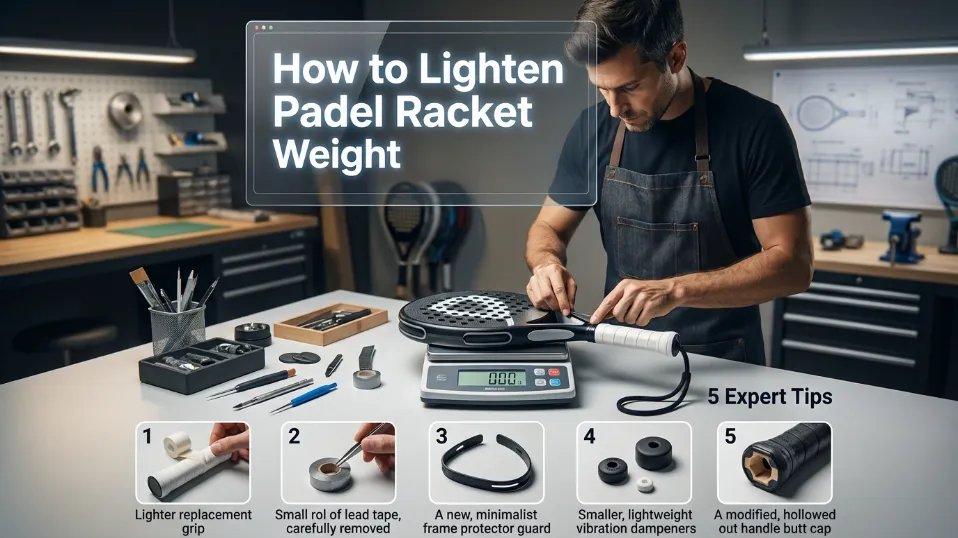
The most immediate method for removing padel racket protectors can save you anywhere from 6 to 12 grammes of “dead weight” at the furthest point from your hand. Most high-end rackets, such as the Bullpadel Vertex 05, come with pre-installed bumpers designed to protect the carbon fibre frame from the abrasive sand and walls of UK courts.
How to Safely Remove the Protector
- Use Controlled Heat: Use a hairdryer on a low setting for 60 seconds to soften the adhesive. This prevents the high-strength glue from stripping the paint.
- Peel Incrementally: Start from one edge and peel slowly. If you encounter resistance, apply more heat.
- Clean Residue: Use a tiny amount of alcohol-based cleaner or WD-40 on a cloth to remove sticky residue without damaging the carbon fibre padel racket surface.
If you still want protection without the weight, consider replacing the plastic guard with a thin padel racket protector made of transparent adhesive tape, which typically weighs less than 3 grammes.
3. Handle Customisation and Lightweight Overgrips
The handle is often overlooked in Padel racket weight customization. Most rackets feature a thick factory undergrip (usually PU foam) that can weigh up to 18 grammes. A popular technique among competitive players at Stratford Padel Club is to strip the racket to the bare handle.
The “Pro” Handle Setup
- Remove the original factory undergrip.
- Apply one or two lightweight padel overgrips directly to the handle.
- This can save up to 10 grammes and significantly improves your ability to feel the bevels of the racket.
However, be aware that thinning the padel racket grip increases vibration. In the cold UK climate, this can lead to “padel elbow” if you aren’t careful. For players with smaller hands, this setup is often a game-changer, as detailed in our guide to the best lightweight padel rackets for women.
4. Padel Racket Balance Adjustment: Counter-Weighting
If you don’t want to actually remove weight, you can achieve Padel racket balance adjustment by adding mass to the handle. While this increases the static weight, it shifts the centre of gravity toward your hand, making the head feel lighter and more agile.
Using lead or tungsten tape inside the butt cap or under the grip can lower the balance point by several millimetres. This is particularly useful for top-heavy models like the Adidas Metalbone HRD 2026 review, which already features a custom weight system.
5. The “UK Factor”: Humidity, Cold, and Moisture
This is the “missing angle” most international guides ignore. In the UK, relative humidity often exceeds 80%. This affects your racket in three ways:
- Ball Mass: A damp padel ball can absorb enough moisture to increase its weight by 15%. Hitting a heavy ball with a heavy racket increases the shock to your arm.
- EVA Foam Compression: In temperatures below 10°C, the EVA core of your racket contracts and becomes stiffer. A stiff, heavy racket is the primary cause of epicondylitis.
- Overgrip Saturation: Moisture in the air makes overgrips lose tackiness faster. Using a padel backpack with a thermal compartment is essential to keep your gear dry.
For more technical advice on managing these conditions, refer to the LTA’s official padel equipment guidelines.
6. Material Science: Why Carbon Matters
If you are serious about weight, you must choose the right materials. Cheap rackets often use 100% fiberglass, which is heavier and more flexible. Professional-grade rackets use 12K or 18K carbon weaves, which provide structural strength at a much lower weight. If you are a beginner, look for a best budget padel racket that still incorporates a carbon frame for weight stability.
Advanced Tweak: The Wrist Strap
Many players don’t realise that the wrist strap and butt cap can weigh up to 10 grammes. While safety rules by the FIP and LTA require a strap, some brands like Nox offer the “SmartStrap” system, which allows you to swap to a lighter, thinner cord, saving a few crucial grammes of handle weight.
Conclusion
Reducing the weight of your padel racket is a precise science of trade-offs. By removing padel racket protectors and opting for lightweight padel overgrips, you can transform a clumsy power racket into a defensive scalpel. Always remember to make adjustments in small increments—changing your racket’s weight by more than 10 grammes at once can significantly throw off your timing during a bandeja or smash.
How to Lighten Your Padel Racket Weight-Frequently Asked Questions
Does removing the protector affect my warranty?
Most major brands sold in the UK consider the adhesive protector a consumable part, but if you damage the paint while removing it, your warranty may be voided. Always use the heat method described above.
How much weight does an overgrip actually add?
A standard overgrip adds about 5 to 7 grammes. If you use three overgrips, you are adding nearly 20 grammes to the handle, which significantly shifts the balance point toward the hand.
Can I drill more holes to lighten the racket?
Absolutely not. Drilling into the racket face will compromise the carbon fibre structure and ruin the aerodynamics, making the racket unstable and prone to snapping. If you need a lighter racket, it is better to consult our guide on how to choose a padel racket.
Why does my racket feel heavier in the rain?
It isn’t just your imagination. The felt on the padel balls and your overgrip absorb moisture, increasing the effective weight you are swinging. Always dry your racket thoroughly after play and store it in a quality padel bag.