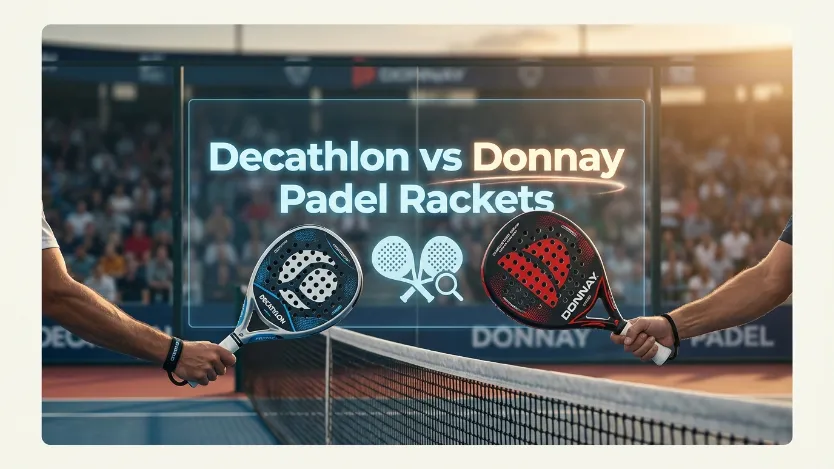
As padel centres sprout across the UK from Bermondsey to Glasgow, the most common question on the baseline isn’t about tactics—it’s about the kit. Specifically, players are caught between two heavyweights of the “value” market. In the blue corner, we have Decathlon’s technical powerhouse, Kuikma. In the red corner, the century-old heritage brand Donnay, now a staple of British high-street sports retail. If you are trying to decide on Decathlon vs Donnay Padel Rackets, you aren’t just choosing a brand; you are choosing between a modern disruptor and a classic nameplate. This guide breaks down the engineering, the British weather performance, and the “missing” details the big review sites overlook.
| Comparison Feature | Decathlon (Kuikma) | Donnay Padel |
|---|---|---|
| Target Audience | Technical intermediates & pros | Beginners & heritage seekers |
| Key Features | Shock Block, TeXtreme Carbon | Round shapes, soft EVA cores |
| Material & Build | 12K/18K Carbon & Dual Foam | Fibreglass to 18K Carbon |
| Model Variety | PR 500, PR 990, Pro Series | Cyborg, Afterglow, Luna Light |
| Price Range | £25 – £160 | £25 – £150 (often discounted) |
Decathlon vs Donnay Padel Rackets: The Market Showdown
To understand the rivalry, we must look at how these brands operate in the UK. Decathlon’s Kuikma range was launched in 2017 with a specific goal: to offer professional-grade equipment without the “marketing tax” charged by major Spanish brands. They control everything from the TeXtreme carbon sourcing to the shelf in their UK stores. For a deeper look at their entry-level range, see our guide on the Decathlon padel racket options.
On the other hand, Donnay is a brand with a legendary pedigree, once associated with Björn Borg. In the UK, Donnay padel rackets are primarily distributed through Sports Direct and Frasers Group. This makes them incredibly accessible, often appearing with aggressive 50% discounts. While Kuikma targets the “serious” club player, Donnay has historically captured the beginner market. However, with the launch of their premium series, the Kuikma vs Donnay padel debate has moved from the budget bin to the advanced court.
Engineering Deep Dive: Kuikma (Decathlon) Technology
When analyzing Decathlon padel racket price vs performance, the value proposition lies in their “Shock Block” and “Dual Foam” technologies. Unlike generic budget rackets, Kuikma invests heavily in R&D at their technical centre in Spain.
- Shock Block System: An elastomer insert in the handle that reduces vibrations by up to 38%. This is vital for UK players who often play in cold, damp conditions where EVA foam stiffens, increasing the risk of “tennis elbow.”
- Dual Density Foam: A combination of high-density Black EVA for power on smashes and a softer inner layer for manoeuvrability and control on soft blocks.
- TeXtreme 18K Carbon: Found in the MS Pro and LS Pro models, this aeronautical-grade carbon provides a “dry” hit and exceptional durability.
Many club-level players find that the PR 990 series outperforms rackets costing twice as much. This is why we often compare them to other budget giants in our Slazenger vs Decathlon padel rackets analysis.
Donnay Pro Padel Series Specifications
Donnay has recently moved upmarket with its Pro Series. If you are browsing the aisles of a UK sports shop, you need to understand the Donnay Pro Padel series specifications to avoid overpaying for what might look like a “discounted” high-end racket.
- Donnay Cyborg Pro 18K: The flagship model. It features a round shape, which is unusual for a top-tier power racket, and weighs between 365g and 375g. It uses 18K carbon and a soft core to balance precision with impact.
- Donnay Eclipse 3K: A lighter option at roughly 355g. Designed for advanced players who prioritse defence and quick volleys over brute force.
- Donnay Afterglow 3K: This model focuses on control. It has a balanced weight distribution and a very forgiving sweet spot, making it ideal for those moving from beginner to intermediate levels.
- Donnay Luna Light: At just 345g, this is one of the lightest padel rackets on the UK market, specifically designed for juniors and female players who want to avoid arm fatigue.
Crucially, the “RRP” on many Donnay rackets (like the £100 list price for the basic model) is often seen by experts as a marketing anchor, with the real “performance value” aligning more with the £25–£50 sale price. For a comparison against other high-street budget options, check out Slazenger vs Donnay padel rackets.
The Price vs Performance Gap in the UK
The Decathlon padel racket price vs performance ratio is widely considered the gold standard. A £150 Kuikma MS Pro is technically equivalent to a £300 racket from a premium Spanish brand. In contrast, the entry-level Donnay padel racket (priced around £25 on sale) is typically made of 100% glass fibre.
While glass fibre is excellent for beginners because it provides a “springy” feel and more ball output on slow shots, it lacks durability. A regular player in a UK league (playing 2-3 times a week) will find a glass fibre racket “dies” or loses its elasticity within 4-6 months. Upgrading to a carbon-hybrid model from the best padel rackets under £100 category is usually a smarter long-term investment.
The British Context: Weather and Courts
The UK climate presents a unique challenge for padel gear. Most of our play happens in 15-20°C indoor environments or high-humidity outdoor courts. This affects the EVA foam density inside your racket.
- Cold Sensitivity: EVA foam becomes harder in the winter. An 18K carbon racket that feels perfect in August might feel like a “wooden plank” in January. Kuikma’s “Dual Foam” helps mitigate this better than the single-density foams often found in budget Donnay models.
- Surface Texture: British humidity makes the ball heavier and the racket face slippery. Kuikma’s 2025 Pro models feature a sandblasted surface to maintain spin, whereas many mid-range Donnay rackets have a smooth gloss finish which can struggle for “bite” in the damp.
Following expert padel tips regarding racket storage—keeping your kit in a thermal bag—is essential in the UK to prevent the core from degrading due to temperature swings.
Warranty and Aftercare: Decathlon vs Sports Direct
This is a “missing gap” in most online reviews. If you buy a Kuikma racket in the UK, you benefit from Decathlon’s standard 2-year warranty. They are known for their “no-quibble” replacement if a racket frame cracks under normal play. This provides massive peace of mind for an investment over £100.
Buying a Donnay racket via Sports Direct or other Frasers Group outlets usually falls under a standard 28-day return policy. If a fault develops after three months, the returns process can be more arduous, often requiring the item to be sent away for inspection. For many UK players, the Decathlon after-sales service is the deciding factor in the Decathlon vs Donnay Padel Rackets debate.
Frequently Asked Questions (FAQ)
Do Kuikma rackets feel “empty” compared to big brands?
Lower-end Kuikma models (under £40) can sometimes have a hollow sound due to the thin fibreglass faces. However, the PR 990 and Pro series feel incredibly solid and comparable to brands like Bullpadel or Nox.
Why is there a discrepancy in Donnay weight listings?
Donnay often lists a wide weight range (e.g., 360-375g). This is due to mass-manufacturing variances. It is always best to weigh your racket at home and use an overgrip to find your personal balance.
Does 18K carbon become too stiff in a British winter?
The carbon itself doesn’t change, but the EVA core inside does. If you play in very cold outdoor courts, a softer 12K carbon or a fibreglass hybrid may feel more comfortable than a stiff 18K “Power” racket.
Can I trust the LTA guidance on these brands?
The LTA official padel guidance recommends choosing equipment based on skill level rather than brand prestige. Both Decathlon and Donnay are recognised as legitimate providers for the UK’s growing player base.
Final Verdict: Which Racket Should You Buy?
In the battle of Decathlon vs Donnay Padel Rackets, the winner depends on your commitment to the sport:
- Choose Donnay (Luna or Basic) if: You are a total beginner playing your first few matches and want to spend less than £30. It’s a “safe” entry point that is more comfortable than a rental racket.
- Choose Kuikma (PR 500 or 990) if: You are an intermediate player looking for the best possible specs for your money. The 2-year warranty and technical innovation like the Shock Block system make it the superior choice for regular club play.
- Choose Donnay (Cyborg Pro) if: You specifically prefer a round-shaped racket with high-end carbon materials and a heritage aesthetic.
Ultimately, while Donnay offers accessibility, Kuikma offers a technical ladder that supports your growth from your first serve to your first tournament.
For more kit comparisons, check our guide on Lidl vs Decathlon padel rackets.