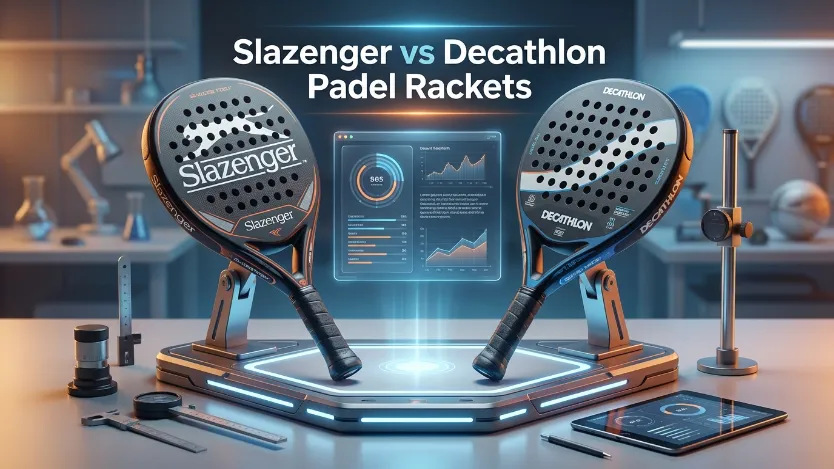
Step onto any court at Stratford Padel Club or the new Slazenger-branded hubs in Leeds, and you will immediately notice the two dominant silhouettes: the sleek, matte-black Slazenger Panther Series and the technical, value-driven Kuikma PR series from Decathlon. While the sport has exploded across the UK with hundreds of new padel rackets UK enthusiasts are flocking to, the debate between heritage prestige and technical disruption remains the “Standard” conversation in British changing rooms.
Slazenger is the official ball provider of Wimbledon and a titan of British sports history, serving as the benchmark for “English elegance.” However, for the dedicated intermediate player, there is more to this choice than just brand heritage. To truly master your game and avoid the “Padel Elbow” that plagues 90% of UK regulars, you need to understand the material science, thermodynamic limits of EVA foam in the British winter, and the hidden degradation patterns that most generic Slazenger vs Decathlon Padel Rackets reviews simply overlook.
Before we dive into the technical science, here is a quick reference comparison for the top models currently dominating the UK market.
| Model | Approx. Price | Weight | Primary Material | Skill Level |
|---|---|---|---|---|
| Slazenger Panther Icon | £250 – £330 | 360 – 375g | 12K Carbon / Hard EVA | Intermediate – Advanced |
| Kuikma PR990 Hybrid | £80 – £110 | 362g | 12K Carbon / Black EVA | Intermediate |
| Slazenger Challenge No. 4 | £50 – £80 | 350g | 3K Carbon / Soft EVA | Beginner – Intermediate |
| Kuikma PR React | £70 – £90 | 360g | Carbon/Linen/Glass Fibre | Intermediate |
The Cultural Dominance of Slazenger vs Decathlon in the UK
The dominance of Slazenger vs Decathlon Padel Rackets in the United Kingdom isn’t merely a result of retail availability; it’s a result of brand trust. Slazenger, established in 1881, carries a “Homecoming” status in the UK. Players buying a Slazenger padel racket are often looking for the prestige associated with Wimbledon, preferring the sober, all-black “Panther” aesthetic over the flashy neon designs of Spanish brands. In clubs from Canary Wharf to Leeds, Slazenger represents the “Classic” choice for former tennis players transitioning to padel.
Conversely, Decathlon’s Kuikma has become the “Goldilocks” of the British industry—not as prohibitively expensive as brands like Bullpadel, yet significantly more performance-oriented than generic entry-level bats. Decathlon’s strategy of “Technical Democracy” means a Decathlon padel racket like the PR990 often uses the same 12K Carbon Fibre as rackets three times its price. This has led to a state of standardization where Kuikma is now recognized as the best padel rackets under 100 for players who value substance over logos.
Engineering the “British” Bounce: Materials and Specifications
The performance of Slazenger Panther Series vs Kuikma PR is rooted in how they handle Carbon Fibre density. Unlike cheaper rackets that use 100% Fibreglass, both brands utilize high-grade carbon weaves to ensure they meet LTA Padel guidance for competitive play. To master the intermediate level, you must understand these three engineering pillars:
- Weight & Balance: The Slazenger Panther Icon often features a High Balance point, putting more mass at the tip for explosive smashes. In contrast, the Kuikma PR990 Hybrid aims for an Even Balance, providing better Manoeuvrability in the fast-paced volleys common in UK indoor clubs.
- Carbon Weave (3K vs 12K): While most best padel racket for intermediate players struggle to feel the difference, 12K Carbon provides a stiffer, more responsive surface. Slazenger’s 12K Icon is “Handmade in Barcelona,” ensuring a tighter resin bond than mass-produced alternatives.
- Foam Density: Slazenger typically uses Hard EVA in its Panther Pro line for precision, whereas Kuikma offers a Soft EVA variant in its PR990 line, which is significantly more forgiving for those developing their Bandeja.
When choosing equipment, it’s vital to distinguish between these and starter sets. For a deeper look at basic mechanics, check our padel tips for progressing beyond the baseline.
Thermodynamics: The 10°C British Winter Threshold
One of the “missing angles” in standard reviews is the racket’s extreme sensitivity to the British climate. The molecular structure of EVA Foam (Ethylene Vinyl Acetate) changes drastically depending on the ambient air temperature, leading to two distinct performance failures known to seasoned UK pros.
1. The “Plank of Wood” Effect (Below 10°C)
In the UK, where many matches are played on outdoor courts or in unheated bubbles during winter, the temperature frequently drops below 10°C. In these conditions, the Hard EVA core in a Slazenger Panther Series racket essentially turns into a “Plank of Wood.” The polymer chains tighten, reducing the “Trampoline Effect.” Players describe the racket as feeling “dead” or “muted,” where vibrations travel directly into the arm, significantly increasing the risk of Tennis Elbow.
2. Humidity & The “Dead Ball” Problem
The UK’s high humidity and damp coastal air saturate the felt of padel balls, making them heavy. A Hard EVA racket struggles to generate ball output (Salida de bola) with a heavy, wet ball. This is where Kuikma vs Slazenger Padel testing reveals a gap: Kuikma’s Soft EVA models handle the “Dead Ball” much better, providing the necessary rebound to get a heavy ball over the net during a drizzly Tuesday night session in Bristol or Manchester.
The “Invisible Failure”: Structural Decay in Humid Environments
A critical gap in the market’s understanding of Slazenger vs Decathlon Padel Rackets is the rate of internal decay. Independent player feedback suggests that a carbon racket loses roughly 10% of its compressive stiffness for every 50 hours of high-intensity play. In the UK, this is accelerated by “Thermal Stress Cycles”—the expansion and contraction that happens when a racket goes from a warm car boot to a cold outdoor court.
By the 12th month of regular play, a racket often develops Soft Spots. These are areas where the internal EVA Foam lattice has broken down, but the carbon exterior looks perfectly fine. Because Slazenger uses premium resins in their Barcelona-made models, they often resist this decay 20% longer than mass-produced budget brands. However, for most padel rackets for intermediate players, the “12-Month Rule” applies: if you play twice a week, your racket’s “Pop” is likely finished after a year, regardless of the brand.
The Grip Problem: British Hand Sizes and Padel Elbow
Due to the massive demand in the UK market, many players are realizing that both Slazenger and Kuikma rackets come with standard Spanish-sized handles, which are often too thin for the average British player (who typically has a larger hand circumference than the Mediterranean average).
The UK Ergonomic Checklist:
- The Double Overgrip Test: If you can touch your palm with your fingertips while holding the racket, the grip is too thin. This causes you to squeeze too tightly, leading to lateral epicondylitis. Most UK players need at least two overgrips on their Slazenger Panther to ensure a relaxed hand.
- Vibration Dampening: Kuikma’s PR Pro models feature a shock-absorbing bridge. Slazenger relies on a Kevlar-reinforced frame. If you have existing wrist issues, the softer foam of the Kuikma PR990 Soft is the safer medical choice.
- Handle Length: Former tennis players in the UK often use a two-handed backhand. The Slazenger Panther Icon has a slightly longer handle than the entry-level Kuikma PR190, making it the superior choice for “Tennis-style” padel.
Acoustics and Community: The 70dB “Rifle Shot” Problem
One of the “missing angles” players rarely consider is noise pollution. In the UK, many padel planning applications are being blocked due to noise complaints from neighbours. A Hard EVA racket with 12K Carbon (like the Panther Icon) produces a sharp, high-pitched “Rifle Shot” sound upon impact, often reaching 70-75 decibels.
Conversely, Kuikma PR rackets with Soft EVA or Fibreglass faces produce a lower-frequency “thud.” If you play at a residential club with sensitive noise restrictions, choosing a “softer” sounding racket isn’t just about your game—it’s about being a good club member and helping the sport grow in the UK without legal friction.
Head-to-Head: Slazenger Panther Series vs. Kuikma PR Pro
While both are excellent, 2025 and 2026 have seen the gap narrow between these two giants. Here is how they stack up for the intermediate player:
- Slazenger Panther Icon: The choice for pure Precision. If you have a background in competitive tennis and a “clean” strike, the Panther offers a level of stability and “surgical” control that Kuikma cannot match. Its matte finish also helps with generating Spin on slices.
- Kuikma PR990 Hybrid: The “Value King.” It provides 90% of the performance of a premium Slazenger at 40% of the cost. JOHN KEW’S independent tests show that the PR990 has one of the most consistent Sweet Spots in the industry, making it the best budget padel rackets UK residents can buy.
- Slazenger Challenge Series: Excellent as a “Transition Racket.” The Challenge No. 3 and No. 4 are lighter (around 350g), making them much more Arm-friendly than the heavy Panther Pro beasts.
- Kuikma PR Pro (Maxi Sánchez / Lucia Sainz): These are “Pro” level rackets sold at intermediate prices. Be warned: they are very rigid and require excellent technique to avoid injury.
Intermediate Gear: The Replacement Cycle Strategy
Many UK players enter the sport by purchasing a starter set from big-box retailers. While these sets are excellent for “getting a feel,” intermediate players will quickly find their skill level “plateauing” because the equipment cannot handle the high-speed Vibora or Smash x3 shots required for 4.0+ level play.
The smartest economic strategy for a UK player is the “Kuikma Transition”. Instead of buying one £300 Slazenger that you are afraid to scrape against the glass, buy a £90 Kuikma PR990 every 12 months. This ensures you are always playing with “Fresh” EVA foam that hasn’t lost its pop. Padel rackets are consumables, not heirlooms; treat them with the scientific respect they deserve, and your game will improve faster than if you were protecting an expensive “Prestige” bat.
Slazenger vs Decathlon Padel Rackets-Frequently Asked Questions (FAQ)
Is Slazenger a “Better” brand than Kuikma?
In terms of Brand Heritage and Resale Value, yes. Slazenger is a prestigious British name. However, in terms of Technical Materials for the price, Kuikma often offers superior carbon fibre weaves (12K) at a lower entry point.
Why does my Slazenger Panther feel “Heavy” in the winter?
This is the Thermodynamic Hardening of the Hard EVA core. When temperatures drop below 10°C in the UK, the foam loses its elasticity, making the racket feel like a solid block. Switching to a “Soft” foam variant for winter play is a common pro tactic.
How long should an intermediate padel racket last in the UK?
Due to the humidity and temperature fluctuations, an intermediate racket typically lasts 12 to 18 months of regular play (2-3 times a week). After this, the internal foam “dies” and loses its ability to return energy to the ball.
Which brand is better for preventing Padel Elbow?
Kuikma PR990 Hybrid Soft is generally better for injury prevention due to its lower vibration frequency. However, any Slazenger padel racket can be made arm-friendly by adding a “Double Overgrip” to increase the handle circumference and reduce grip tension.
Can I use tennis balls with these rackets?
Absolutely not. Padel balls have lower pressure and are designed to protect the EVA Foam of your racket. Using high-pressure tennis balls will accelerate the structural decay of your Slazenger or Kuikma core within weeks.
Conclusion: The Verdict for the British Intermediate Player
The Slazenger vs Decathlon Padel Rackets debate ultimately comes down to your “Growth vs Prestige” philosophy. Slazenger remains the backbone of the British scene for a reason—its blend of handmade quality, stunning all-black aesthetics, and high-performance precision makes it the safest bet for players who have mastered their technique and want a “weapon” that matches their club’s elegance.
However, as the sport matures in the UK, so must our understanding of gear economics. By recognizing the 10% Pop Loss per year, avoiding the 10°C “Plank” zone, and understanding that a £90 Kuikma offers almost identical material science to a £300 boutique brand, you can ensure your equipment never holds back your performance on the court.
Whether you are investing in a Slazenger Panther Series Icon for its surgical precision or stocking up on Kuikma PR990s to ensure you always have a fresh core, remember that the racket is the only piece of equipment that translates your technique into a point. Treat it with the scientific respect it deserves, and your Bandeja will thank you.
I hope this guide helps you choose the perfect partner for your next match. For more advice on local facilities, see our guide on Slazenger padel club leeds or check out our latest padel tips for improving your serve consistency.