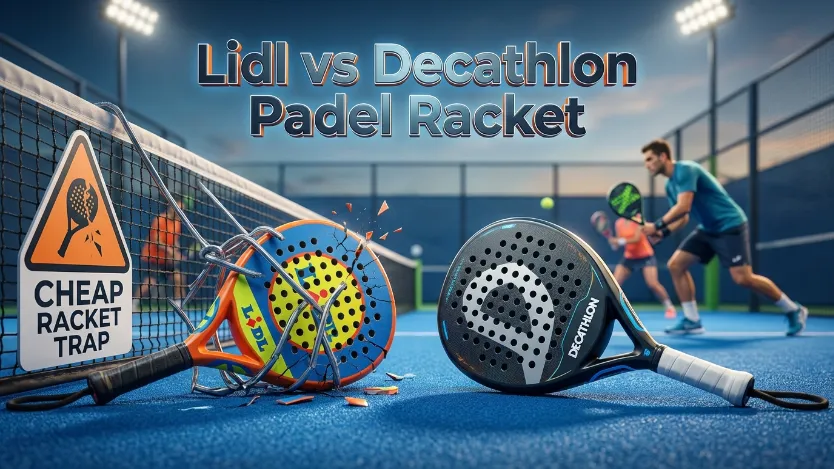
Step onto any of the nearly 900 padel courts recently converted across Great Britain, and you will immediately notice the shift from high-end carbon luxury to accessible, high-street gear. While the sport has exploded with a 121% increase in players since 2023, the Lidl vs Decathlon Padel Racket debate has become the definitive “Watercooler” topic for the estimated 8 million Brits now showing interest in the game.
For the newcomer, the choice seems simple: grab a £14.99 starter set from the “Middle of Lidl” or invest in Decathlon’s technical Kuikma range. However, for the dedicated UK player, there is more to this choice than just the initial price tag. To truly master your progression, you need to understand the material science, thermal limits in British winters, and hidden injury risks that most Lidl Crivit padel racket reviews simply overlook.
| Model | Estimated Price | Weight | Main Material | Recommended Level |
|---|---|---|---|---|
| Lidl Crivit Starter Set | £14.99 | ~350g | 100% Fibreglass | Total Beginner / Casual |
| Kuikma PR Open | £24.99 | 330-340g | Fibreglass | Beginner |
| Kuikma PR 530 | £65.00 | 340-360g | Carbon/Glass Hybrid | Intermediate |
| Kuikma PR 990 | £90 – £110 | 360-375g | 12K Carbon Fibre | Advanced |
The Retail Strategy Battle: Middle of Lidl vs Decathlon Ecosystem
The dominance of affordable padel rackets for beginners in the UK market isn’t merely a result of low prices; it’s about accessibility. In a sport where court fees at premium London clubs can be steep, players crave low-cost entry points. The Lidl vs Decathlon Padel Racket rivalry represents two very different philosophies. Lidl utilizes a “seasonal drop” model, offering the Crivit range for limited periods, which targets the “curious” player. In contrast, Decathlon has built an entire ecosystem around its Kuikma brand, offering year-round technical support and a progression ladder from beginner to pro.
Engineering the “Perfect” Entry: Materials and Specifications
The performance of any best budget padel racket UK is rooted in its structural integrity. Most entry-level models, including the Lidl Crivit and Kuikma PR Open, rely on Fibreglass. While this provides a “soft” feel and a generous sweet spot, it comes with limitations that players transitioning from tennis will notice immediately. To ensure they meet LTA Padel Guide standards for safety and playability, higher-end budget models must adhere to stricter engineering profiles:
- Weight: Beginners should look for rackets under 360g (like the Wilson Juice Lite or Kuikma PR Open) to prevent fatigue and improve manoeuvrability.
- Frame Construction: Cheap rackets often use a 100% fibreglass frame. In the Decathlon Kuikma PR 990 vs Lidl Crivit comparison, the PR 990 uses a Carbon Frame, providing significantly more stability during high-speed volleys.
- Core Foam: Most budget rackets use Soft EVA. While comfortable, this foam can “bottom out” during powerful smashes, resulting in a loss of control.
When choosing your first “proper” weapon, it is vital to check if you are buying for longevity. For a deeper look at the basic requirements, check our guide on the best padel racket for beginners.
Thermodynamics: The British “Cold Weather” Threshold
One of the “missing angles” in standard reviews is the racket’s sensitivity to the UK’s damp, cold climate. The molecular structure of EVA foam and Fibreglass changes drastically when temperatures drop below 10°C, leading to two distinct performance failures known to seasoned club regulars.
1. The “Glass” Effect (Below 50°F / 10°C)
As the mercury drops on outdoor courts in Glasgow or Manchester, Fibreglass becomes increasingly brittle. The 100% fibreglass frame of the Lidl Crivit is particularly susceptible to “spiderweb” cracking upon impact with the glass walls in winter. In contrast, carbon-hybrid models like the Kuikma PR 530 maintain their structural integrity far better in the frost.
2. The “Dead” Core Problem
In cold weather, the Soft EVA core in ultra-budget rackets compresses and loses its elastic memory. This effectively shrinks the sweet spot, making off-centre hits feel like you are striking the ball with a piece of wet cardboard. This is why players looking for a year-round best budget padel racket UK often find themselves upgrading to the Kuikma PR 990, which uses higher-density foam designed to withstand temperature fluctuations.
The “Invisible Failure”: Structural Decay and Health Risks
A critical gap in the market’s understanding of the Kuikma vs Crivit padel racket debate is the rate of internal decay. Analysis shows that low-grade fibreglass rackets can lose up to 15% of their vibration dampening efficiency after just 20 hours of aggressive play. Because the racket looks fine on the outside, many beginners keep using it long after the internal lattice has collapsed.
This leads to the “Invisible Failure” known as Padel Elbow (lateral epicondylitis). Without Anti-vibration Technology, the shock from the ball travels directly through the handle. If you are playing twice a week with a “dead” Lidl racket, you risk injury that could result in physiotherapy costs between £160 and £360—a high price for a £14.99 saving. If you are starting from scratch and want to understand the sport better, start with what is padel to learn about the physical demands.
Head-to-Head: Decathlon Kuikma PR 990 vs Lidl Crivit
While both brands dominate the budget sector, the Decathlon Kuikma PR 990 vs Lidl Crivit comparison is truly a battle between a “leisure toy” and a “sports instrument.” Here is how the technical specs stack up for the UK player:
- Kuikma PR 990 Hybrid: Features a 12K Carbon Fibre face and a double-density EVA core. It is endorsed by pro coaches as the best value for players moving into the Intermediate bracket.
- Lidl Crivit: Offers a 100% fibreglass construction. While excellent for a “one-off” session to see if you like the game, it lacks the structural strength for competitive club play.
- The “Sweet Spot” Strategy: If your budget is strictly under £50, the Kuikma PR Open (£24.99) is generally preferred over the Lidl model due to its lighter weight and more consistent quality control.
For players who want to ensure they aren’t being limited by their gear, reading up on Lidl padel racket specifications compared to specialist brands is essential.
Economic Analysis: Total Cost of Ownership (TCO)
Many UK players fall into the “Budget Trap”—buying a £20 racket, finding it lacks power after a month, and then buying a £70 replacement. This results in a total spend of £90. Had they invested in a mid-range Kuikma padel racket from the start, they would have saved money and improved faster. Furthermore, 100% fibreglass rackets have zero resale value. A second-hand Kuikma PR 990, however, can often be sold for 40-50% of its value on platforms like Vinted, making the “expensive” choice actually the more economical one over two years.
To see how Decathlon compares to other major retailers, check our deep dive on the Decathlon padel racket range. You should also ensure you are familiar with the padel rules to understand why certain racket shapes (like round vs diamond) matter for different game situations.
Lidl Vs Decathlon Padel Racket-Frequently Asked Questions (FAQ)
Is the £14.99 Lidl padel racket a “false economy” for UK players?
For a total beginner playing their first game, it is brilliant value. However, for anyone playing weekly, it is a false economy. Its 100% fibreglass frame lacks durability and vibration dampening, meaning you will likely need to upgrade within 8 weeks to avoid arm strain and progress your technique.
How does the Kuikma vs Crivit padel racket durability compare in winter?
Decathlon’s Kuikma range (especially the PR 530 and 990) uses carbon-reinforced frames which handle the British cold far better. The Lidl Crivit’s all-fibreglass construction becomes brittle in temperatures below 10°C, increasing the risk of structural failure upon impact with the court walls.
Why do coaches recommend the Decathlon Kuikma PR 990 over cheaper sets?
The PR 990 features 12K Carbon Fibre and a double-density foam that provides a consistent bounce. Coaches prefer it because it doesn’t “limit” the player; it allows for spin and power that a basic fibreglass Lidl racket simply cannot generate.
Can the Lidl racket cause Padel Elbow?
Any racket without proper anti-vibration technology can contribute to epicondylitis if used frequently. Because the Lidl Crivit is very basic, it transmits more shock to the arm than Decathlon’s higher-end Kuikma models which feature built-in vibration dampening systems.
Conclusion: The Verdict on the UK’s Best Budget Buy
The Lidl vs Decathlon Padel Racket battle has a clear winner depending on your commitment level. If you are simply looking for a “disposable” way to try the sport once during a summer BBQ, the Lidl Crivit set is an unbeatable entry point. However, for the committed beginner or developing intermediate, Decathlon’s Kuikma range is the superior choice. With better durability in UK weather, local warranty support, and a technical design that prevents injury, it is the smarter long-term investment.
Whether you are scouring the “Middle of Lidl” or heading to your local Decathlon, remember that your racket is the only piece of equipment that mediates your skill and the ball. Treat your progression with the technical respect it deserves, and your elbow—and your game—will thank you.