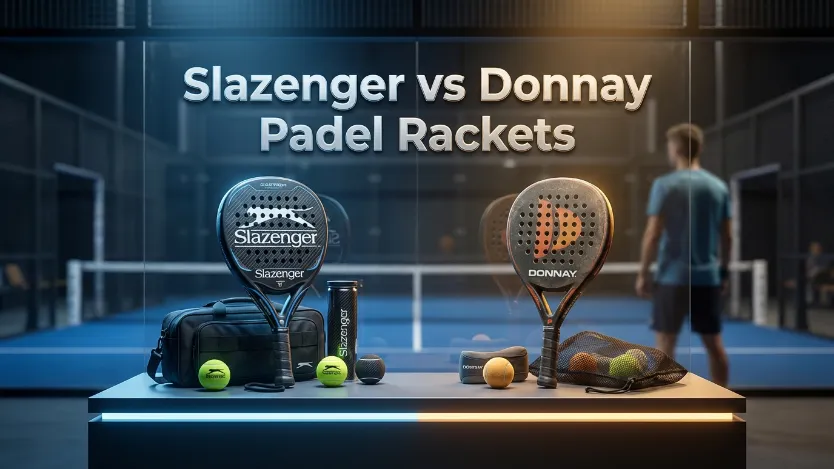
Walk onto any padel court from the newly opened hubs in London to the panoramic indoor courts of Slazenger Padel Club Leeds, and you will notice a distinct trend. While specialized Spanish brands once dominated the “pala” market, the UK scene is currently witnessing a massive resurgence of heritage brands. The battle of Slazenger vs Donnay Padel Rackets has become the focal point for club players looking for high-end carbon technology without the typical £300 price tag.
For the dedicated British player, choosing between these two isn’t just about the logo; it is about understanding how rotational molding, EVA foam densities, and carbon weave counts perform in the unique British climate. Most Slazenger Panther Series reviews focus on the aesthetics, but to truly master your game, you need to understand the material science and the “invisible failure” patterns that occur when equipment isn’t optimised for UK conditions. This guide provides the technical depth required to decide if a Donnay padel racket or a Slazenger frame is your perfect partner on the court.
Quick Comparison: Slazenger vs Donnay Models
Before diving into the technical specifications, here is how the most popular models in the UK stack up regarding price, weight, and materials.
Padel Rackets
Comparison Guide
£120
365–375g
12K Carbon
Intermediate / Pro
£95
365–375g
18K Carbon
Advanced
£105
370g
12K Carbon
Advanced / Expert
£45
345g
Fibreglass
Beginner / Junior
£75
345g
Graphite / Carbon
Beginner / Intermediate
The Heritage Battle: Frasers Group and the “Sports Direct” Effect
The dominance of Slazenger and Donnay in the United Kingdom isn’t merely a result of their long history in tennis; it is a result of strategic retail positioning by Frasers Group (owners of Sports Direct). By acquiring these brands, they have created a “permanent discount” cycle where high-specification rackets with 12K or 18K carbon faces are sold at a fraction of the cost of boutique brands.
For players searching for the best padel rackets under £100, this provides a unique opportunity. You can often find a Slazenger padel racket that originally carried an RRP of £235 for just £105. This economic model has made these names the Best British padel racket brands in terms of market volume, even if the “hardcore” specialist community occasionally debates their “pro” credentials.
Technical Face-Off: The Carbon Code and EVA Dynamics
Understanding the difference in materials is crucial for performance. When comparing Slazenger vs Donnay padel equipment, the primary technical differentiator is how they handle surface rigidity and core density.
1. Carbon Weave (3K vs 12K vs 18K)
- 3K Carbon: Found in models like the Donnay Eclipse 3K. It offers a balanced feel, providing more durability than fibreglass while maintaining enough flex to help with ball output.
- 12K Carbon: The standard for the Slazenger Panther Series and Challenge No.1. This tighter weave is significantly stiffer, providing explosive power but reducing the size of the “sweet spot.”
- 18K Carbon: Featured in the Donnay Cyborg Pro. This is ultra-premium tech that provides maximum stiffness. It requires precise technique because the racket face is very “unforgiving” on off-center hits.
2. The Core Dynamics: Hard vs Soft EVA
Slazenger typically utilizes Hard EVA in its performance ranges. This creates a “sharp” feel and excellent power transfer for advanced players who can generate their own swing speed. However, for those looking for Best beginner padel rackets UK, this hardness can lead to padel elbow if your timing isn’t perfect. Donnay, conversely, often opts for a Soft/Comfort core in its entry and mid-level models, which is much more “forgiving” and better at absorbing harmful vibrations.
Slazenger Panther Series Review: Icon Pro vs Epic
The Panther Series represents Slazenger’s premium push into the market. Our Slazenger Panther Series review highlights two distinct paths for players:
The Panther Series Epic
This is a round-shaped racket designed for ultimate control and maneuverability. Weighing approximately 368g with a head-light balance, it is ideal for intermediate players who prioritize placement and defense. The 12K Carbon fiber face features “Panther Grooves” which increase friction to generate extra spin on bandejas and volleys.
The Panther Series Icon Pro
Unlike the Epic, the Icon Pro adopts a teardrop/diamond hybrid shape. This shifts the balance toward the head, providing more leverage for smashes. It is a powerful “pala” that transitions well for former tennis players who are used to a heavier striking feel. However, UK forum users have noted a specific “missing angle”: the “Paint Peeling” issue. In some batches, the matte finish can chip or peel after only a few games. While this is purely aesthetic and doesn’t affect the structural integrity of the 12K carbon, it is something to consider if you value a pristine-looking kit.
For more details on their high-end range, read our full Slazenger Challenge No.1 review.
Donnay Range: Are Donnay Padel Rackets Good?
The most common question from UK club players is: Are Donnay padel rackets good? The short answer is yes, provided you match the model to your skill level. Donnay’s strategy is highly segmented, targeting specific demographics that Slazenger often overlooks.
- Donnay Cyborg Pro 18K: This is a technical beast. With 18K carbon and a mid-balance, it rivals rackets from Nox or Bullpadel costing twice as much. It is designed for the advanced attacker who wants a “solid” feel with zero “trampoline effect.”
- Donnay Tiffany & Luna: These are among the best lightweight options in the UK. The Donnay Luna, at just 345g with a fibreglass face, is optimised for juniors and female players who want to prevent shoulder fatigue.
- The Basic Donnay Padel Racket: Often found at Sports Direct for under £50, this 100% fibreglass model is a “trap” for committed players but an excellent “entry-level” tool for those who play only once a month.
You can browse the full collection in our dedicated guide to the Donnay padel racket line.
The Slazenger Challenge Series: No.1 to No.4
The Challenge series is Slazenger’s “engine room,” offering a clear progression path:
- Challenge No.1 Hybrid 12K: A top-tier weapon for competitive play. It uses a Hard EVA core and 12K carbon for maximum speed.
- Challenge No.2 & No.3: These transition into round shapes with slightly softer carbon variants (like 6K), making them easier to handle in defensive situations.
- Challenge No.4: The most flexible in the range. It uses 3K carbon and a lighter 350g build, making it a strong contender for the title of one of the Best beginner padel rackets UK.
The “British Climate” Factor: A Missing Angle
A technical detail often ignored by global reviews is how the UK’s weather affects these materials. Most Slazenger and Donnay rackets are tested in the 20-35°C Mediterranean heat. However, in the UK, we often play in temperatures below 10°C.
1. EVA Foam Compression
In cold weather, the EVA foam inside the racket compresses and hardens. A Slazenger Challenge No.1 with a Hard EVA core will feel like hitting with a “brick” during a February outdoor session in Manchester. This reduces the “pop” and increases the vibration sent to your arm. If you primarily play outdoors in the UK, choosing a Donnay with a “Soft” core or a Slazenger SLZ Light Silver may provide a more consistent performance year-round.
2. The “Car Boot” Warning
British players frequently leave their gear in the car overnight. The fluctuation between a freezing car boot and a warm indoor court causes molecular stress on the carbon-resin bond. Over 6-12 months, this can lead to hairline cracks in the resin, which most players mistake for “paint peeling.” To extend the lifespan of your Slazenger padel racket, always store it at room temperature.
Biomechanics and Injury Prevention: Avoiding Padel Elbow
The risk of lateral epicondylitis (padel elbow) is high in the UK due to the combination of cold weather and stiff carbon rackets.
- The Fibreglass Advantage: For those just starting, a 100% fibreglass racket like the Donnay Tiffany acts as a natural shock absorber. It is much safer for the joints than a “pro” 18K carbon frame.
- The Weight Trap: Many beginners buy a heavy 375g racket thinking it provides “power.” In reality, a heavy, head-heavy racket coupled with poor technique is the fastest way to a wrist injury. The SLZ Light Silver (345g) is a much smarter investment for longevity.
For more advice on choosing forgiving gear, check our best beginner padel rackets guide.
The Economic Verdict: RRP vs Reality
Are these “Sports Direct deals” too good to be true? Technically, the materials used in a £100 Slazenger 12K are comparable to those in a £250 Babolat or Head frame. However, the specialized Spanish brands often have tighter quality control and more sophisticated anti-vibration systems integrated into the handle.
If you are a recreational player looking for the cheap padel racket with the best possible specs, Slazenger and Donnay are unbeatable. If you are a high-level competitive player, you might find the finishing quality of boutique brands more to your taste, but in terms of “power per pound,” the heritage brands win every time.
Slazenger vs Donnay Padel Rackets-Frequently Asked Questions (FAQ)
Which is better for a total beginner, Slazenger or Donnay?
For a complete beginner, Donnay typically offers better value with their Luna and Tiffany models. These are lighter and use softer materials that are more forgiving on the arm. If you want to stick with Slazenger, the SLZ Light Silver or Challenge No.4 are the most appropriate choices.
What does 12K and 18K carbon actually mean?
The “K” stands for thousands of carbon filaments per thread. 12K means there are 12,000 filaments in the weave. A higher number generally results in a stiffer, more powerful, and more durable racket face. 18K carbon (found in Donnay Cyborg) is stiffer than 12K (found in Slazenger Panther).
Why does my Slazenger Panther have paint chips?
This is a known issue related to thermal curing. The rigid 12K carbon face doesn’t flex at the same rate as the paint layer when the ball impacts, leading to surface cracking. It is cosmetic and rarely indicates structural failure of the racket itself.
How long will these rackets last in the UK?
If played twice a week and stored properly (not in a car boot), a carbon Slazenger or Donnay racket should last 9-12 months. Fibreglass models have a shorter lifespan of 4-6 months as the material loses its “pop” faster.
Are these rackets suitable for pro-level play?
The top-tier models like the Slazenger Panther Epic and Donnay Cyborg Pro 18K are absolutely capable of high-level play. While they lack the brand prestige of some Spanish labels, their technical specifications (Carbon tech + EVA density) are tournament-standard.
Conclusion: The Verdict on Heritage vs Boutique
The battle of Slazenger vs Donnay Padel Rackets has redefined the UK market. By making 12K and 18K carbon accessible, these brands have lowered the barrier to entry for high-performance padel.
- Choose Slazenger if you want “British Heritage” aesthetics and a stiff, powerful feel. The Panther Series Epic is a standout for intermediate control.
- Choose Donnay if you want the best technical value or a lightweight frame for injury prevention. The Cyborg Pro 18K offers performance that defies its £95 price point.
Regardless of your choice, remember that the most expensive racket isn’t always the best for your game. Ensure you match the weight and core density to your physical capability and playing frequency. For more information on the growth of the sport in the UK, visit the LTA Padel official page.