The difference between a child falling in love with padel and giving up after three matches often comes down to just 40 grams of misallocated weight. Across synthetic courts from London to Edinburgh, thousands of young players are currently struggling against unyielding biomechanics—struggling with adult-spec frames that drag down their arm speed, compromise their technique, and risk long-term shoulder strain.
Finding the best junior padel rackets is no longer just about buying a scaled-down toy; it is an essential investment in tailored ergonomics, cold-weather core engineering, and long-term athletic confidence. As British participation hits unprecedented heights, equipping young talent with a frame engineered specifically for their grip size and impact velocity is the single most critical decision a parent or coach will make this season.
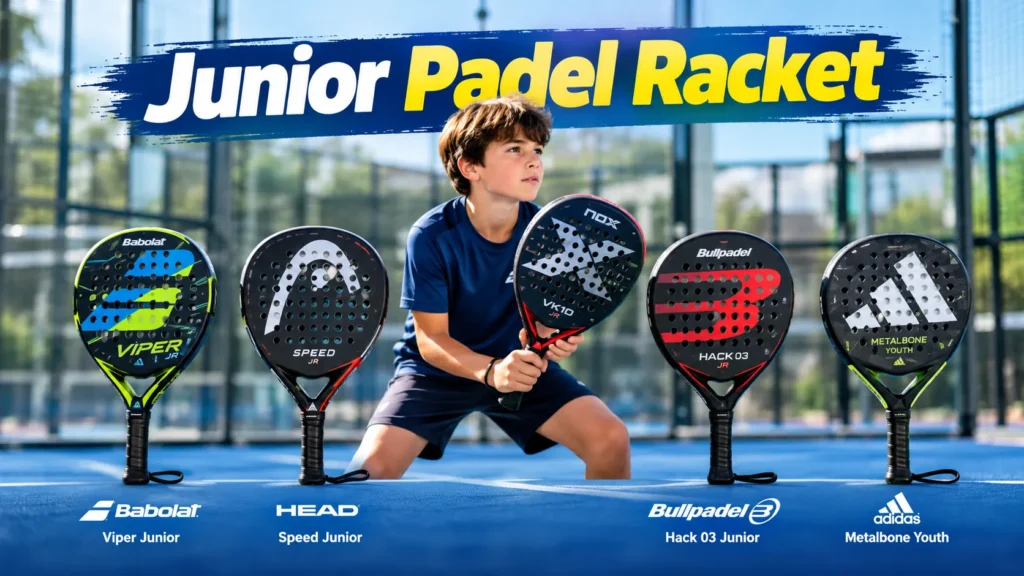
Junior Padel Rackets
United Kingdom · Model Comparison · Age, weight & balance
For UK parents seeking the optimal balance of technical progression, physical comfort, and reliable court performance, the Nox AT10 Genius Junior currently stands as the premier recommendation. Its forgiving round shape, highly responsive HR3 core, and accessible price point across British retailers make it an exceptional tool for nurturing correct swing mechanics without punishing off-centre strikes.
Junior Padel Rackets: The Best Junior Padel Racket Anatomical Breakdown and Core Performance
Understanding the engineering behind junior padel rackets is essential for unlocking a young player’s potential. An anatomical breakdown reveals that these frames are not merely shrunken adult models; they are meticulously recalibrated precision tools. The core performance of the best junior padel racket relies on a delicate interplay between handle circumference, striking surface elasticity, and overall swing weight.
- Shorter Grip Architecture: Junior models utilise L1 or L2 grip sizes (approximately 80 to 100 millimetres in circumference). This prevents over-squeezing, allowing the child’s forearm muscles to remain relaxed during rapid net volleys.
- Reduced Swing Weight: By keeping the mass between 240g and 325g, the racket’s moment of inertia drops significantly. This allows young players to prepare their defensive positions faster without exhausting their shoulder mechanics.
- Dynamic Core Compression: High-density professional foams demand massive impact velocity to activate. A dedicated padel racket junior employs low-density EVA or Polyethylene foam, generating an effortless ‘trampoline effect’ that projects the ball deep into the opponent’s court even with a slow, developing swing.
Before purchasing, it is highly recommended to study the fundamental principles of equipment geometry in our comprehensive guide on how to choose a padel racket, ensuring that the selected frame aligns perfectly with the child’s physical maturity.
The Rapid Rise of Junior Padel in the UK
The United Kingdom has witnessed a spectacular transformation in its sporting landscape. According to the Lawn Tennis Association (LTA) figures released in May 2026, participation has skyrocketed to one million active players. This phenomenal growth is supported by a robust infrastructure of over 1,825 courts spread across 551 venues. With the government committing £3 million to covered multisport hubs, the junior demographic is expanding faster than ever.
This explosion in club participation brings a critical equipment challenge to light. Children borrowing 365-gram adult frames often develop compromised biomechanics. They begin dragging the racket head, hitting late, and compensating by contorting their posture. Transitioning to an age-appropriate frame eliminates these artificial barriers, fostering a natural, fluid swing path.
Material Science and the Great British Weather
Selecting a junior padel racket uk players can rely on year-round requires a firm understanding of material science, specifically how the damp, cold British climate affects composite materials. When temperatures drop below 12°C on exposed outdoor courts, the chemical behaviour of standard EVA rubber changes drastically. The core stiffens, losing its kinetic elasticity. A racket that feels plush and bouncy in July will suddenly feel rigid and unresponsive in November.
To combat this, manufacturers utilise hybrid constructions. An outer face constructed from woven fibreglass (Polyglass) remains much more flexible in cold weather than high-modulus carbon fibre. While exploring a pure carbon fibre padel racket might tempt competitive teenagers, a fibreglass striking surface paired with a soft Polyethylene foam core ensures consistent ball output and impact comfort, regardless of the seasonal frost.
Head-to-Head: Bullpadel Vertex Junior 26 vs. Babolat Viper Junior
When juniors reach the competitive club level, parents frequently face a purchasing dilemma between two titans of the industry. The following head-to-head comparison dissects their contrasting philosophies:
- Structural Rigidity: Bullpadel utilises its 100% CarbonTube frame technology, offering immense structural stability upon impact. Babolat opts for a slightly more forgiving composite blend, which provides a softer touch for prolonged baseline rallies.
Ultimately, the choice depends on the child’s established technique. If they possess the strength to wield a heavier frame, the Vertex is a formidable weapon. For most developing players, however, the Babolat’s manoeuvrability provides a smoother developmental pathway.
Comprehensive Age, Height, and Shape Guide
Matching the racket shape to the child’s developmental stage is paramount for maintaining enthusiasm. The LTA Youth programme categorises progression through coloured ball stages, which directly influences racket selection. Understanding are padel balls the same as tennis balls is crucial here, as low-compression padel balls bounce significantly lower, requiring specific racket mechanics to lift the ball over the net.
Under 8s: Favouring Forgiveness with Round Shapes
Children under 8 years old, playing with Red and Orange stage low-compression balls, require ultra-lightweight models (240g–280g) with a strictly round shape. The low balance point sits near the handle, making the racket feel like a natural extension of the arm. The central, expansive sweet spot guarantees that even clumsy, off-centre swings generate a satisfying connection, building vital early confidence.
Ages 8 to 12: Transitioning to Teardrop Models
As coordination improves and children transition to Green stage balls, a teardrop shape becomes highly beneficial. Teardrop frames elevate the balance point slightly, offering a hybrid blend of baseline control and increased leverage for overhead shots. This is the optimal stage to introduce a specialised kids padel racket featuring a 38mm adult-standard profile, preparing them for full-court competitive play.
The Anatomy of a Racket: Drilling Patterns and Sweet Spots
One of the most overlooked technical aspects of a padel racket is the drilling pattern. Holes are not merely aesthetic; they are engineered to manipulate aerodynamic drag and surface tension. According to official regulations, the central hitting area must contain cylindrical holes measuring between 9 and 13 millimetres.
For junior players, a racket with a dense, evenly distributed hole pattern across the entire face softens the striking surface. This layout allows the fibreglass to flex slightly upon impact, pocketing the ball and expanding the sweet spot towards the outer edges. Conversely, models with fewer holes clustered strictly in the centre create a stiffer, punchier feel suited for high-velocity offensive strikes, though they offer far less forgiveness.
Essential LTA and FIP Regulations for 2026
If your child is stepping into the competitive arena, their equipment must comply with the stringent 2026 updates enforced by the LTA Padel framework and the International Padel Federation (FIP). Familiarising yourself with the official padel rules ensures you avoid technical disqualifications.
- Maximum Dimensions: A junior racket must not exceed a total length of 45.5 centimetres. The handle length is strictly capped at 20 centimetres, with a maximum throat width of 50 millimetres. Any frame exceeding these metrics is prohibited in sanctioned events.
- The Mandatory Wrist Strap Rule: The most heavily enforced regulation of 2026 dictates that every racket must be equipped with a non-elastic safety cord no longer than 35 centimetres. If the cord breaks during a rally, or if the racket slips from the child’s grasp, the point is immediately forfeited to the opponent. Routine inspection of this safety tether is now a mandatory pre-match ritual.
For parents planning to enter their children into national circuits, reviewing the calendar for upcoming padel tournaments uk will provide valuable insight into the competitive standards required at various age groups.
Smart Purchasing and Consumer Rights in the UK Market
Navigating the UK retail landscape requires an understanding of stringent return policies. Premium British retailers generally offer a generous 30-day return window, but the conditions are absolute. To receive a full refund, the racket must be in pristine, unplayed condition.
The most crucial stipulation—often catching parents off guard—is the clear plastic wrap enveloping the grip handle. The moment this plastic is removed, the racket is legally classified as “used,” instantly voiding the right to a full refund due to a change of mind. Furthermore, even a single session on synthetic turf will leave microscopic scuffs on the bumper guard, rendering the racket ineligible for return. Always have your child test the racket’s weight and grip circumference indoors, with the plastic fully intact, before stepping onto the court.
Frequently Asked Questions (FAQ)
At what age should my child transition from a junior racket to an adult racket?
The transition is dictated by height and physical maturity rather than a strict age bracket. Generally, once a child surpasses 155 centimetres in height (typically around 12 to 13 years old) and possesses the upper-body strength to comfortably manoeuvre a 345-gram frame, they can safely graduate to a lightweight adult teardrop or round model.
Are thicker rackets better for junior players?
No. The official maximum thickness is 38mm, which is standard for both juniors and adults. Thicker frames do not inherently provide more power or ease of use for children. The focus should entirely remain on keeping the overall weight low and the balance point near the handle to ensure fluid, comfortable strokes.
Why does my child’s racket feel “dead” during winter matches?
Most rackets utilise EVA rubber cores. In the cold UK winter climate, the kinetic properties of EVA change, causing the rubber to harden and contract. This reduces the trampoline effect, making the racket feel stiff and unresponsive. For consistent outdoor winter play, consider a racket featuring a softer Polyethylene (FOAM) core, which remains structurally resilient in low temperatures.
Can I apply an overgrip to a junior padel racket?
Absolutely. If the standard L1 or L2 grip feels marginally too thin, applying a standard moisture-wicking overgrip is the perfect solution. It adds approximately 1.5 to 2 millimetres of circumference, providing a tailored, comfortable fit without unnecessarily adding heavy mass to the handle base.