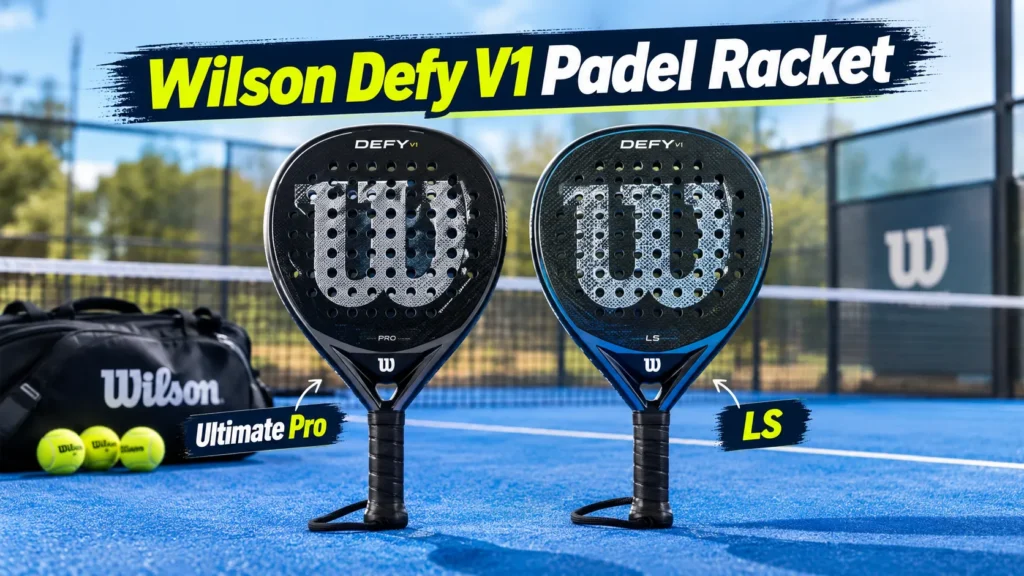
Padel courts across Britain are witnessing a quiet revolution, and it isn’t just about tactical mastery anymore; it is about the precise instrumentation in your hand. When cutting-edge engineering meets explosive power on the twenty-metre glass-backed court, ordinary rallies transform into definitive winners. Enter the wilson defy v1 padel racket—a release that is reshaping how aggressive British club players and tournament contenders dictate pace.
Whether you are dissecting the latest wilson defy v1 padel racket review analyses or weighing the nuanced differences between the wilson defy ls v1 padel racket and the wilson defy pro v1 padel racket, understanding the technical DNA of these frames is the ultimate competitive edge you need before your next match. Scroll down to decode the definitive specifications and performance profiles.
Wilson Defy Padel Rackets
Model comparison · Specifications per player profile
For UK padel players seeking to select the definitive frame from this collection, the optimal choice depends strictly on your swing speed, mechanical proficiency, and position on court. If you are an aggressive left-side player competing in LTA open tournaments who demands maximum kinetic output on flat smashes, the flagship wilson defy pro v1 padel racket is the supreme selection. However, club players operating in standard regional leagues who require defensive maneuverability paired with reliable power will find the standard wilson defy v1 padel racket offers superior overall balance, while agile players or those preferring reduced static mass should opt for the light-spec wilson defy ls v1 padel racket.
Comprehensive Wilson Defy V1 Padel Racket Review: Technical Anatomy
The engineering core of the wilson defy v1 padel racket review centers upon its unified 490 cm² high-leverage diamond shape combined with targeted weight distribution. Unlike traditional teardrop or round control frames, the Defy platform is designed from the ground up to maximize angular velocity at the head tip during overhead swings.
- Duo Grid Hole Pattern Matrix: The face layout integrates variable-diameter drill holes across the striking plane. The upper quadrant features larger diameter apertures that enhance frame flex under maximum impact force, multiplying kinetic energy return on overhead smashes. Conversely, the lower zone incorporates smaller diameter holes that maintain surface rigidity, granting precise ball bite and direction control during defensive block volleys.
- Aeroexact Profile & I-Beam Carbon Bridge: The outer rim features a streamlined geometric contour engineered to reduce aerodynamic drag during high-speed swing paths. Reinforced by a central longitudinal I-Beam carbon bridge through the throat, the frame exhibits exceptional torsional rigidity, preventing torque twisting on off-centre ball strikes.
- Spin^2 Texture & Sharp Hole Perimeter: To generate violent rotational spin on heavy kick smashes (por tres) and sliced bandejas, the structural surface employs high-friction 3D texturing paired with sharp-edged hole perimeters that grip the felt of official Wilson padel balls on contact.
The composite face construction varies intentionally across the range to cater to distinct dynamic striking forces. By offering options in high-modulus 15K carbon, standard 3K carbon, and flexible ComfortFlex composite weaves, Wilson allows players to customize impact stiffness according to their physical mechanics. For players exploring options across diamond padel rackets, evaluating the dedicated structural mechanics outlined in our analytical look at how to choose a padel racket provides clear contextual background before buying.
Head-to-Head: Wilson Defy Pro V1 vs. Defy V1 vs. Defy LS V1
Deciding between the three flagship variants requires dissecting how subtle changes in static mass, core foam density, and surface weave stiffness translate to on-court execution. While all three models share a 490 cm² diamond head geometry and a 265mm high balance point, their dynamic responsiveness on court diverges significantly.
The primary performance differentiators across the range are detailed below:
- Static Mass and Swing Weight Discrepancies: The 370g mass of the Pro V1 provides enormous inertial mass, requiring established forearm strength to accelerate rapidly during net defense. The standard 365g Defy V1 hits the sweet spot for most competitive club players, offering manageable weight with high kinetic potential. The 355g Defy LS V1 drastically reduces swing mass, allowing lightning-fast wrist adjustments during rapid net volleys.
- Surface Carbon Hardness and Energy Return: The 15K carbon weave on the Pro V1 is remarkably rigid, producing an unyielding impact feel that rewards clean, high-velocity mechanics with devastating smash power. The 3K carbon on the standard model offers moderate face deformation, enlarging the sweet spot slightly. The ComfortFlex face on the LS version absorbs ball kinetic energy smoothly, yielding high defensive comfort and easy wall exits.
- Core Foam Damping and Vibration Transmittance: The high-density Power Foam in the Pro V1 creates a firm touch that demands precise technique. In contrast, the soft EVA formulation in the LS V1 dissipates harsh strike vibrations efficiently, making it an exceptional choice for players seeking an effortless swing feel without physical fatigue.
If you are an advanced player seeking to combine heavy overhead performance with elite control tools, reviewing our detailed rankings of the best padel rackets for advanced players will ensure your entire equipment setup functions in perfect technical alignment.
Wilson Defy Pro V1 Padel Racket: Anatomical Breakdown and Core Performance
The flagship wilson defy pro v1 padel racket represents the absolute peak of Wilson’s aggressive engineering. Engineered specifically for elite tournament play and aggressive left-side (revés) attackers, this model combines a 370g static frame mass with an ultra-stiff 15K carbon face and a high-density Power Foam core.
The frame utilizes an advanced C2 Carbon Tubular construction, which ensures uniform wall thickness across the perimeter for enhanced structural durability and zero frame flex under extreme loads. On overhead strikes, energy transfer is immediate; the ball compresses minimally against the stiff 15K face before accelerating explosively across the glass. Professional tour players like Javi Leal and Javi Garrido rely on this exact framework for its aerodynamic drag reduction and relentless overhead power transmission.
- Pros: Unmatched smash power and overhead velocity; C2 tubular construction provides exceptional frame stability; Spin^2 texture generates heavy rotational spin on kick smashes; elite structural durability under high-impact conditions.
- Cons: Demanding 370g static mass requires strong forearm conditioning; small, high sweet spot punishes off-centre defensive strikes; rigid touch can feel unforgiving during delicate drop shots (chiquitas).
Wilson Defy V1 Padel Racket: Anatomical Breakdown and Core Performance
Serving as the versatile core benchmark of the lineup, the standard wilson defy v1 padel racket delivers a highly effective synthesis of power, aerodynamics, and control. In our thorough wilson defy v1 padel racket review testing, this 365g frame proved to be the most adaptable option for intermediate and advanced UK club competitors.
The combination of a 3K woven carbon face and high-rebound Power Foam provides a slightly softer impact feel than the Pro V1 while retaining explosive overhead capability. The Aeroexact frame geometry cuts through the air cleanly, allowing players to generate rapid head speed during offensive transition play. It provides an ideal landing zone for players moving up from control frames who want extra overhead power without compromising net reaction speed.
- Pros: Outstanding equilibrium between raw smash power and net maneuverability; more forgiving 3K sweet spot than the Pro model; excellent energy transmission on bandejas; premium black/gold aesthetic finish.
- Cons: High 265mm balance point still requires good preparation time on low defensive glass exits; default grip may require an additional overgrip for players with larger hands.
Wilson Defy LS V1 Padel Racket: Anatomical Breakdown and Core Performance
The wilson defy ls v1 padel racket is specifically engineered for players who demand the overhead leverage of a diamond shape without managing excessive physical weight. Weighing in at a lightweight 355g, this specification pairs a soft EVA / Power Foam core with a flexible ComfortFlex carbon-composite face.
Our comprehensive wilson defy ls v1 padel racket review reveals that this combination delivers outstanding ball-pocketing duration and effortless rebound velocity. During defensive rallies, players can maneuver the racket quickly to block fast net volleys or retrieve difficult wall rebounds with minimal physical effort. It serves as an exceptional bridge for players developing their technical mechanics before stepping up to heavier carbon models.
- Pros: Exceptionally lightweight (355g) and agile through the air; soft core provides excellent vibration damping and comfortable impact feel; enlarged sweet spot reduces errors on off-centre hits; highly accessible retail price.
- Cons: Reduced overall mass yields lower maximum power output on flat overhead smashes compared to the Pro V1; soft face can feel bouncy under extreme opponent drive speeds.
Information Gaps Resolved: Dynamic Hardness vs. Laboratory Tests & UK Climate Adaptation
A major source of confusion among British padel players stems from published independent laboratory ratings—such as Testea Padel assigning the Defy series a 3/5 hardness rating—which contradicts live player feedback describing a rigid, explosive impact feel. This gap exists because static bench tests measure frame flex under slow mechanical pressure, whereas dynamic live match play engages the stiff 15K carbon face and high-density Power Foam simultaneously during high-velocity impacts. In real court conditions, the Defy operates as a genuine hard-touch power racket.
Furthermore, British climate conditions present unique environmental challenges. Outdoor padel courts across the UK frequently feature cold, damp synthetic turf during winter months. Low ambient temperatures harden standard EVA cores, making rackets feel stiffer, while wet felt balls add extra weight. The high-rebound Power Foam and aerodynamic I-Beam throat in the Defy range help compensate for damp, heavy balls, allowing UK players to maintain smash depth even in cold weather conditions.
UK LTA Rating Selection Matrix & Customisation Protocols
To assist UK competitors in selecting the precise model for their official rating tier, match your current playing level against the LTA padel rankings framework below:
- LTA Level 2.5 – 4.0 (Intermediate League): Select the wilson defy ls v1 padel racket to benefit from effortless swing acceleration, quick defensive reactions, and forgiving impact mechanics.
- LTA Level 4.0 – 5.5 (Advanced Club Player): Opt for the standard wilson defy v1 padel racket to balance aggressive overhead smash power with reliable court positioning during competitive league matches.
- LTA Level 5.5+ / Tour Competitor: Choose the wilson defy pro v1 padel racket for maximum kinetic energy conversion, rigid frame stability, and elite tournament performance.
For fine-tuning frame ergonomics, adding two standard overgrips increases handle mass by approximately 8g–10g, shifting the balance point 3mm–5mm downward toward the handle. This enhances handle agility without compromising the overhead leverage of the diamond head. Additionally, applying a protective padel racket protector along the top frame edge shields the carbon frame from glass wall contact during intense defensive retrievals. For complete technical verification and direct range details, consult the Official Wilson UK Padel portal.
Frequently Asked Questions (FAQ)
Are all Wilson Defy V1 models featuring the exact same head size and shape?
Yes. Official manufacturer specifications confirm that every variant across the Defy V1 range—including the Pro, standard, and LS models—shares a unified 490 cm² (76 sq in) diamond head surface area, maintaining a consistent high-leverage geometric profile regardless of weight differences.
How does atmospheric weather in the UK affect the Power Foam core?
Cold winter temperatures cause synthetic foam cells to contract slightly, resulting in a firmer impact feel on court. Conversely, warm summer play restores maximum core elasticity, generating higher ball rebound velocity during overhead rallies.
Can I adjust the high balance point of the Defy Pro V1 for easier defensive play?
Yes. You can shift the effective balance point handle-ward by installing two thick overgrips or adding handle counterweights. This lowers the balance point by 3mm to 5mm, improving defensive wrist speed without removing top-end smash leverage.