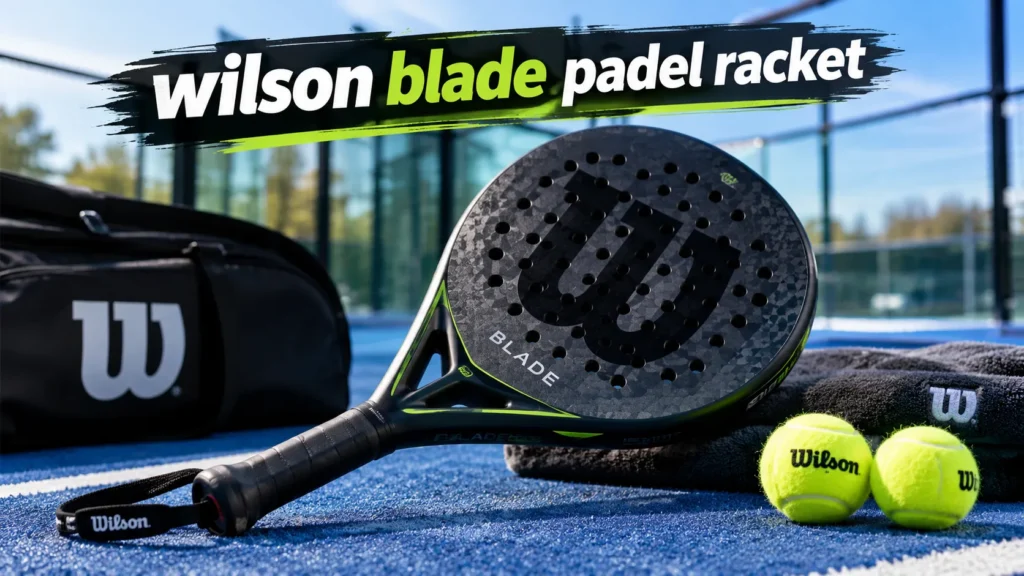
Every winter evening across damp club courts from London to Edinburgh, thousands of British padel players unknowingly sabotage their matches by fighting their own equipment. When the temperature drops and the glass hardens, the compromise between raw power and surgical precision is brutally exposed. That perpetual equipment tug-of-war—choosing between explosive put-aways and delicate defensive control—is precisely why the wilson blade padel racket has quietly dismantled the traditional hierarchy of British club play.
Far from just another aesthetic refresh, this engineering lineage redefines how kinetic energy translates from your forearm through the core and directly onto the glass. Whether you are navigating the chilling damp of an outdoor Manchester court or tightening your grip for a decisive bandeja, understanding the hidden mechanics of this franchise changes everything about how you command the court.
Why This Breakdown Matters For UK Players
Environmental Resilience: Unlocking how distinct core foam densities react to Britain’s sub-10°C winter climate.
Biomechanic Matching: Eliminating the “sweet spot paradox” that prematurely traps intermediate players on professional-grade gear.
Precision Tailoring: A rigorous dissecting of weight tolerances, swing weights, and real-world court performance.
Best Wilson Blade Padel Rackets
Model comparison (2026) · By player level
Wilson blade padel racket review:
To truly understand how this franchise operates, we must dissect the anatomical breakdown and core performance of each distinct model. The teardrop architecture remains consistent across the board, but the internal material science dictates entirely different playing experiences on the court.
Wilson Blade Power Padel Racket: Accessible Offense
The wilson blade power padel racket is engineered specifically for players who are transitioning into regular club play and need a racket that assists in generating depth. Utilising a Soft Core Foam and a highly flexible fibreglass surface, it provides an expansive sweet spot.
- Pros: Exceptional vibration absorption, making it incredibly comfortable during extended matches; very forgiving on off-centre defensive shots; excellent price-to-performance ratio.
- Cons: Lacks the structural rigidity required for high-velocity, flat smashes; advanced players will find it too “bouncy” during fast net exchanges.
Wilson Blade Elite V2 Padel Racket: The Intermediate Benchmark
Positioned as the most versatile option for regular club players, the wilson blade elite v2 padel racket swaps rigid carbon for a Fibreglass Weave. This setup completely alters the racket’s playability, absorbing the ball upon impact and offering a plush, comfortable feel that mitigates high-frequency vibrations.
- Pros: Outstanding manoeuvrability for fast net blocks; the medium balance ensures it does not drag during rapid preparation; highly forgiving in cold UK climates.
- Cons: Some users report a harmless but distracting acoustic rattle from the plastic throat bridge after heavy use; it requires significant physical exertion to hit the ball out of the court on a smash.
Wilson Blade V2 Padel Racket: The Precision Instrument
The standard wilson blade v2 padel racket (and its subsequent V3/V4 evolutions) is built for the high-intermediate to advanced competitor. Featuring a carbon composite face and Firm EVA foam, it deliberately limits the compression phase upon ball impact, providing a dry, crisp response.
- Pros: Surgical precision on volleys and bandejas; exceptional torsional stability against heavy incoming pace; C2 Tubular Construction prevents the racket from twisting in the hand.
- Cons: The firm core offers zero “trampoline effect,” meaning if you are late to the ball or off-balance, the ball will not exit the racket effectively; it demands flawless footwork.
Wilson Blade Junior V2 Padel Racket: Scaled Biomechanics
Youth development requires equipment proportional to physical capabilities. The wilson blade junior v2 padel racket is scaled down in both length and profile, weighing only 300g with a 439 square-centimetre head size. Constructed entirely of fibreglass, it ensures the racket is incredibly forgiving.
- Pros: Prevents the development of poor biomechanical habits; ultra-lightweight design ensures safe swing execution for children under 12; highly durable against inevitable court scrapes.
- Cons: Quickly outgrown once a junior player develops significant strength and requires more mass to block heavier adult shots.
Missing Angles: Thermodynamics, Tolerances, and the Sweet Spot Paradox
While standard reviews focus on generic metrics, serious UK players must account for environmental and physical variables that drastically alter equipment behaviour. Before you evaluate how to choose a padel racket, consider these critical, often overlooked factors.
The Thermodynamics of UK Padel
One of the most ignored variables in padel is thermodynamics. In the United Kingdom, where players frequently compete in cold, damp conditions (routinely ranging from 0°C to 10°C during the winter), the molecular structure of EVA foam contracts and hardens. If you play with a Firm EVA racket (like the Pro V2) in January, it transforms into a rigid board, shrinking the sweet spot drastically. For winter play, selecting models with Soft EVA (like the Elite V2) provides a distinct biomechanical advantage, as the soft foam hardens just enough to feel like medium-density, maintaining optimal playability.
Weight Tolerances and Swing Weight Customisation
When purchasing a racket, consumers fixate on the printed weight (e.g., 365g). However, standard manufacturing realities dictate a tolerance of ±10g. Furthermore, post-purchase customisation fundamentally alters the racket’s identity. Adding a standard overgrip adds approximately 5 to 7 grams to the handle, lowering the balance. Conversely, applying a heavy-duty polyurethane frame protector to the head adds 8 to 10 grams, drastically raising the balance point and the swing weight. A seemingly light racket can quickly become an exhausting, head-heavy weapon.
The Sweet Spot Paradox
A recurring theme within the intermediate community is the rush to purchase professional-tier rackets. This leads to the “sweet spot paradox.” Advanced models utilise dense 24K carbon, which provides devastating power only if struck in the exact geometric centre. The “bad spot” provides near-zero ball exit. When an intermediate player mistimes a defensive lob, the racket absorbs the energy, resulting in a dead ball into the net. Upgrading too early actively hinders performance.
Head-to-Head: Wilson Blade Elite V2 vs. Wilson Blade Pro V2
For players trying to choose between the accessible Elite V2 and the uncompromising Pro V2, the decision hinges entirely on technical consistency. Both models are officially available through Wilson UK, but they serve drastically different purposes.
- Output on Mishits: The Elite V2’s fibreglass face actively assists in pushing the ball over the net even when you hit near the frame. The Pro V2 offers no such help, demanding perfect centre-face contact.
- Defensive Lobs: Generating depth from the back glass is effortless with the Elite V2 due to its soft core. The Pro V2 requires a full, accelerated swing to achieve the same depth.
- Finishing Power: This is where the Pro V2 dominates. Its rigid carbon face snaps the ball back instantaneously, rewarding high arm speed with devastating flat smashes that the Elite V2 simply cannot replicate.
Frequently Asked Questions (FAQ)
Are Wilson Blade padel rackets suitable for players transitioning from tennis?
Yes. The teardrop shape of the Blade series provides an excellent transitional geometry. It offers a higher sweet spot for overheads (familiar to tennis players) while remaining more manoeuvrable and forgiving than aggressive diamond-shaped rackets.
How often should I change my overgrip to maintain optimal performance?
For club players hitting twice a week, overgrips should be replaced every 4 to 6 weeks. Overgrips not only provide tackiness but also absorb minor impact vibrations. Once the grip becomes slick, players subconsciously squeeze the handle tighter, leading to severe forearm fatigue and compromised mechanics.
Do I need to install a frame protector on my Wilson Blade racket?
Yes, it is highly recommended. The confined nature of a padel court means incidental contact with the glass or metallic mesh is inevitable. While a protector adds roughly 8-10g to the head of the racket (slightly increasing swing weight), it is essential for preventing cosmetic paint chips and structural micro-fractures.