The hollow thud of a tennis-style drive crashing uselessly against a glass wall is the universal soundtrack of a newcomer learning padel the hard way on British courts. This sport is a high-speed game of chess played within a glass box, where raw muscle is routinely dismantled by precision and geometry. If your local club matches currently end in frustration rather than control, the missing piece isn’t your fitness—it’s your mastery over the tactical anatomy of padel shots. Decoding the subtle physics of the glass, the weight of a slice, and the secrets of Spanish terminology is the definitive line between chasing ghosts and dictating the tempo.
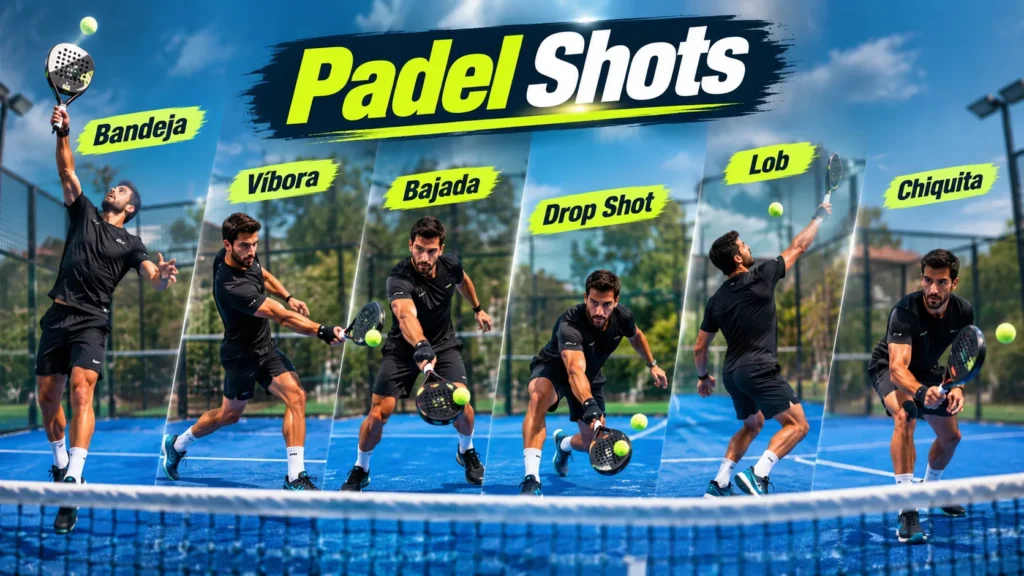
Padel Shots
UK terms · Spanish terms · Objective & tactical application
Comprehensive Guide to padel shots names, padel shots names in spanish
Understanding the dual nomenclature of this sport is essential for seamless communication with coaches and partners. When we examine padel shots names, padel shots names in spanish, we uncover a rich tactical vocabulary that defines the exact spin, pace, and geometric angle required for each stroke. Below is an exhaustive, unbiased breakdown of the core shots, highlighting their strategic advantages and inherent vulnerabilities.
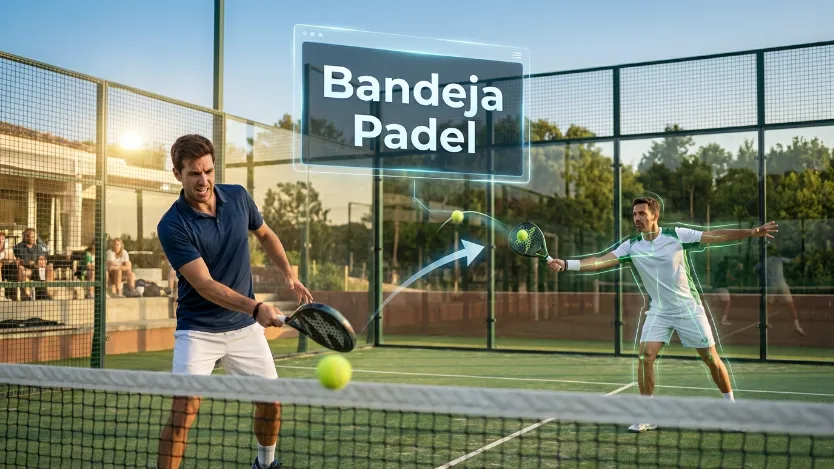
The Bandeja (The Tray)
The Bandeja is arguably the most iconic transitional shot in the sport. Executed with an open racket face resembling a waiter carrying a tray, it is played when a moderately deep lob forces you backward, but not deep enough to concede the net entirely.
- Pros (Advantages): Grants the player enough time to recover their net position; the heavy backspin forces the ball to skid low off the back glass, preventing opponents from executing aggressive counter-attacks.
- Cons (Disadvantages): It lacks outright finishing power. If executed with insufficient depth or too much height, it becomes an easy target for opponents waiting at the baseline to launch a fast drive.
The Víbora (The Viper)
The Víbora is an advanced, aggressive overhead sliced with severe sidespin. Instead of merely maintaining position, the Víbora is designed to inflict maximum pressure by biting into the turf and sliding sharply upon hitting the side or back walls.
- Pros (Advantages): The intense sidespin makes the rebound trajectory highly unpredictable for defenders; it frequently results in forced errors or extremely weak returns that can be smashed for a winner.
- Cons (Disadvantages): Requires exceptional technical mastery and precise timing. The margin for error is razor-thin, and mistiming the sidespin often results in the ball crashing directly into the net or floating out of bounds.
The Bajada (Wall Descent)
When an opponent hits a fast lob that bounces high off your back glass, the Bajada allows you to attack the ball on its descent, whipping it past the net players.
- Pros (Advantages): Turns a deeply defensive position into an immediate offensive threat; utilizes the opponent’s pace against them; highly satisfying and difficult for net players to track if disguised well.
- Cons (Disadvantages): Demands excellent footwork and spatial awareness. Striking the ball too late causes it to hit the net, while striking too early sends the ball straight into the opponents’ upper body or out of the court.
The Chiquita (The Little One)
A delicate, dipping shot played from the back of the court, designed to land softly just over the net and right at the toes of the advancing opponents.
- Pros (Advantages): Forces the net players to hit an uncomfortable, upward volley from below their knees, generating a slow pop-up that you can easily aggressively volley away.
- Cons (Disadvantages): It is a high-risk, low-pace shot. If it clears the net too high, an alert opponent will effortlessly swat it away for an immediate winner.
The Globo (The Lob)
Often misunderstood by tennis converts as a desperate defensive measure, the padel lob is the absolute cornerstone of high-level tactical play, used to deliberately displace the opposing team.
- Pros (Advantages): The safest and most effective way to steal the net; resets the tempo of a frantic rally; neutralises aggressive smashers by forcing them into deep corners.
- Cons (Disadvantages): A short or overly flat lob is heavily punished. In outdoor UK courts, adverse weather conditions (wind or sun glare) can completely ruin the precision of the lob.
The Evolution of Padel in the UK: A Shift Towards Tactical Play
The landscape of British padel has undergone a radical transformation. Moving away from a casual novelty, the sport has solidified its infrastructure. With the Lawn Tennis Association (LTA) recording nearly 900 courts across the nation by 2026, the local club scene is fiercely competitive. This expansion means players are no longer just figuring out how to hold the racket; they are actively studying the geometry of the court and the governing parameters set out by the International Padel Federation (FIP) to gain an edge.
This maturity in the UK market has created a noticeable shift in playing styles. Brute force is rapidly being replaced by nuanced, tactical manipulation. To truly excel, players must understand that the walls are not boundaries, but active participants in every rally. If you wish to build your foundations correctly from day one, familiarising yourself with the official padel rules is the first non-negotiable step toward understanding why specific ball trajectories are prioritised over raw speed.
Essential Padel Shots: Mastering the Fundamentals over Power
For those transitioning from traditional racquet sports, the impulse to crush every ball is overwhelming. However, high-level padel is built on a foundation of consistency, precision, and low-margin errors. The two most critical fundamental shots you must master are the flat volley and the tactical lob.
The flat volley in padel differs significantly from its tennis counterpart. Rather than punching the ball with heavy topspin or dramatic wrist flicks, the padel volley requires a locked wrist and a compact, shortened swing. The objective is to guide the ball with minimal pace into the deep corners, forcing it to die against the cold glass. Power is secondary; placement is paramount.
Equally critical is the lob. When evaluating the broader dictionary of padel shot names, the Globo often goes underappreciated by amateurs. A well-executed lob that lands within a foot of the back glass instantly neutralises any attacking formation. It forces your opponents to retreat, opening the door for you and your partner to sprint forward and claim the net. For a deeper dive into establishing these foundational mechanics, reviewing comprehensive guides on how to play padel will drastically accelerate your learning curve.
The Padel Drop Shot (Dejada): Tactical Masterclass or High-Risk Error?
Few techniques generate as much debate in British clubhouses as the drop shot padel strategy. To the untrained eye, feathering the ball just over the net seems like an elegant way to bypass a grinding baseline exchange. However, among experienced competitors, attempting a drop shot from the back of the court is frequently labelled a severe tactical crime.
The Controversy at Club Level
The primary issue with the drop shot is its mathematical probability of failure. When executed from deep within your own half, the ball must travel a significant distance at a very slow speed. This gives alert opponents ample time to read the trajectory, sprint forward, and comfortably dispatch the floating ball. Furthermore, amateurs often fail to impart the necessary sidespin, resulting in a ball that bounces too high, presenting an unmissable target.
The Ideal Positioning for a Successful Drop Shot
So, when is this shot actually viable? The tactical reality dictates that a drop shot should only be deployed under highly specific, advantageous conditions. You must be positioned aggressively at the net, receiving a slow or floating ball. Crucially, both of your opponents must be firmly pinned against their back glass, expecting a deep, powerful smash. By absorbing the pace and gently slicing the ball laterally toward the side fence, you exploit the vast, empty space in the middle of the court, leaving them stranded without a chance to recover.
Head-to-Head: The Aggressive Smash vs. The Tactical Bandeja
When positioned at the net and faced with an incoming lob, players are forced to make a split-second decision: attempt to end the point with an explosive Smash, or retain control via a measured Bandeja. Understanding this dichotomy is what separates intermediate players from advanced tacticians.
- Primary Objective and Kinetic Energy: The Smash utilizes massive vertical kinetic energy, aiming to bounce the ball over the 3-metre fence (a ‘por tres’) or blast it back to your own side. The Bandeja absorbs energy, using a slicing motion to keep the rebound as close to the turf as possible.
- Risk Tolerance: A failed smash (one that strikes the back glass too high) results in an immediate, punishing counter-attack. The Bandeja carries a significantly lower risk profile, prioritising positional safety over highlight-reel finishes.
- Court Positioning: The Smash is exclusively viable when the lob is short, allowing you to strike the ball well in front of your body. The Bandeja is deployed when the lob forces you behind the service line, requiring a defensive posture. For an extensive breakdown of this specific movement, consult expert analysis on mastering the bandeja padel technique.
Optimising Equipment: Selecting the Best drop shot padel rackets
Translating tactical intent into physical reality requires equipment engineered for the task. If your game heavily features touch-based strokes, intricate defensive blocks, and the occasional perfectly disguised dejada, standard high-density power frames will work against you. Selecting dedicated drop shot padel rackets involves scrutinizing the core materials and surface technologies.
Core Technologies for Enhanced Touch and Defence
The engine of any control-oriented racket lies in its internal foam and external carbon weave. Rackets designed for finesse heavily feature EVA Soft or low-density polyethylene cores. This highly elastic rubber creates a pronounced “trampoline effect” at low speeds, allowing you to easily guide the ball over the net without relying on full, aggressive swings. Externally, the face is typically constructed from flexible 3K carbon fibres or fibreglass composites. Unlike ultra-stiff 18K or 24K carbon, these softer faces increase the ball’s dwell time on the racket, providing the micro-seconds needed to impart vicious backspin or sidespin.
Top Racket Models for Control-Oriented Players
Within the premium market, certain silhouettes stand out for their defensive capabilities. Models featuring a round shape and a low balance point are highly sought after because they offer maximum manoeuvrability. This rapid handling is vital when digging out low balls off the corners or adjusting your grip at the last millisecond to execute a drop shot. If you are preparing to upgrade your arsenal, diving into comprehensive breakdowns on how to choose a padel racket will help you align your physical tools with your tactical ambitions.
Bridging the Gap: Advanced Tactics Uncovered for Club Matches
Beyond isolated stroke mechanics, true court dominance requires the synthesis of strategy, anticipation, and spatial control. Elevating your club game requires abandoning reactive habits and adopting a proactive, manipulative mindset.
Countering the “Brute Force” Opponent
Every club has players who attempt to smash every ball, relying purely on velocity. The secret to dismantling these opponents is not matching their pace, but absorbing it. By utilizing heavily sliced, low-trajectory shots, you force the aggressive player to constantly bend down and dig the ball out from below knee height. It is biomechanically impossible to hit a flat, powerful drive from that position. Consistently feeding them slow, awkward balls will frustrate their rhythm, eventually forcing an unforced error as they over-swing.
The Tactical Advantage of the “Two-Forehand” Cheat Code
One of the most potent, yet rarely discussed, advantages in doubles geometry is partnering with a left-handed player (a “lefty”). When the left-handed player operates on the right side of the court, and the right-handed player takes the left, an incredible defensive and offensive fortress is created. Both players’ forehands are now positioned directly in the centre of the court. Because the vast majority of rallies naturally gravitate toward the middle gap, this setup essentially eliminates the traditional backhand vulnerability, allowing the team to smash and volley with their dominant sides simultaneously.
Perfecting Early Shot Preparation
The most ubiquitous mechanical flaw among amateur players is late racket preparation. Due to the enclosed nature of the court, the ball rebounds off the glass much faster than expected. If you wait until the ball is upon you to take your racket back, you will inevitably strike the ball behind your body, resulting in a weak, uncontrollable float. The moment you determine the ball’s trajectory, your shoulders must turn, and the racket must be locked into the cocked position. Shorten your swing, establish contact out in front, and let the racket’s momentum carry through. For a wealth of strategic enhancements regarding timing and positioning, bookmarking a dedicated repository of padel tips is highly recommended.
Frequently Asked Questions (FAQ)
Are drop shot padel rackets exclusively used by defensive players?
Not entirely. While rackets featuring EVA Soft cores and 3K carbon are favoured for their touch and shock absorption, highly technical attacking players also use them. The increased dwell time allows for superior spin generation, which is crucial for aggressive, biting Víboras, not just defensive blocks.
Why do we use padel shots names in spanish rather than English translations in the UK?
The sport’s deep roots in Spain and Argentina mean that the most elite coaches, training academies, and professional broadcasts utilize the original terminology. Terms like ‘Bandeja’ and ‘Chiquita’ describe highly specific biomechanical actions that lack direct, single-word equivalents in British English, making the Spanish terms the universal standard for tactical clarity.
Does a heavier racket help execute better drop shots?
Generally, no. Executing a precise drop shot requires minute, last-second wrist adjustments and rapid manoeuvrability. A heavy racket with a high balance point (head-heavy) is sluggish and difficult to manipulate softly. A lighter racket with a round head and low balance provides the agility required to absorb pace and execute delicate touch shots effectively.