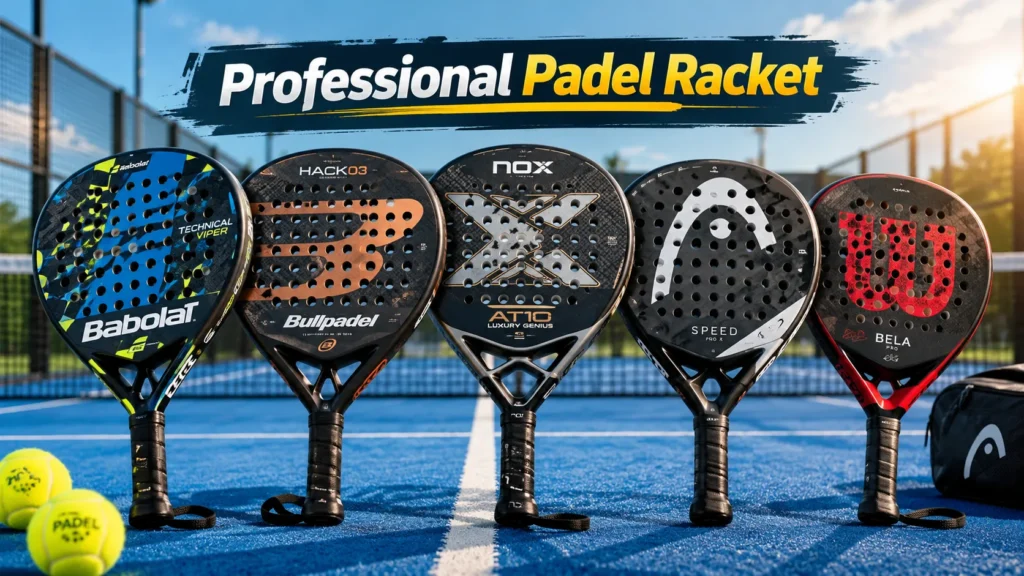
In the high-intensity UK padel scene, standard power frames quickly reveal their limits when forced into tactical, split-second counter-attacks. Choosing a true professional padel racket is no longer about raw stiffness or marketing hype; it comes down to exact balance distribution, high-density EVA core feedback, and direct control during fast-paced net exchanges. Whether you are battling under the indoor lights of London or competing in regional LTA-sanctioned tournaments, holding a frame engineered for elite precision changes every defensive reset into an offensive opportunity.
Best Professional Padel Rackets
Verified specs & UK pricing (2026) · By performance focus
Anatomical Breakdown: The best padel rackets for professional
When evaluating the best padel rackets for professional players, raw specifications only tell half the story. The physical interaction between the carbon lay-up and the internal rubber defines how the racket performs under extreme duress. Below is a head-to-head analysis of the market’s leading aggressive frames, detailing their genuine core performance, strengths, and unapologetic flaws.
Head-to-Head: Babolat Technical Viper 3.0 vs. Wilson Bela Pro V3
Both of these frames are built for pure, aggressive dominance, but they approach power delivery through entirely different engineering philosophies.
- The Babolat Philosophy: The Technical Viper 3.0 utilises a tightly woven 3K carbon face layered over a Hard EVA core. This creates a remarkably dry, stiff impact that transfers maximum kinetic energy into smashes. Its main advantage is pure explosiveness; however, the major drawback is a punishing lack of forgiveness. If you mistime a defensive lob, the racket absorbs nothing, resulting in a dead ball and significant vibration transferred to your arm.
- The Wilson Philosophy: The Bela Pro V3 utilises a 24K carbon face paired with Firm EVA. Despite the higher ‘K’ number, this open weave provides slightly more flex and structural stability on blocks and volleys. The advantage here is better directional control during chaotic net exchanges. The flaw? It lacks modern adjustable weight systems and demands absolute mechanical perfection from the player.
Decoding Carbon Fibre: Why the ‘K’ Rating is Misunderstood
A persistent myth among amateur players is that a higher ‘K’ rating equates to a stiffer, more powerful padel racket professional model. In reality, the ‘K’ simply refers to the thousands of carbon filaments grouped in a single thread (e.g., 3,000 for 3K). Because a 3K weave is much finer, it requires significantly more intersecting “knots” per square centimetre. This high density creates immense surface tension, resulting in a highly rigid, unyielding impact feel.
Conversely, an 18K or 24K weave uses wider, flatter carbon bands with fewer intersections, allowing the surface to act with more elasticity and spring-like responsiveness. If you want a comprehensive look at how these materials shape elite play, our breakdown of the best padel rackets for advanced players offers deeper context.
The UK Climate Factor: Weather’s Impact on Racket Performance
The core of almost every high-end racket is made from EVA foam, a thermoplastic polymer highly sensitive to temperature shifts. During a cold British winter, the EVA core contracts and hardens. This shrinks the sweet spot, making the racket feel like a wooden board and increasing the harsh feedback felt in the forearm. In contrast, summer heat causes the foam to expand and soften. While this increases ball exit speed on defensive shots, the softer core absorbs energy during heavy smashes, robbing the player of finishing power. Brands are countering this by using aluminised 18K carbon, which acts as a thermal shield to provide consistent performance regardless of the ambient temperature.
The Anatomy of the Sweet Spot: Laboratory Realities
Marketing often claims that diamond-shaped rackets move the sweet spot to the top of the frame. However, rigorous robotic testing by the Polytechnic University of Valencia (UPV) proved otherwise. By testing 225 different rackets, researchers found that the sweet spot—the exact overlap of maximum ball speed, minimum vibration, and zero frame twisting—is anatomically fixed between 118 mm and 147 mm from the top edge (averaging 134 mm). A diamond shape does not move the sweet spot higher; it merely shrinks the geographical size of this forgiving zone, demanding extreme precision. If you are struggling to find the right balance, understanding how to choose a padel racket based on sweet spot width is crucial.
Pro-Level Customisation: Optimising Grips and Lead Tape
Unlike tennis rackets, which are sold in specific grip sizes (L1 to L5), padel rackets leave the factory with a universally slim handle measuring approximately 95 mm to 105 mm. This slim baseline allows for fast grip transitions but forces players to manually customise their equipment. You must apply overgrips until there is a one-finger gap between your fingertips and the base of your palm. Failing to adjust your padel racket grip forces over-gripping, accelerating forearm fatigue. Furthermore, elite players heavily utilise lead or tungsten tape; applying 3g to the racket’s throat drastically improves torsional stability without sluggishly increasing the swing weight.
Consumer Rights: Navigating Professional Racket Warranties in the UK
When investing heavily in the best professional padel racket, understanding your legal coverage is essential. In the UK, consumers are protected by a 24-month warranty against manufacturing defects. This explicitly covers internal failures such as epoxy delamination (where the carbon layers separate from the core without external impact). However, no brand or official retailer (such as Bullpadel Official UK) will honour a warranty claim for structural fractures caused by striking the court glass, the floor, or a partner’s racket. Those are classed as normal wear and tear in an abrasive sport.
Frequently Asked Questions (FAQ)
Do professional padel rackets come in different grip sizes like tennis rackets?
No. Almost all padel rackets are manufactured with a single, standardised slim handle. Players are expected to customise the thickness manually by layering overgrips to achieve their ideal ergonomic fit.
Does a higher ‘K’ carbon number mean the racket is more powerful?
Not necessarily. A 3K weave is denser with more intersecting threads, resulting in a stiffer, drier impact. 18K and 24K weaves are wider and naturally more flexible, providing a springier response. Total power depends entirely on how the carbon interacts with the EVA foam core.
How long should a high-end professional racket last under regular competitive play?
For a player competing 3 to 4 times a week, the EVA core will naturally begin to lose its mechanical memory and responsiveness after 6 to 9 months, even if the exterior carbon remains structurally intact.