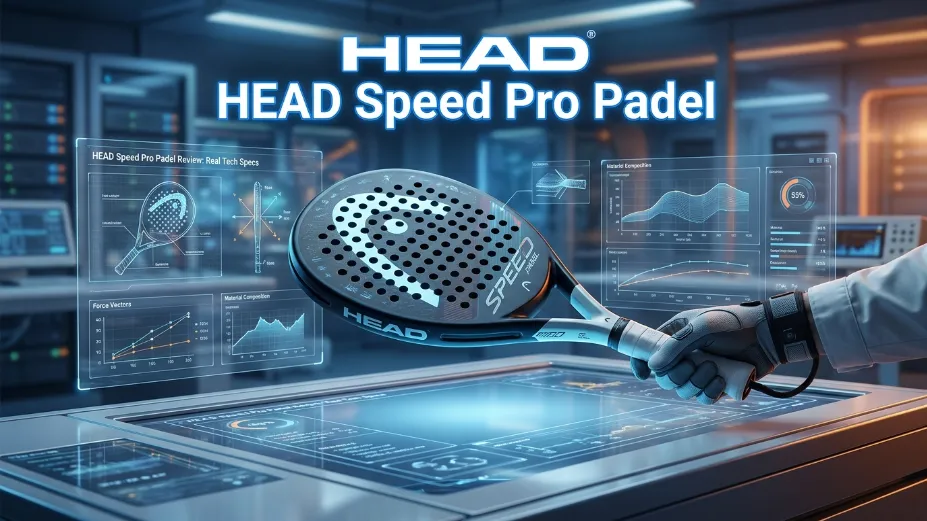
Splitting the difference between raw, unyielding power and surgical control is the single greatest engineering challenge in modern padel manufacturing. Most advanced players sub-optimise their game by choosing racquets that force a tactical compromise: inheriting head-heavy fatigue during extended defensive transitions, or suffering frame-twist when blocking heavy, fast-incoming volleys at the net. The HEAD Speed Pro Padel Racquet enters this high-stakes landscape not as a subtle iteration, but as a complete structural overhaul designed to systematically replace the legacy HEAD Alpha series.
By engineering a precise blend of structural mass and reactive material density, this frame aims to solve the biomechanical friction faced by aggressive, competitive players who demand high ball output without sacrificing structural stability on off-centre strikes. Moving far beyond superficial retail descriptions, an analytical breakdown of this frame’s actual material science reveals exactly how its weight distribution impacts rotational wrist torque and factual on-court playability across UK clubs.
Padel Racket — Technical Specs & Performance Impact
Official technical data · On-court performance impact
For intermediate to advanced UK padel players seeking the absolute midpoint of HEAD’s control-to-power spectrum, the HEAD Speed Pro Padel Racquet delivers unmatched high-speed stability and overhead power due to its calibrated 27.1cm balance and heavy kinetic mass. It stands as the definitive upgrade for transitioning tennis players requiring a structurally stable frame that mitigates the risk of arm fatigue when playing on standard or premium UK courts. Players prioritizing raw maneuverability over structural stability should consider lighter teardrop alternatives.
Technical Specifications & Material Science: The True Blueprint
Manufacturer Specifications vs. Laboratory Measurements
In the highly competitive world of high-end sports engineering, manufacturing tolerances often conflict with real-world product delivery. The nominal weight profile listed by HEAD sits at 370g with an industry-standard deviation buffer of ±10g. Independent laboratory validation baselines demonstrate that a clean, uncustomised production model yields a highly consistent physical mass of 368g. This slight reduction in raw weight does not compromise kinetic momentum but instead works harmoniously with the frame’s internal architecture.
The primary area of retail deception, however, lies in the marketed balance classification. Catalogues routinely label this model as possessing an “even or medium balance” to avoid alienating intermediate buyers. Physical measurements completely dismantle this narrative. A true balance test positions the balance point at exactly 27.1cm from the base of the buttcap, establishing a 59% balance ratio weighted distinctly toward the head. This places the frame squarely within the moderately head-heavy category, explaining its profound plow-through effect during high-rate ball collisions. The exact physical dimensions reinforce this advanced design footprint:
- Handle Length:
- Blade Length:
- Overall Length:
- Profile Thickness:
- Hole Count:
The Hybrid Surface and Reactive Core Matrix
The driving force behind the performance of the head speed pro padel racket is its sophisticated Hybrid Woven hitting surface. Unlike lower-tier models that rely solely on flexible glass fibers or ultra-stiff, unyielding pure carbon, this face structure weaves high-modulus carbon-fibre strands seamlessly with premium fiberglass filaments. This hybrid integration delivers the ultimate dual benefit: the high-tensile carbon provides a rigid structural backbone that blocks heavy hits without buckling, while the fiberglass elements allow for localized micro-flexing, extending the ball dwell-time during precise tactical placements.
Deep inside the racquet lies HEAD’s high-rebound Power Foam core, engineered as a direct contrast to traditional control-centric, high-density EVA compounds. This specific polymer matrix responds dynamically to the rate of incoming ball deformation. On soft defensive touch shots, the core absorbs minimal energy, allowing the hybrid face to gently guide the ball deep into the opposition’s territory.
When facing maximum aggressive acceleration, the foam matrix compresses and snaps back instantaneously, generating a lethal trampoline effect that enhances exit speed. Furthermore, the surface texture relies on a micro-forged lacquer grid pattern rather than a deep, sand-blasted grain. This debunked design philosophy acknowledges that true modern spin generation depends on structural core dwell-time and clean ball compression, rather than superficial, high-friction surface scraping.
Head-to-Head Comparative Analysis: Navigating the HEAD Speed Hierarchy
The Ultimate Structural Head to Head Evolution
To truly understand how the modern head padel speed pro range operates, one must examine how it systematically replaced the iconic HEAD Alpha series once wielded by the legendary Sanyo Gutiérrez. The Alpha series relied heavily on a legacy teardrop mold that prioritized classic touch, but it struggled to maintain structural integrity against the modern game’s explosive ball speeds. By re-engineering the frame with Auxetic technology, HEAD shifted the product line into the Speed family, providing faster face adaptation on impact. When choosing your next weapon, understanding the exact technical variants within this specific hierarchy is vital for selecting the right model for your standard of play.
Speed Pro vs. Speed Pro X (The 12K Carbon Powerhouse)
The distinction between the standard Pro and the head speed pro 2023 padel racket variations versus the ultra-premium Speed Pro X comes down entirely to material stiffness and physical strain. The Pro X swaps out the hybrid woven face for a pure, ultra-stiff 12K carbon-fibre layer. This structural upgrade makes the Pro X an absolute weapon for generating pure, unadulterated power, but it demands impeccable timing and flawless biomechanical execution from the player.
Furthermore, the Pro X inflicts a noticeable physical weight and balance penalty. It features a heavier unstrung specification of 375g coupled with an elevated balance point of 27.6cm. On the court, this combination means the Pro X is significantly harder to maneuver when defending off the back wall or executing quick reaction reflex volleys. For the vast majority of advanced UK amateurs, the standard Pro model provides a much safer, more forgiving sweet spot, whereas the Pro X is built strictly for elite tournament competitors who can handle an intensely stiff frame without sustaining injury.
Speed Pro vs. Speed Motion (Sánchez’s Choice)
The strategic trade-off between the standard Pro and the Speed Motion—the weapon of choice for World Padel Tour star Ari Sánchez—centres entirely on total physical mass. While the Pro commands a substantial on-court weight of 370g, the Speed Motion drops down to a nimble 355g. This weight reduction drastically lowers structural swingweight, allowing players to manipulate the racquet instantly during high-speed net exchanges and rapid defensive recoveries.
However, this weight reduction introduces a distinct structural stability deficit. The heavier mass of the standard Pro excels at absorbing massive, high-velocity incoming volleys, keeping the racquet stable upon impact. The lighter Speed Motion, by contrast, is prone to twisting in the hand when meeting high-powered shots off-centre. Advanced players who generate their own explosive swing speed will appreciate the stability and reassuring heft of the heavier Pro model, whereas players prone to shoulder fatigue should naturally look towards the Motion variant.
Speed Pro vs. Speed Team (The Progression Variant)
The Speed Team variant is a completely redesigned model built for developing intermediate players, moving away from elite premium materials. It features a much softer, fiberglass-heavy face and a noticeably lower balance point. This construction provides effortless ball output on low-speed swings, helping players learn how to hit a proper bandeja padel stroke without fighting the racquet’s inertia. It lacks the top-end power ceiling and absolute stability of the Pro, making it a stepping stone rather than a definitive weapon for advanced players.
For players still figuring out their individual playstyle, reviewing a comprehensive guide on how to choose a padel racket is a vital step before jumping into high-end, advanced gear like the Speed Pro series.
Biomechanical Performance & Injury Prevention: Confronting the Information Gaps
Real-World Weight & Balance Shifts (The Customisation Trap)
A major flaw across major commercial retail sites is analyzing racquets based purely on their pristine, out-of-the-box factory configurations. In the real world, advanced players almost immediately customize their gear. Adding a standard plastic or silicone padel racquet protector adds roughly 8g to the absolute tip of the frame. To balance that addition and accommodate hand size, adding two standard overgrips adds another 12g to the base of the handle. This pushes the total static weight of the racquet past a heavy 385g.
This modification fundamentally alters the racquet’s swingweight via the physics principle of Moment of Inertia. This relationship is calculated using the formula:
$$I = m \times d^2$$
Where I represents the total swingweight, m equals the added mass, and d represents the exact distance of that mass from the player’s pivot point in the wrist. Because the frame protector is placed at the absolute tip of the racquet, its distance value is maximized. This exponential mathematical change massively increases rotational wrist torque, placing severe mechanical strain on the forearm muscles during late, rushed contacts. Players looking to fine-tune these metrics can find practical tips in this guide on how to lighten your padel racket weight.
The Stiff-Light Paradox & Tennis Elbow (Epicondylitis)
A dangerous, widespread myth in amateur UK clubs is that choosing a lighter racquet always protects the arm from injury. This misunderstanding leads players to buy ultra-light, extremely stiff frames under the assumption that less mass equals less strain. In reality, a light and stiff frame lacks the mass required to absorb shock waves upon impact. When hitting a heavy ball, the frame cannot absorb the kinetic force, sending high-frequency vibrations straight through the grip into the player’s elbow tendons.
The structured mass of the head speed pro 2023 padel works as a built-in kinetic buffer, safely dampening impact energy through pure physical weight. This protection is further enhanced by the integrated Soft Buttcap 2.0 system, which uses a specialized elastomer base to break up harsh shock waves before they reach the hand. However, this system relies on the player keeping a fresh, tacky padel racquet grip on the handle. A worn-out, slippery grip forces the player to squeeze the handle too tightly, causing continuous muscle tension that leads to painful micro-tears over time. For players already suffering from chronic joint pain, checking out a curated selection of the best padel rackets for tennis elbow is highly recommended.
The Tennis-to-Padel Technical Trap
Due to the explosive growth of padel across the United Kingdom, thousands of former tennis players are entering the sport, and they naturally gravitate toward the head speed pro 2023 padel racket due to its familiar name and look. However, these players often bring long, loopy tennis strokes onto the padel court, which can quickly lead to injury. To unlock the full potential of this frame without getting hurt, players must adapt their technique:
- Shorten the Backswing:
- Adapt the Stance:
- Stop the Wrist Snap:
- Optimise Contact Points:
UK Buyer’s Guide: Post-Brexit Logistics, Customs, & Specialist Sourcing
The Overseas Import Trap: Hidden Brexit Tariffs
UK consumers are often lured into buying from discount European websites that show lower base prices for the head padel speed pro range. However, ordering from continental warehouses outside the UK comes with significant financial and logistical downsides post-Brexit. When an order crosses the border, it triggers a mandatory 20% UK import VAT if the item’s value exceeds the standard statutory threshold. On top of that, international couriers charge a customs clearance fee that typically adds a £30+ surcharge before delivery can be completed.
Worse still is the absolute nightmare of handling international returns for a damaged or defective frame. If a racquet cracks prematurely due to a manufacturing defect, shipping it back across the border requires dealing with tedious customs declarations, paying expensive international postage fees, and facing weeks of processing delays. This completely wipes out any initial savings made at checkout.
Sourcing Domestically in the UK
To avoid these cross-border headaches, intermediate and advanced players should buy from dedicated domestic retailers who hold physical stock right here in the UK. This ensures reliable consumer rights protections, easy warranty claims, and fast shipping speeds. Two top-tier options dominate the current domestic market:
- PadelHQ
- EverythingPadel
On-Court Verdict: Defensive vs. Attacking Performance
Baseline Defence (Score: 8/10)
Playing deep in the corners with this racquet requires clean technical execution and proper positioning. The frame’s oversized teardrop shape offers a forgiving sweet spot that handles low, awkward wall bounces well. The medium-touch response from the hybrid face prevents the ball from flying out of control into the back glass. However, because of its 27.1cm balance point, players must use positive physical effort to move the racquet quickly under low, fast-sinking balls. It is not an effortless defensive racquet, but it rewards good technical mechanics with exceptional accuracy.
Net Play & Volleys (Score: 8.5/10)
The racquet shines brightest at the net. Thanks to its 368g baseline weight, the frame feels incredibly stable when blocking heavy, fast-paced passing shots from the opposition. It resists twisting completely, allowing you to punch volleys deep into the corners with excellent control. The Auxetic 2.0 carbon weave provides crisp, real-time feedback, giving you the touch needed to execute soft, drop-shot volleys that die before hitting the side glass.
Smashes & Overheads (Score: 9/10)
When it comes to finishing points, the head-heavy weight distribution makes this racquet an absolute powerhouse. On flat smashes and aggressive kick smashes, the racquet accelerates through the hitting zone with tremendous momentum. The Power Foam core delivers high energy return, making it easy to smash the ball clean out of the court or bring it back over the net. For advanced players listed on the LTA padel rankings, this racquet delivers the consistent top-end performance needed to win high-level matches.
Conclusion & Strategic Purchase Recommendations
The HEAD Speed Pro Padel Racquet stands out as a masterclass in modern sports engineering, successfully blending premium materials with functional performance. It avoids the common mistakes of overly stiff power racquets, offering a balanced weapon for players who understand how to use its weight and balance on the court. To make your final decision easier, use this simple purchasing guide based on your specific playing level:
- Buy the HEAD Speed Pro if you are an advanced player or an experienced former tennis player looking for a highly stable, powerful, and versatile weapon to dominate competitive matches. It is easily one of the best padel rackets for advanced players available today.
- Choose the Speed Motion if you want to avoid shoulder fatigue or prefer a lighter, faster feel for quick reflex volleys at the net.
- Opt for the Speed Team if you are a developing intermediate player looking to transition smoothly from a basic round control racquet to a higher-performing shape.
Frequently Asked Questions (UK Padel Edition)
Is the HEAD Speed Pro suitable for absolute beginners in the UK?
Absolutely not. Due to its unstrung weight of 370g and its distinct head-heavy balance point, beginners will find it difficult to maneuver, which can quickly lead to bad technique and arm strain. Beginners should start with a lighter, round-shaped control frame.
What is the main structural difference between the 2023 version and older Alpha models?
The older Alpha models used a legacy carbon frame that focused mostly on classic touch. The updated Speed Pro series features a re-engineered Auxetic 2.0 internal weave that expands and contracts dynamically on impact, giving you much better stability and power against modern, high-speed balls.
Will adding an external frame protector make the racquet too heavy?
For intermediate players, it might. Adding a standard 8g protector to the tip shifts the balance further up the frame, noticeably increasing its swingweight. If you want to keep the racquet feeling nimble, consider using a lightweight protective tape instead of a thick molded plastic strip.
How long can I expect the hybrid woven face to last under normal playing conditions?
When playing 2 to 3 times a week at typical indoor or outdoor UK clubs, the premium carbon-fiberglass weave will maintain its optimal crisp feel for roughly 9 to 12 months. After this period, the internal Power Foam core will naturally begin to soften, resulting in a slight drop in top-end power.