The margins in competitive British padel have razor-thinned. A fraction of a second lost manoeuvring a sluggish frame at the net is no longer a minor mechanical flaw—it is a tactical surrender that competent opponents will exploit mercilessly. Add the unforgiving reality of damp, freezing UK winter courts that instantly turn standard EVA rackets into brittle, unresponsive boards, and your equipment choices suddenly dictate your survival in gruelling rallies.
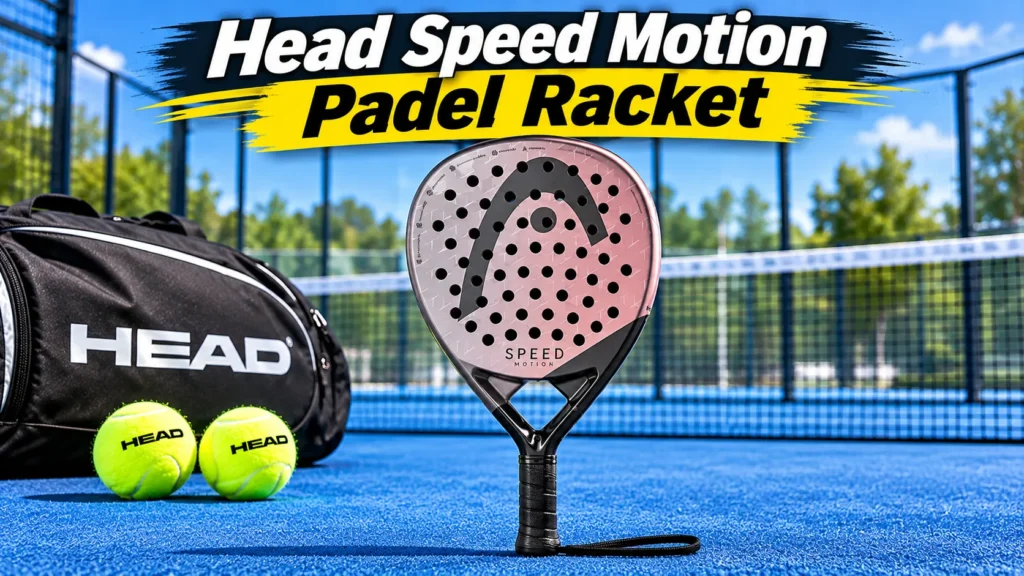
For aggressive players demanding explosive velocity, fluid transitions, and a thermal core engineered to rebound flawlessly below 10°C, the head speed motion padel racket serves as the ultimate structural countermeasure. Before you commit your budget or step onto the court again, you must understand exactly how this teardrop silhouette—and its precise weight-to-balance ratio—is quietly rewriting the rules of high-speed engagement.
Head Speed Motion
2023 vs 2025 Model · Verified Rates & Booking Info · 2026
Head Speed Motion padel racket review: Anatomical Breakdown
The engineering core of the head speed motion 2025 padel racket centres upon its non-traditional weight-to-balance ratio. While legacy racquet formats relied primarily on uniform mass distribution, this silhouette bridges modern material science with the rigorous kinetic constraints of rapid court sports. By dissecting critical angles often omitted by mainstream reviews—such as thermal core dynamics and torsional stability—players can make truly informed decisions.
- The Core Matrix: Utilising the proprietary Power Foam engineered via advanced chemical processing, the primary cushioning engine offers exceptional mechanical bounce. When defending heavy smashes in cold British weather, the polyethylene-based foam absorbs massive kinetic energy before rebounding immediately to assist the next counter-attack, actively outperforming rigid EVA structures that turn brittle below 10°C.
- The Hybrid Woven Boundary: Because pure carbon is naturally rigid and harsh under high loads, it requires a structural countermeasure. The Hybrid Woven face blends 3K carbon with high-elasticity fibreglass, delivering explosive velocity while maintaining enough flex to enhance joint comfort and prolong rally endurance during sharp defensive digs.
- Structural Mechanics (Twistweight): A missing angle in many evaluations is how a lightweight 355g frame handles off-centre torque against heavy opposition pace. The engineered Tailored Frame limits the “pole effect” (wobbling on the vertical axis), ensuring stability when you are stretched wide for a rapid volley, effectively filtering high-frequency vibrations through the Auxetic 2.0 yoke.
The outer layer balances ultra-lightweight structural integrity with a smooth glossy finish, bypassing heavy 3D textures to prioritise raw swing velocity through the air. For players analysing options across the entire market matrix, evaluating the dedicated structural differences outlined in our analytical look at how to choose a padel racket provides clear contextual background before buying.
Generational Upgrades: Deciding on your Head Speed Motion 2023 Padel Racket vs 2025
Navigating the product family requires a clear understanding of the mechanical differences between the foundational head speed motion padel racket 2023 layout and its highly refined counterpart. Selecting your specific version dictates both your physical stamina preservation and your kinetic output on court.
The Weight and Dampening Variance
The 2023 architecture focuses extensively on established stability, weighing in at an average of 360g. It utilises Auxetic 1.0, which delivers raw, unfiltered feedback directly to the hand. Conversely, the 2025 configuration employs the Soft Butt Cap 2.0 and the upgraded Auxetic 2.0, dropping the average weight to 355g. This shift provides speed-focused players with a sharper sense of manoeuvrability while simultaneously delivering a significantly more muted, vibration-dampened feel during heavy ball striking sequences.
Customisation and Pro-Stock Discrepancies
The high 270 mm balance introduces a unique dynamic to both models. While the static weight is incredibly low, the pendulum momentum feels robust at the net. To neutralise this for deeper defence, advanced players frequently modify the handle geometry. Applying a dense replacement grip significantly lowers the balance point, transforming it into the ultimate agile tool. For a deeper understanding of this physical modification, our guide on the padel racket grip details how to manipulate structural leverage perfectly.
If you are a high-level competitor seeking to match advanced court dynamics with elite-tier control tools, exploring the definitive structural mechanics detailed in our guide on best lightweight padel rackets for women will ensure your entire equipment setup functions in perfect technical alignment, much like the bespoke pro-stock frames wielded on the professional circuit.
Head-to-Head: Head Speed Motion 2025 vs. Nox AT10 Genius 18K Alum
For players trying to choose between the premium 2025 Motion and the legendary Nox AT10 Genius 18K Alum, the choice comes down to a fundamental split in design philosophy. Both models command top-tier placement across UK retail outlets but approach court performance from completely opposing angles.
The primary differences in on-court performance are detailed in the comparison matrix below:
- Surface Texture and Spin Mechanics: The Nox model wins decisively on pure mechanical spin, delivering a rough 3D sand finish that grips the ball heavily, especially in damp conditions. The HEAD model features a completely smooth, glossy face, relying entirely on the player’s mechanical brushing technique to generate topspin or deep slice.
- Core Reactivity: HEAD dominates the dynamic power category through its highly responsive Power Foam, which acts as a mechanical spring to propel the ball effortlessly. The multi-layered MLD Black EVA used by Nox provides excellent linear placement control but feels noticeably stiffer and more demanding during rapid, flat block volleys.
- Manoeuvrability and Swing Velocity: The 355g weight of the HEAD easily delivers rapid acceleration, though its high 270 mm balance requires sound forearm mechanics to wield effectively over ninety minutes. The Nox provides a slightly lower, more centralised balance, yielding slightly more forgiveness during desperate defensive digs off the back glass.
For a complete, comprehensive overview of the broad variety of accessories currently occupying the competitive landscape across British clubs, take a moment to read our detailed breakdown on how to apply a padel racket protector alongside our independent evaluation of how heavy damp conditions affect play in are padel balls the same as tennis balls to select your ideal structural fit.
Frequently Asked Questions (FAQ)
How does the 2025 model handle cold UK winter conditions?
Exceptionally well. Because it utilises a polyethylene-based Power Foam rather than high-density EVA, the core resists the severe thermal stiffening that plagues many premium rackets when temperatures drop below 10°C, maintaining its responsive bounce and vibration dampening properties.
Is the smooth surface a disadvantage for advanced slice volleys?
In completely dry conditions, proper mechanical brushing generates ample spin on the smooth glossy face. However, a missing angle often overlooked is that in damp UK outdoor conditions, the lack of 3D texture means moisture can cause the ball to slip slightly upon impact, requiring steeper paddle angles to compensate.
How can I neutralise the high 270 mm balance point?
If the pendulum momentum feels too aggressive for your defensive game, applying a dense silicone under-grip and two standard overgrips will add roughly 15 to 20 grams directly to the handle. This shifts the balance significantly lower, offering a customised structural feel as discussed in our how to lighten your padel racket weight technical guide.