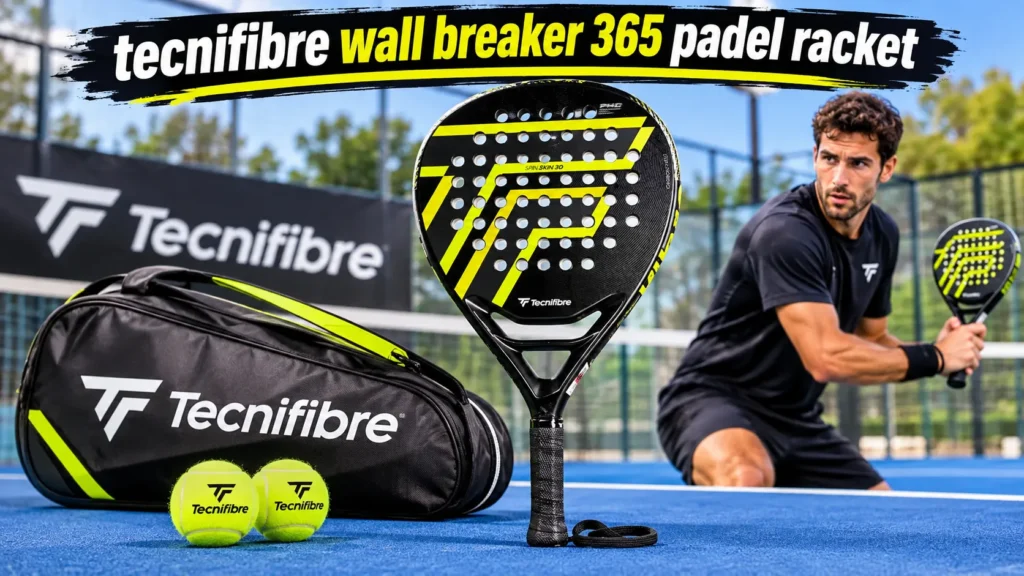
Power in padel is rarely a product of sheer force; it is the mathematical result of swing speed, mass distribution, and kinetic energy transfer upon impact. For aggressive right-side players or dominant left-side attackers competing on slower, damp British courts, relying on a generic frame is a tactical error. The engineering behind the tecnifibre wall breaker 365 padel racket directly addresses this biomechanical gap. By completely eliminating the traditional plastic bumper in favour of a woven aramid and PTFE ‘X-Top’ coating, Tecnifibre has eradicated redundant head drag. This structural overhaul not only accelerates aerial manoeuvrability but fundamentally redefines how efficiently you can channel downward force into an unreturnable smash, making this 2024 iteration a focal point for serious competitor analysis.
Tecnifibre Wall Breaker 365 Padel Racket
Verified Data & Performance · UK Court Conditions · 2026
The rapid expansion of the club scene across the United Kingdom has fundamentally altered player expectations regarding specialised gear. Generic, overly soft frames no longer suffice on highly abrasive, sand-filled synthetic turf where the ball dies quickly against the back glass. With specialised premium rackets arriving on the market, understanding the engineering beneath your grip becomes paramount to maintaining technical execution, controlling the pace of the rally, and preserving muscular comfort during extensive, high-intensity matches.
Comprehensive tecnifibre wall breaker 365 padel racket review: Anatomical Breakdown and Core Performance
The engineering core of this racket centres upon a highly specific, uncompromising material setup. While legacy padel equipment relied primarily on standard fibreglass or mixed composites to provide a broad margin for error, this silhouette bridges aerospace-grade materials with the rigorous kinetic constraints of modern, aggressive court sports. In our detailed tecnifibre wall breaker 365 padel racket review, it becomes immediately apparent that this is not a forgiving tool designed to mask technical flaws; it is a precision amplifier for players who already possess exceptional timing.
- The HMX Carbon Matrix: Utilising High Modulus Carbon (HMX), the primary striking surface offers exceptional torsional rigidity. When landing heavy smashes from high vertical extensions, the carbon face refuses to deform. Instead of the racket absorbing the energy (the ‘trampoline effect’), the energy is channelled entirely into the ball, resulting in a devastatingly dry, crisp output that elite attackers crave.
- Progressive Holes Diameter (PHD): Because rigid carbon can feel unforgiving, Tecnifibre employs a three-tiered drilling pattern. The holes are narrowest at the absolute geometric centre to maintain dense power, while gradually expanding in diameter toward the frame edges. This engineered variance artificially broadens the sweet spot, providing essential mechanical tolerance for off-centre hits during fast reflex volleys.
- The D-Bridge Geometry: The throat of the racket features a direct structural brace. This artificially raises the flex point of the shaft towards the head. When blocking a heavy shot, this prevents the frame from twisting violently in your hand, granting a highly stable platform to redirect pace without sacrificing positional integrity.
The surface layer balances this rigidity with the Spin Skin 3D texturing. Unlike standard sand-grit paint finishes that wear smooth after a few weeks on abrasive turf, these embossed 3D decals are integrated directly into the resin layer. This permanent topography grips the felt of the padel ball upon contact, allowing players to execute dipping chiquitas and heavy viboras that bite aggressively into the turf. For players exploring how this fits into the wider brand ecosystem, examining the specifications in a broader guide to the Tecnifibre padel racket line-up provides vital contextual background.
tecnifibre wall breaker x top 365 padel racket: The Bumperless Revolution
Perhaps the most radical structural innovation evaluated in this tecnifibre wall breaker x top 365 padel racket analysis is the eradication of the traditional plastic bumper guard. Standard plastic bumpers introduce significant static weight at the furthest possible point from the player’s hand, drastically increasing the swing weight and making the racket feel sluggish. Tecnifibre replaced this with an integrated matrix of aramid fibres and a Polytetrafluoroethylene (PTFE, commonly known as Teflon) treatment.
Aramid fibres—utilised in aerospace engineering—provide extraordinary tensile strength against blunt force. Simultaneously, the PTFE treatment drastically alters the surface friction coefficient. When a player digs a low ball out of the corner, the top of the racket seamlessly slides against the glass or artificial turf without the abrasive catching and grinding that typically degrades underlying carbon. This streamlined aerodynamic profile fundamentally enhances rapid manoeuvrability.
Uncovering the Missing Angles: Weight Matrices and UK Climate Dynamics
When analysing the tecnifibre wall breaker 365 2024 padel racket, standard marketing materials often overlook critical real-world variables that deeply affect UK consumers. Two of the most misunderstood concepts involve manufacturing tolerances and the thermodynamic response of the racket’s core during British winters.
Thermodynamics: The Winter Core Hardening
Padel rackets are highly thermosensitive. The internal core of the Wall Breaker 365 utilises a medium-firm density EVA (Ethylene-Vinyl Acetate) rubber. In temperatures below 10°C—a standard condition for outdoor UK facilities from November to March—the molecular structure of EVA rubber contracts, losing its elasticity and hardening significantly. A racket that feels responsive in a 22°C indoor facility will transform into an extremely rigid board in damp, 5°C outdoor conditions. Because this frame already features a stiff High Modulus Carbon face, this temperature drop severely restricts ball output and increases the transmission of shock vibrations. Players must account for this by either playing indoors during winter or generating significantly more mechanical force themselves.
Static Weight vs. Swing Weight Realities
Another major gap in competitor analyses is the misunderstanding of the 365g label. Due to industry-standard carbon layups, the racket carries a manufacturing tolerance of +/- 10g. You could theoretically receive a 375g or 355g frame. Furthermore, because it is a diamond shape with a 275mm high balance point, its swing weight is immense. It requires profound muscular torque from the forearm to initiate and arrest the swing. Advanced players understand that adding multiple overgrips shifts the balance slightly lower but drives the overall static weight closer to 380g, requiring robust physical conditioning to avoid severe arm fatigue over a three-set match. Understanding these nuances is critical when researching how to choose a padel racket properly.
Head-to-Head: Tecnifibre Wall Breaker 365 vs. Babolat Technical Viper
For UK competitors trying to select their ultimate offensive weapon, the tecnifibre wall breaker 365 padel racket 2024 is most frequently cross-shopped against the legendary Babolat Technical Viper. Both command top-tier placement but approach absolute power from slightly different philosophical angles.
- Peak Power and Stiffness: The Babolat Technical Viper is notoriously one of the stiffest rackets on the global market, utilising a multi-layered X-EVA core and tight 12K carbon. It offers slightly higher absolute peak power but is entirely unforgiving. The Tecnifibre model, while still exceptionally powerful, utilises a single-density medium EVA core that provides slightly more ball retention, making it marginally less punishing on the arm during heavy impact.
- Aerodynamics and Defence: Babolat relies on traditional frame architecture, which can feel heavy when defending off the back glass. Tecnifibre’s X-TOP bumperless design gives it a distinct advantage in aerial speed. It cuts through the air noticeably faster during reflex volleys, allowing the player to prepare milliseconds earlier.
- Vibration Dampening and Comfort: The Viper transfers immense kinetic shock directly to the player. Tecnifibre offsets this harshness through the integration of the aramid fibres in the frame and the specific TEI carbon layup, which acts as a natural dampener. While neither racket is considered “soft,” the Wall Breaker is significantly more comfortable over a two-hour match, drastically reducing the onset of muscle fatigue.
If you are committed to dominating the aerial game but want to ensure your equipment relies on the most modern composite engineering, diving into the specifics of a dedicated carbon fibre padel racket will clarify why High Modulus layouts outlast their cheaper fibreglass counterparts.
Frequently Asked Questions (FAQ)
Does the X-TOP technology mean the racket is completely unbreakable against the glass?
No. The X-TOP system uses aramid fibres and PTFE to practically eliminate abrasive damage (scrapes and paint peeling) when sliding the racket against the glass or turf. However, a full-force, perpendicular strike against the metallic mesh fencing or a concrete pillar will still fracture the carbon frame. It is designed for aerodynamic speed and scrape resistance, not to be indestructible against blunt trauma.
Is the 365g model suitable for an intermediate player looking to add power?
Generally, no. The 365g weight combined with the high balance point and stiff carbon face requires a mechanically sound, fast swing to generate pace. If an intermediate player uses it, they often find the ball “dies” on the racket face during defensive lobs. Intermediates are better suited to the 360g version, which features a more forgiving hybrid face for “easy power.”
What exactly does the manufacturer warranty cover in the UK?
Tecnifibre warranties, evaluated case-by-case, cover structural manufacturing defects that occur during normal play. This includes delamination (carbon layers separating from the core) or clean fractures across the face with absolutely no sign of impact. Cracks on the frame edge accompanied by scuffs or dents (indicating a strike against the wall or floor) are classified as impact damage and are strictly not covered. Always keep your proof of purchase from a verified UK retailer.
How does this racket compare to other elite options?
It ranks highly for offensive specialists. To see where it stands against other flagship models from competing brands, review our comprehensive breakdown of the best padel rackets for advanced players to ensure your tactical style matches the frame’s capabilities.