Performance on the padel court is ruthlessly determined by the physics of your equipment, yet most players completely ignore the structural composition of their frame until they hit a performance plateau. When advanced material science introduced flax fibre composites to the British market, it disrupted the traditional carbon-fibre monopoly. This wasn’t merely an environmental gimmick; it was a fundamental shift in kinetic energy transfer. For players actively seeking a green padel racket, the calculus has evolved. You no longer have to compromise aggressive power or tactical precision for sustainability.
Whether you are analysing the impact absorption of a standard padel racket green model or dissecting the specific aerodynamic drag of the adidas adipower green padel 3.1 racket, understanding the acoustic and structural feedback of these eco-centric frames is critical. Below, we dismantle the engineering behind the premier adidas green padel racket options—proving exactly how the adidas padel racket green lineup translates plant-based materials into competitive court dominance.
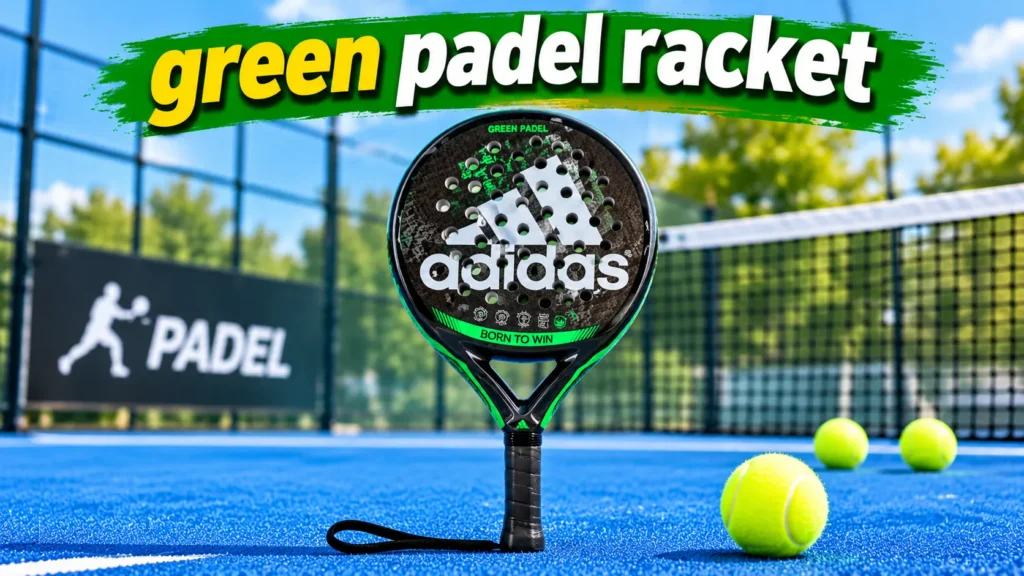
adidas adipower green padel 3.1 racket
Green Padel Rackets · Verified Specs & Performance Data · 2026
adidas adipower green padel 3.1 racket: Anatomical Breakdown and Core Performance
The engineering core of the adidas adipower green padel 3.1 racket centres upon its non-traditional surface setup. While legacy racquet manufacturing relied primarily on standard carbon layups, this model bridges modern sustainable material science with the rigorous lateral constraints of modern court sports. The integration of 100% natural flax fibre fundamentally changes how kinetic energy is processed at the exact moment of ball impact.
- The Surface Matrix: Utilising a highly dense weave of flax fibre, the primary striking face offers exceptional mechanical bounce. When defending against high-velocity smashes, the viscoelastic nature of the plant fibres absorbs massive kinetic energy before rebounding immediately to assist the ball exit, creating a distinctly softer acoustic feedback compared to brittle carbon.
- The Structural Reinforcement: Because natural fibres have different flexural profiles under high loads, they require a structural countermeasure. The internal Dual eXoskeleton chassis wraps around the frame perimeter using dense, rigid reinforcements, locking the bridge into place during sharp lateral swings and preventing unwanted torsion.
- Aerodynamic & Spin Mechanics: The Spin Blade Gritt formulation incorporates a multi-directional, sandpaper-like rough texture across the hitting surface. This allows players to execute sudden, heavy-spin viboras near the rear glass walls without the ball slipping off the racket face in damp British weather.
The internal layer balances this ultra-responsive surface with the elastic EVA Soft Performance core. This rubberised shield prevents immediate mechanical fatigue caused by continuous heavy hitting during prolonged defensive sequences. For players analysing options across the entire brand matrix, evaluating the dedicated structural differences outlined in our analytical look at the adidas padel racket range provides clear contextual background before buying.
Carbon Fibre vs. Flax Fibre: Deciding on your Adidas Green Padel Racket
Navigating the product family requires a clear understanding of the mechanical differences between the flagship flax fibre layout and its carbon-centric counterparts. Selecting your specific version of an adidas green padel racket dictates both your physical output and your kinetic velocity on court.
The Vibration Damping Variance
The flax fibre architecture focuses extensively on energy dissipation and structural longevity. The ductile composite resists sudden brittle fractures upon accidental impacts with the cage. More importantly, flax fibre provides a vibration decay rate that is mechanically superior to carbon. High-frequency shockwaves generated by off-centre hits are absorbed into the microscopic cellular structure of the plant fibres, preventing that harsh, resonant feedback from reaching the handle. Conversely, standard carbon configurations employ an ultra-stiff, high-density weave designed for instantaneous energy transfer. This gives speed-focused players a sharper sense of ball feel but significantly less mechanical dampening during heavy defensive blocks.
Weight Distribution and Environmental Discrepancies
The unique density of the premium flax composite introduces a highly stable weight profile, pushing a standard model to roughly 360–375 grams. The even balance drops the swing weight noticeably, providing a highly manoeuvrable sensation for nimble baseline retrievers. This material variance reflects clearly across UK commercial retail channels and aligns directly with the official adidas Greenpadel initiative, which guarantees the reforestation of 3 square metres of woodland for every racket sold, fundamentally offsetting the carbon footprint of production.
If you are a developing competitor seeking to match advanced material dynamics with your growing skill set, exploring the definitive structural mechanics detailed in our guide on how to choose a padel racket will ensure your entire equipment setup functions in perfect technical alignment. For those transitioning out of the beginner phase, evaluating the best padel racket for intermediate levels is a logical next step.
Head-to-Head: adidas adipower green padel 3.1 racket vs. Adidas Metalbone Greenpadel
For players trying to choose between the rounded precision of the adidas adipower green padel 3.1 racket and the aggressive geometry of the Metalbone Greenpadel, the choice comes down to a fundamental split in tactical design philosophy. Both models command top-tier placement across UK retail outlets but approach court dominance from completely opposing angles.
The primary differences in on-court performance are detailed in the comparison below:
- Shape and Sweet Spot: The Adipower model wins decisively on forgiveness, delivering a large, centrally located sweet spot through its round shape. The Metalbone features a diamond oversize format, which shifts the sweet spot to the top of the head, requiring advanced technical precision to strike cleanly.
- Weight Customisation and Balance: The Metalbone dominates the adaptability category through its highly innovative Weight & Balance System. Using six removable screws in the bridge, players can actively alter the racket’s centre of gravity. The Adipower provides a fixed, medium-low balance that guarantees excellent fluid comfort and rapid directional changes but yields slightly less momentum under extreme, high-velocity overhead extensions.
- Target Demographic: The Adipower is engineered for intermediate to advanced tacticians who rely on placement, lobs, and controlled pacing. The Metalbone is strictly tailored for aggressive attackers who seek to end points violently at the net, demanding a much higher standard of baseline technique to wield effectively.
For a complete, comprehensive overview of the broad variety of choices currently occupying the competitive landscape for highly skilled competitors, take a moment to read our detailed breakdown of the best padel rackets for advanced players alongside our independent evaluation of the flagship adidas metal bone series to select your ideal structural fit.
Frequently Asked Questions (FAQ)
Does the flax fibre construction absorb moisture in damp UK weather, ruining the racket’s structural integrity?
No. While raw natural fibres are inherently hydrophilic, the flax utilised in high-end models like the adidas padel racket green lineup undergoes advanced chemical treatments (similar to Hypermat bio-resin processing) prior to moulding. The fibres are fully encapsulated in a non-porous epoxy matrix, preventing any moisture penetration during outdoor play in humid or rainy British conditions.
How can I distinguish between a superficial cosmetic scratch and a critical structural crack on a painted green padel racket?
In fully painted frames, surface damage is incredibly common due to glass wall impacts. A cosmetic scratch only removes the clear coat and pigment, leaving the woven fibre beneath intact. A structural crack is identifiable by a distinctly dead or hollow acoustic sound upon ball impact, accompanied by a visible splintering or separation of the actual composite weave beneath the paint layer. Due to the ductile fracture mechanics of flax, catastrophic shattering is far less common than with pure carbon frames.
What is the appropriate LTA (Lawn Tennis Association) player rating for the Adipower Greenpadel 3.1?
Given its round shape, forgiving sweet spot, and medium balance, this frame perfectly complements players spanning LTA Padel Ratings 3.5 to 5.0 (Division B). It provides the essential mechanical control needed for those developing tactical point construction, while still offering enough structural rigidity for players beginning to compete in local club tournaments.