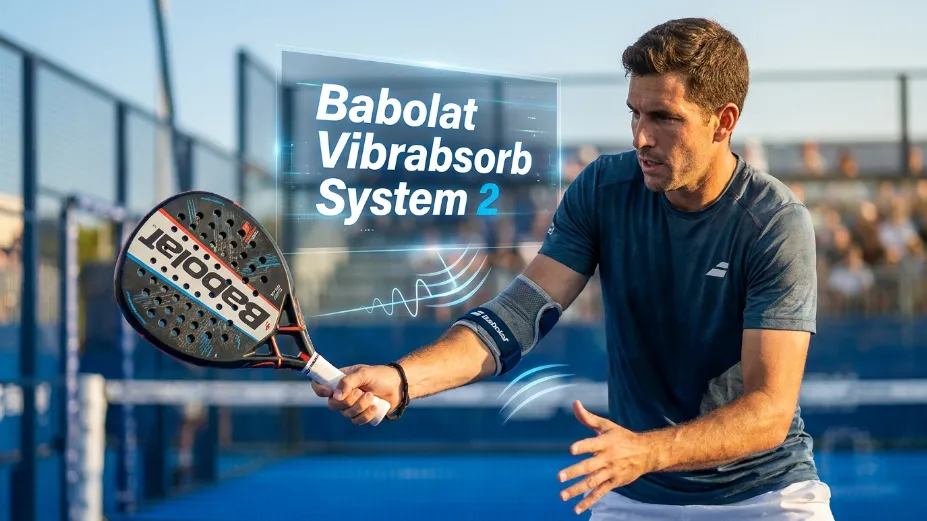
The damp, heavy courts of a British winter have a brutal way of exposing every vibration in a carbon frame. For players managing lateral epicondylitis—or looking to avoid it entirely—that stiff jarring sensation on off-centre hits isn’t just frustrating; it’s a direct threat to longevity on the court. While many brands simply thicken the grip or soften the foam to mask the shock, the newly refined Babolat Vibrabsorb System 2 tackles the energy transfer directly at the heart of the racket. By dissecting how this specific elastomer integration works alongside modern updates, we can pinpoint exactly which 2026 models bridge the gap between uncompromising raw power and absolute joint protection.
Babolat Padel Rackets — Arm Comfort (2026)
Core Foam · Vibration Tech · Arm Comfort Rating · Tennis Elbow Suitability
For UK club players navigating intensive court schedules, selecting the ultimate frame relies entirely on balancing dynamic wrist torque against the structural rigidity of the racket composite. If you are recovering from a severe, active case of tendon strain, the progressive flex of the hybrid-faced Veron line offers unmatched impact filtration on cold outdoor courts. However, fully conditioned offensive players seeking maximum energy return without inducing structural micro-trauma will find the lightweight architecture of the Air series to be the most ergonomically balanced option available across retail channels.
Biomechanical Engineering Breakdown: Babolat SMAC technology padel and Comfortable padel rackets with X-EVA
The core of modern joint protection within court sports lies within the advanced material science embedded directly within the frame matrix. Rather than relying on simple external rubber plugs or thick overgrips, Babolat SMAC technology padel architecture introduces an aerospace-grade damping matrix that intercepts destructive kinetic energy before it reaches the player’s soft tissues.
- The Aerospace Elastomer Network: Developed in partnership with French aerospace firm SMAC, this system utilises high-grade viscoelastic elastomers embedded directly within the carbon layers of the racket heart. These specialized polymers isolate sensitive electronics in rocket launchers and defense systems; when applied to padel, they actively shear high-frequency waves exceeding 150 Hz, preventing them from traveling up the handle.
- The Multi-Layered Advantage: While first-generation layouts focused solely on frame stabilization at the throat, the 2026 Babolat Padel racket technology 2026 setup implements secondary viscoelastic inserts within the handle shaft. This creates a multi-stage defensive barrier that completely decouples the solid impact of the racket face from the player’s grip.
- Dynamic Density Cores: To balance raw offensive output with precise joint safety, creating comfortable padel rackets with X-EVA requires a complex sandwich structure. The architecture utilizes two stiff outer layers of ethylene-vinyl acetate to handle high-velocity smashes, paired with a soft, elastic inner EVA core that deforms during defensive blocks to cushion the forearm muscles.
The interaction between these materials ensures that low-velocity blocks absorb destructive shock waves seamlessly, while high-velocity swings engage the rigid outer carbon weave for explosive power. For players assessing alternative profiles across the market, reviewing the comprehensive design differences highlighted in our expert guide to the Babolat Counter Veron 2026 reveals how flexible face weaves can completely change the mechanical feedback of a racket.
Check Best Rackets for Tennis Elbow Guide
Exposing the Information Gaps: Face Composites vs. Tendon Stress Dynamics
A significant missing angle across mainstream retail review spaces is the deep mechanical relationship between carbon density, fiberglass elasticity, and chronic tendon strain. Choosing a frame solely based on its visual marketing or pro-player endorsements frequently leads to severe operational issues on the court.
Carbon Weave Discrepancies
High-density carbon surfaces, such as the 12K and 16K weaves found on premium professional configurations, offer exceptional structural responsiveness and top-end power. However, their physical modulus of elasticity is exceptionally low. When a solid padel ball strikes an off-centre zone on a 16K carbon face, the frame experiences immediate torsional twisting. Because the face does not deform, the entirety of that twisting force is converted into raw rotational torque, forcing the extensor carpi radialis brevis (ECRB) muscle to contract violently to stabilize the grip.
The Hybrid Matrix Alternative
To directly combat this issue, Babolat engineered the Carbon Flex face weave. This hybrid technology seamlessly combines the structural strength of carbon strands with the high elasticity of high-grade fiberglass. The resulting surface allows for a progressive deformation upon impact, creating a subtle trampoline effect that generates easy depth with less physical effort from the player. This elasticity serves as a primary mechanical cushion, ensuring that the initial impact wave is smoothed out before it triggers Babolat Viper vibration reduction systems in the throat.
For competitive athletes looking to align these advanced face dynamics with precision offensive tools, evaluating the detailed specifications found in our technical breakdown of the Babolat Technical Viper 2026 ensures your tactical requirements don’t overwrite your physical safety boundaries.
Resolving the Counter Viper Paradox: Dynamic Torque Under the Microscope
One of the most persistent misconceptions across competitive UK clubs is that round-headed rackets are automatically safe for players suffering from chronic lateral epicondylitis. While a round frame geometry inherently widens the lateral sweet spot, the total distribution of weight across the physical chassis alters its dynamic swing mechanics drastically.
The Babolat Counter Viper 2026 perfectly illustrates this complex mechanical paradox. Despite featuring a highly forgiving round head profile, its static mass stands at a substantial 365 grams, coupled with a distinctly head-heavy balance point measured at 270 millimetres. To understand the risk this creates for an injured arm, one must apply basic rotational physics:
Where T represents the physical torque applied to the player’s wrist joint, F is the dynamic centrifugal force generated during the swing, and d is the exact distance from the user’s hand to the racket’s center of mass
Because a balance point of 270 millimetres places the physical mass furthest away from the grip, the racket generates a massive moment of dynamic inertia. During rapid defensive volleys, late glass rebounds, or heavy overhead extensions, this leverage puts intense strain on the wrist joint. To prevent the head from dipping or twisting upon contact, the forearm tendons must remain under continuous, forceful contraction. Real-world feedback from independent player forums highlights that intermediate players who bought this frame purely for its round shape still experienced severe tendonitis flare-ups, proving that head-heavy leverage can quickly negate the benefits of premium internal dampening systems.
Ergonomic Optimisation: Extended Handles and Aftermarket Filtration
While the internal carbon composition dictates the initial wave propagation, the physical interface between the player’s hand and the handle determines the final energy transfer into the arm structure.
- The 14-Centimetre Extended Handle: International Padel Federation (FIP) regulations restrict total racket length to 45.5 centimetres. Babolat’s Air and Counter lines leverage an elongated 14 to 14.5-centimetre handle architecture. This extended lever reduces the muscular grip pressure required to stabilize off-centre hits and provides ample clearance for two-handed backhands, shifting up to 45% of the raw impact load to the non-dominant shoulder and core.
- Hexagonal Silicone Undergrips: Upgrading the standard factory grip with faceted, hexagonal undergrips alters the volumetric geometry of the handle. By filling the natural voids within a closed human fist, these structures increase total surface area contact, allowing players to hold the racket securely with significantly less forearm tension.
- Viscoelastic Absorption Bands: Specialized aftermarket underlays applied directly to the raw handle shaft absorb up to 96% of residual high-frequency vibrations. When paired with factory-installed systems, they create the ultimate best padel racket for tennis elbow defensive configuration.
Optimizing grip thickness remains a critical factor; a grip that is too narrow forces the fingers to clench tightly, overworking the forearm muscles. Conversely, a grip that is too thick restricts natural wrist movement, placing extra strain on the elbow during overhead shots. Ideally, when holding the racket in a standard continental grip, there should be a gap of approximately one finger’s width between the fingertips and the palm.
Performance on British Courts: The Environmental Winter Climate Factor
Evaluating modern dampening matrices requires analyzing the highly variable, cold, and damp court environments found throughout the United Kingdom during late autumn and winter play.
On traditional outdoor synthetic turf courts, the felt covering of standard padel balls quickly acts like a sponge, absorbing moisture from the air and court surface. In typical British playing conditions, a ball’s static mass can easily double. Striking a heavy, waterlogged ball with an ultra-stiff carbon frame significantly increases the structural shock wave amplitude. Because the wet ball loses its natural elasticity, the raw impact energy bypasses the racket’s built-in damping systems, transmitting a heavy mechanical shock directly to the player’s elbow joint.
During these cold winter months, players must adjust their equipment metrics to avoid severe injury. It is highly recommended to transition away from rigid carbon models and adopt lighter, more flexible frames utilizing hybrid faces or soft fibreglass layers. Keeping balls meticulously dry and replacing them regularly is essential to maintain safety and prevent micro-trauma during intense outdoor sessions.
Head-to-Head: Babolat Counter Veron 2026 vs. Babolat Technical Viper Soft
For players trying to choose between the progressive flexibility of the Babolat Counter Veron 2026 and the refined power of the specialized Babolat Technical Viper Soft, the decision comes down to a fundamental split in player technique and physical recovery status.
The primary performance variances observed under high-stress conditions are detailed below:
- Impact Cushioning and Elasticity: The Veron model utilizes a proprietary Carbon Flex hybrid face, providing immediate elasticity and a forgiving feel. The Technical Viper Soft uses a specialized 3K soft carbon twill face; while softer than standard Viper variants, it retains a firmer, crisper feel that requires precise timing to utilize safely.
- Sweet Spot Accessibility: The round head geometry of the Veron delivers a massive, centrally located sweet spot that easily handles off-centre hits. The diamond profile of the Technical Viper Soft features a compressed sweet spot positioned high up the frame, punishing mistimed overhead shots with sudden mechanical feedback.
- Power Generation and Control: The Technical Viper Soft wins decisively on raw offensive output, utilizing its head-heavy distribution to generate exceptional ball speed during aggressive smashes. The Veron relies on its flexible trampoline effect, delivering progressive depth and comfort during defensive baseline rallies.
For a complete, comprehensive overview of the broad variety of configurations occupying the competitive landscape across British clubs, taking a moment to analyze our detailed guide to premium padel rackets uk will help you select your ideal structural fit.
Actionable Selection Pathway: Matching Recovery to Frame Mechanics
To prevent and effectively manage lateral epicondylitis, club players should choose their equipment based on a structured, progressive pathway that matches their recovery status and technique.
- The Active Rehabilitation Stage: Players experiencing active, sharp pain must focus on rest and physical therapy. Upon returning to the court, they should prioritize ultra-elastic, flexible frames with pure fibreglass faces and even balances. These properties maximize shock absorption to protect healing tendons.
- The Strength Building Stage: Intermediate players who are pain-free but prone to injury should prioritize lightweight, highly manoeuvrable frames. Even-balance options weighing roughly 355 grams drastically reduce muscle fatigue, while hybrid faces cushion off-centre impacts effectively.
- The High-Performance Maintenance Stage: Advanced players who require raw power but have a history of joint strain should avoid ultra-stiff, head-heavy rackets. Specialized models incorporating soft carbon weaves, multi-density cores, and advanced elastomer networks allow for aggressive play without sacrificing arm safety.
Babolat Vibrabsorb System 2 – FAQ
Are Babolat 2026 rackets manufactured entirely within the United Kingdom?
No. While all initial engineering concepts, aerospace material partnerships, and player prototyping are managed at European corporate design hubs, final composite assembly and specialized carbon weaving are handled by primary manufacturing partners in Asia, matching standard production practices across the tennis industry.
Can I safely utilize an aftermarket weighted guard tape on my racket head?
It is highly discouraged if you have a history of arm strain. Adding weighted lead or polymer tape to the top of the frame raises the balance point significantly, increasing the dynamic torque (T = F · d) exerted on your wrist and overworking the forearm extensor muscles during quick volleys.
How often should I replace my padel balls during winter play in the UK?
To protect your joints, balls should be replaced every 1.5 to 2 hours of outdoor match play during damp conditions. Once the felt absorbs surface moisture and dirt, the ball becomes excessively heavy, functioning like a solid brick and bypassing the built-in vibration dampening technologies of your frame.