The £300 flagship racket currently sitting in your padel bag was engineered for a statistical ghost.
Mass-produced frames roll off the assembly line calibrated for an ‘average’ player’s biomechanics—meaning they are perfectly optimised for absolutely no one. As the British club scene rapidly matures from a recreational weekend pursuit into a fiercely competitive circuit, relying on factory-issue balance points and generic EVA cores has become a glaring tactical vulnerability. You are subconsciously modifying your natural swing to accommodate the gear, rather than demanding the equipment accommodate you.
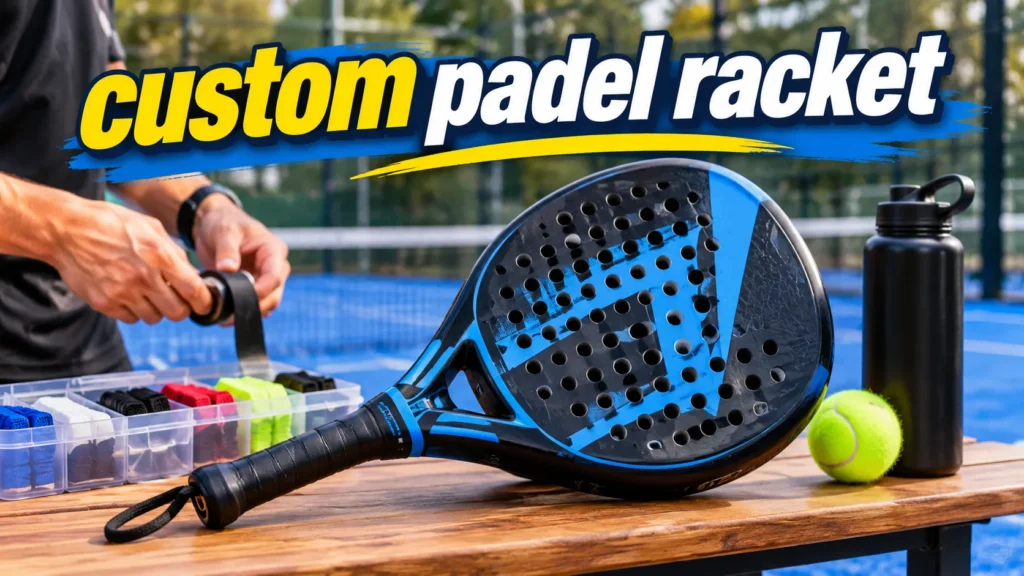
The transition to a bespoke custom padel racket is no longer a mere aesthetic indulgence; it is a structural necessity. If you are ready to stop playing against your own equipment and start wielding a frame exclusively engineered for your exact swingweight, twistweight, and aggressive net play, the era of settling for the factory standard ends right here.
Custom Padel Rackets & Services
United Kingdom · Verified Rates & Booking Info · 2026
customize padel racket: Anatomical Breakdown and Core Performance
When you decide to customize padel racket specifications, you are no longer relying on generic factory averages; you are engaging directly with racket biomechanics. The market is saturated with players who purchase flagship models only to find them sluggish or overly rigid. True customisation dissects the anatomy of the frame—manipulating the core density, face material, and aerodynamic profile to harmonise with your specific swing velocity. This level of intervention ensures your equipment actively supports your tactical intentions rather than resisting them.
- Core Density (EVA Foam): The engine of your racket. Selecting a medium-soft EVA core increases the trampoline effect for effortless baseline lobs, whilst a high-density core demands severe player input but rewards with devastating smashes.
- Face Composition: A bespoke build allows you to dictate the carbon weave. 3K carbon provides a flexible, highly responsive touch, whereas an 18K or 24K carbon surface offers a rigid, board-like response favoured by aggressive strikers seeking zero energy absorption.
- The Sweet Spot Shift: By altering the external geometry or redistributing internal mass, custom builders can artificially stretch the sweet spot. This guarantees that off-centre defensive volleys maintain their intended trajectory rather than dying prematurely into the net.
The primary advantage of ordering custom padel rackets is the elimination of the “break-in” guessing game; the racket arrives perfectly tuned to your physical output. However, the inherent drawback is the inability to test a fully bespoke frame before purchasing. For players still refining their technique, locking into rigid specifications might hinder natural development. Exploring the foundational elements detailed in our guide to the personalised padel racket is essential before committing substantial capital to a factory order.
Demystifying Racket Physics: Static Weight vs. Swingweight
The most significant knowledge gap across the British club scene is the fundamental misunderstanding of mass. The number printed on your racket (e.g., 365g) is simply the static weight. It is practically useless for determining how the racket will perform dynamically. The crucial metric is the Moment of Inertia (often referred to as Swingweight), which measures the racket’s resistance to rotation during your stroke.
A racket weighing 360g with its mass concentrated near the tip (a balance point of 280mm or higher) will feel drastically heavier and slower through the air than a 375g racket with mass situated near the handle (a balance point below 260mm). This high swingweight generates immense momentum for overhead shots, but severely penalises rapid net exchanges. Understanding this metric allows you to dissect why two identical-looking frames handle like completely different sports. If your current setup feels overwhelmingly sluggish, reviewing our analytical breakdown on how to lighten your padel racket weight provides immediate, practical solutions for shifting that critical balance point.
Head-to-Head: Factory Setup vs. Custom Made Padel Racket
The debate between purchasing a standard flagship model and commissioning a custom made padel racket hinges on structural transparency. Standard rackets cater to a bell curve; they are designed to be “good enough” for the widest possible demographic. A bespoke frame, conversely, is unapologetically singular in its purpose.
The primary differences in on-court application are outlined below:
- Dynamic Response: Factory rackets often suffer from subtle manufacturing variances; a production run meant to weigh 365g can fluctuate by +/- 10g. Custom manufacturers weigh and balance components incrementally, ensuring the final product matches your exact requested specification down to the gram.
- Aesthetic Identity: Mass-produced frames force you into corporate colour schemes. A customized padel racket allows clubs, corporate teams, or individual competitors to dictate visual branding entirely, wrapping high-performance carbon in proprietary logos without compromising the grit or texture of the surface.
- Value Depreciation: Factory rackets lose resale value instantly. While bespoke rackets are entirely personal and difficult to resell, their structural longevity and precise alignment with your game often mean they remain in your bag significantly longer than commercial alternatives.
How to Modify Your Existing Padel Racket for Peak Performance
If ordering a fresh custom build is not viable, aftermarket modification remains a highly potent alternative. Using tungsten or lead tape, players can manipulate the physical properties of their existing gear. This process is exact and unforgiving; a mere 5 grams placed incorrectly will completely ruin your timing.
The Sides (3 and 9 O’clock)
Adding weight precisely to the sides of the racket frame dramatically increases ‘Twistweight’—the racket’s resistance to torsion upon impact. If you frequently strike the ball near the frame edge during rapid volleys, the racket will twist in your hand, killing the shot. Placing 2-3 grams on either side stabilises the frame horizontally, artificially widening the effective sweet spot without heavily dragging down your swing speed.
The Tip (12 O’clock) and The Handle
Applying tape to the very top of the racket instantly elevates the swingweight. Just 3 grams at the apex can shift the balance point upwards by several millimetres, delivering crushing kinetic force on overheads. Conversely, if a racket is too head-heavy, replacing the standard buttcap with a weighted custom insert (or adding dense under-grip tape) pulls the balance point securely back towards your wrist. This allows you to maintain overall mass for blocking heavy drives while retaining lightning-fast manoeuvrability. For a broader look at which base frames are most receptive to these modifications, evaluate our comprehensive tier list of padel rackets UK.
Does Aftermarket Modification Void Your Warranty?
A critical blind spot for many UK players is the legal implication of racket modification. Padel frames undergo intense stress testing based on their factory weight distribution. When you independently alter that distribution, you change how kinetic force travels through the carbon structure.
Most major manufacturers explicitly state that structural alterations, including the application of dense lead tape or third-party heavy bumper guards, can immediately void the warranty. If a racket snaps at the bridge (the most common failure point) and the brand discovers heavy aftermarket weighting at the tip, they will classify the breakage as abnormal stress caused by unapproved modification. If you demand a perfectly balanced, warranty-backed setup from day one, consulting a master builder like Cork Padel Official ensures your custom weight specifications are engineered safely into the core structure rather than taped onto the outside.
UK Logistics, Import Duties, and HMRC Taxes on Custom Orders
Since Brexit, acquiring bespoke gear from premier European or Asian manufacturers introduces severe logistical friction. The most common trap for British buyers is misunderstanding the £135 HMRC de minimis threshold. Many mistakenly believe that orders under £135 are entirely tax-free. This is factually incorrect.
While consignments valued under £135 are exempt from Customs Duty, they are absolutely subject to a 20% Import VAT. Furthermore, the UK calculates customs value based on the CIF method (Cost, Insurance, and Freight). This means HMRC applies the 2.7% sports equipment duty (and subsequent 20% VAT) not just to the racket’s price, but to the combined total of the racket, the shipping fees, and the insurance. When your bespoke £180 racket arrives at the border, the courier will hold it hostage until you pay the duty, the VAT on the CIF total, plus an arbitrary courier “handling fee” which usually sits between £8 and £12. Factoring in these hidden border tariffs is essential before confirming any international custom build.
Frequently Asked Questions (FAQ)
Is the swingweight of a custom padel racket printed on the frame by the manufacturer?
No. Almost all manufacturers only print the static weight (in grams) on the frame. Swingweight (moment of inertia) is a dynamic measurement requiring specialised pendulum calibration machines to calculate, which is why aftermarket testing is crucial for serious competitors.
Will adding a heavy protective bumper guard change how my racket plays?
Absolutely. A standard heavy-duty protector can add up to 8 grams directly to the apex (12 o’clock) of the racket. This severely pushes the balance point upwards, dramatically increasing the swingweight and making the racket feel significantly more sluggish during defensive net play.
Are all custom orders from the EU subject to UK import taxes?
Yes. Every commercial import into the UK is subject to a 20% VAT regardless of value. If the intrinsic value of your custom racket exceeds £135, you will additionally be charged customs duty (typically around 2.7% for sports equipment) calculated on the total cost of the goods, shipping, and insurance.