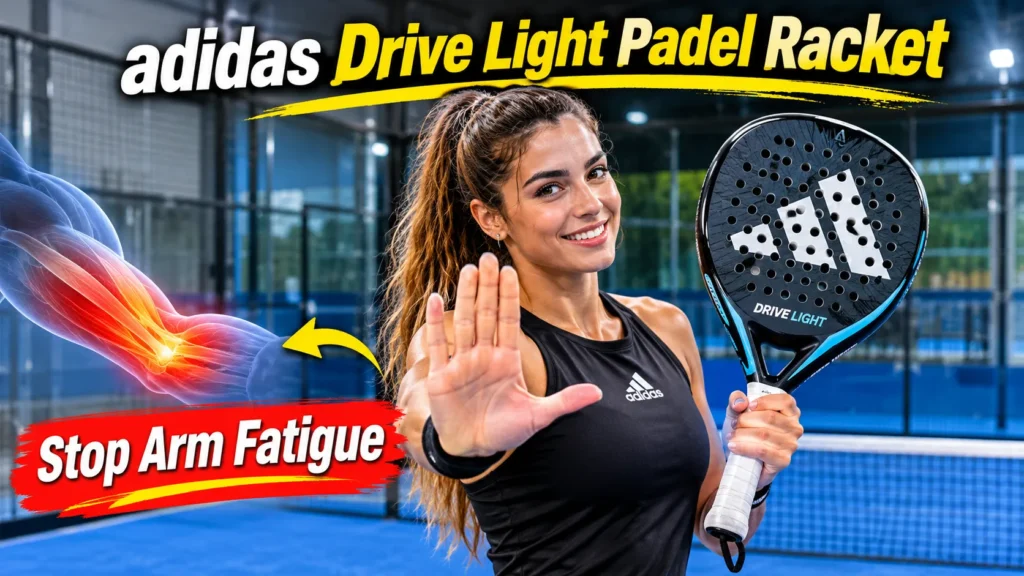
There is a silent threshold in club-level padel where raw power yields to reactionary speed—a truth magnified tenfold under the damp, heavy atmospheric conditions typical of British winter fixtures. Dragging a sluggish, head-heavy frame through a two-hour evening session doesn’t just drain your stamina; it quietly accelerates forearm fatigue and joint strain. Shifting from an unwieldy club-grade bludgeon to a meticulously balanced kinetic instrument changes the entire equation. That exact mechanical turning point is where the adidas drive light padel racket fundamentally reshapes court dynamics, offering UK players an uncompromising blend of ergonomic relief and rapid defensive recovery.
adidas Drive Light Series
Verified Technical Specifications · 2026
adidas drive light 3.3 padel racket review
The transition from generic, club-provided rental equipment to a specialised personal frame marks the most critical phase in a player’s technical development. When analysing the foundation of the modern lightweight control sector, the 3.3 iteration established a formidable benchmark. Engineered explicitly for the “Discovery” tier, this racket systematically dismantled the misconception that entry-level equipment must be inherently heavy and cumbersome. By strictly isolating the mass parameter, the brand created an instrument that actively compensates for developing swing mechanics rather than punishing them.
The adidas Drive Light 3.3: Establishing the Benchmark
Anatomical Breakdown
The architectural triumph of the 3.3 model lies in its meticulous weight distribution. Weighing strictly between 345 and 360 grams, the racket boasts an exceptionally low balance point, shifting the centre of gravity directly adjacent to the player’s hand. This engineering decision drastically reduces the dynamic swingweight. In practical terms, while the static mass reads 355 grams on a scale, the aerodynamic resistance during an overhead swing feels noticeably lower, granting the player exceptional reactionary speed at the net. Furthermore, the classic round mould maximises the 519 cm² surface area, delivering an expansive, perfectly centralised sweet spot.
However, an objective evaluation reveals a notable ergonomic limitation regarding the factory grip. Supplied with a highly minimal, thin polyurethane base grip over a standard 455mm overall length, players with average-to-large hands often find the circumference too restrictive. This forces a “death grip” scenario, increasing isometric tension in the forearm. To achieve optimal ergonomic comfort, it is virtually mandatory for UK players to build up the handle thickness using quality overgrips immediately after purchase.
Core Performance
The engine driving the 3.3’s defensive supremacy is its EVA Soft Performance core, easily identifiable within the adidas padel engineering catalogue by its black butt-cap. This low-density rubber is highly compressible. When the ball impacts the flexible fibreglass face, the core deforms deeply, absorbing the kinetic shockwaves before they can travel down the shaft and into the player’s joints. This exceptional acoustic and kinetic dampening makes the frame highly recommended for players prioritising joint relief and long-term ergonomic comfort.
The synergy between the elastic fibreglass and the soft EVA creates a pronounced “trampoline effect”. For a developing player, this means that deep, defensive lobs from the back glass require minimal physical exertion; a compact, well-timed block is sufficient to propel the ball deeply into the opponent’s territory. The primary drawback, however, is a heavily capped power ceiling. Aggressive, flat smashes tend to “bottom out” the soft core, absorbing the energy rather than transferring it aggressively through the court surface.
The Evolution: adidas drive light 3.4 padel racket & 2026 Iteration
As the sport’s tactical demands evolved, so too did the Discovery lineup. The introduction of the adidas drive light 3.4 padel racket, and its seamless transition into the current adidas drive light 2026 padel racket, represents a subtle but highly strategic refinement of the original blueprint. Retaining the strict 345–360 gram weight limit, the newest iterations focus on enhancing structural longevity and tactical versatility without alienating the core demographic. For those seeking to deepen their understanding of how modern equipment balances these metrics, exploring our comprehensive guide on how to choose a padel racket is highly recommended.
Anatomical Breakdown & Structural Reinforcements
The most significant anatomical shift in the 2026 model is the adoption of the ALLROUND (hybrid) shape, subtly transitioning away from the strict, perfectly circular geometry of its predecessor. This hybridisation slightly elevates the sweet spot, providing a fractional increase in leverage for offensive volleys without compromising the racket’s legendary defensive forgiveness. To combat the mechanical fatigue that typically plagues lightweight fibreglass frames, the 2026 model integrates the Structural Reinforcement perimeter system. This continuous reinforced carbon-fibre tubing prevents the head from twisting violently during off-centre defensive blocks against heavy smashes.
A crucial update addresses the biomechanical reality of the UK player base: the prevalence of the two-handed backhand, a direct consequence of tennis crossovers. While the absolute handle length remains restricted by FIP regulations, the new throat geometry allows players to cleanly wrap a secondary overgrip higher up the bridge. This simple, user-applied modification artificially extends the gripping real estate, accommodating a stable, two-handed grip that vastly improves backhand return consistency.
Core Performance & The UK Winter Factor
The thermodynamic behaviour of the 2026 model requires specific attention from the UK consumer. Padel materials are highly sensitive polymers. When exposed to the typical British winter (regularly dropping below 10°C), the EVA Soft Performance core undergoes a distinct physical stiffening. The plush, bouncy sensation experienced during summer months transforms into a slightly firmer, more direct response. While this stiffening marginally reduces the trampoline effect, the 2026 Drive Light utilises the softest foam available in the catalogue, ensuring it remains significantly more playable in cold weather than denser, carbon-heavy alternatives that can feel like rigid timber in December.
Moisture management is equally critical. The fibreglass face, while highly elastic and comfortable, is inherently more porous than premium carbon fibre. In high-humidity UK conditions or when playing with damp, heavy balls, the surface can absorb ambient moisture, leading to a deadened, “mushy” impact sensation and premature material degradation. Proactive maintenance is non-negotiable: players must diligently dry the racket face with a microfibre cloth post-match and store it securely within a thermo-insulated racket bag to preserve the core’s kinetic properties. To see how this frame stacks up against other ultralight options in damp climates, review our breakdown of the lightest padel rackets currently dominating the market.
Head-to-Head: adidas Drive Light vs. Internal & External Competitors
To fully validate the investment in an adidas drive light padel racket 2026, it is imperative to benchmark its performance metrics directly against its closest rivals. Evaluating a racket in a vacuum often obscures its true functional value on the court.
Internal Rivalry: Drive Light 2026 vs. Match Light 2026
Within the brand’s own Discovery tier, the Drive Light and Match Light represent two distinct philosophies operating at the exact same price point. Both utilise the 345–360g weight profile, fibreglass construction, and EVA Soft Performance core. The divergence is purely geometric. The Match Light employs a more pronounced teardrop architecture, raising the balance point slightly higher up the face. This provides superior leverage for players who naturally default to an aggressive, attacking game. However, for sheer defensive consistency, rapid net transitions, and maximum ergonomic joint protection, the lower balance of the Drive Light remains mathematically superior. For a broader perspective on the brand’s complete hierarchy, consult our definitive overview of every modern adidas padel racket available.
External Market Benchmarks: Bullpadel and Nox
When placed against rival giants in the UK market, the Drive Light 2026 fiercely defends its territory:
- Against the Bullpadel Indiga CTR: The Indiga is a formidable control racket, but it typically weighs in heavier, between 360 and 370 grams. While this extra mass offers excellent stability when blocking heavy shots, it can induce premature forearm fatigue during two-hour sessions. The strict sub-360g parameters of the Drive Light make it far superior for players seeking extreme aerodynamic ease.
- Against the Nox X-One: The Nox X-One is arguably the Drive Light’s closest competitor, featuring a highly comfortable HR3 core and a round face. Both offer outstanding vibration dampening. However, the integration of the Smart Holes Lineal technology in the adidas model provides a slight edge in resisting the micro-fissures that eventually plague fibreglass faces, translating to slightly better long-term structural durability.
For an exhaustive comparison of how these entry-level titans compare in terms of commercial value, explore our analysis of the best budget padel racket options, or dive deep into the wider national landscape by reviewing the most popular padel rackets uk players are currently adopting.
Frequently Asked Questions (FAQ)
Is the adidas drive light 2026 padel racket suitable for aggressive attacking players?
No. The ultra-low weight profile and highly compressible soft core are explicitly engineered for defensive manoeuvrability, control, and ergonomic comfort. When striking aggressive, flat smashes, the racket lacks the upper-head mass and stiffness required to generate explosive, point-ending penetration. It acts as a highly forgiving training tool, not a raw power instrument.
How does the UK winter climate affect the fibreglass and EVA core performance?
The thermodynamic reality of cold weather (below 10°C) causes the low-density EVA foam to temporarily stiffen, marginally reducing the “trampoline effect” and sweet spot responsiveness. Additionally, the fibreglass face is susceptible to moisture absorption from damp courts. To preserve structural integrity and kinetic performance, players must meticulously dry the racket post-match and store it in a dedicated, thermo-insulated bag.
Do I need to modify the factory grip to execute a two-handed backhand?
Yes, it is highly recommended. The racket ships with a thin factory grip on a standard-length handle. UK players transitioning from tennis typically apply a high-quality overgrip, wrapping it slightly higher up onto the throat/bridge of the racket. This artificial extension not only accommodates a comfortable two-handed hold but also increases the handle’s circumference, preventing the “death grip” that leads to severe forearm fatigue.