Raw power is the most overvalued currency on a British padel court. When the temperature drops below 8°C on a damp synthetic surface, the wrong carbon layout turns an aggressive swing into a tactical liability, leaving you horribly exposed during high-velocity exchanges against the glass. True court dominance is never forced—it is meticulously engineered. For UK club competitors who understand that surgical precision neutralises brute force, relying on a generic, beginner-moulded frame is simply competitive self-sabotage.
Upgrading to an adidas control padel racket is not merely an aesthetic choice; it is a calculated paradigm shift. It offers the structural stability and thermodynamic adaptability required to absorb a punishing smash and instantly reprogramme it into a clinical, pinpoint counter-attack. If you are ready to stop bleeding points on unforced errors and start dictating the exact tempo of every rally, the secret lies hidden in the carbon matrix beneath your grip. Here is the unfiltered technical anatomy of what it actually takes to weaponise your defensive game this season.
Best adidas Control Padel Racket Options
Verified specs & UK market data (2026) · By recommended protection
Comprehensive Adidas Adipower Control Padel Racket Review: Technical Anatomy
The engineering core of the adidas adipower control 3.2 padel racket centres upon its non-traditional frame setup. While legacy racquet manufacturing relied primarily on standard carbon tubular frames, this silhouette bridges modern aerodynamic technology with the rigorous structural constraints of modern court sports, providing a missing angle that most competitors overlook.
- The Dual eXoskeleton Matrix: Utilising double-height, 100% carbon ribs integrated directly into the heart of the frame, this primary structural engine offers exceptional torsional resistance. When defending heavy smashes, the ribs absorb massive kinetic energy before rebounding it immediately, preventing the frame from twisting and ensuring the ball stays on its intended trajectory.
- The EVA Core Boundary: Because padel involves extreme climatic variances in the UK, the internal foam requires a structural countermeasure. The internal high-memory EVA chassis locks the strike zone into place during sharp, flat volleys, providing zero artificial trampoline effect and rewarding pure, mechanical swing speed.
- Spin Blade Mould Mechanics: The surface formulation incorporates a multi-directional 3D relief pattern etched directly into the carbon mould. This allows players to execute sudden, heavily sliced bandejas near the rear glass walls without the ball sliding off the racket face in damp conditions—a common failure in cheaper, sand-grit decal alternatives.
The outer layer balances ultra-stiff structural yarns with a highly reinforced perimeter shield. This carbon shield prevents immediate premature wear caused by continuous scraping against the glass during low defensive lunges. For players analysing options across the entire brand matrix, evaluating the dedicated structural differences outlined in our analytical look at the adidas adipower ctrl 3.2 padel racket provides clear contextual background before buying.
EVA High Memory vs. EVA Soft Performance: Deciding on your Weapon
Navigating the product family requires a clear understanding of the mechanical differences between the rigid flagship layout and its softened counterpart. Selecting your specific version dictates your tactical efficiency and how well your equipment responds to the unpredictable British climate.
The Thermodynamic Variance
The EVA High Memory architecture (found in the 3.2) focuses extensively on energy return and structural rigidity. However, the hidden variable is thermodynamic sensitivity. When ambient temperatures drop below 8°C on an outdoor UK court, the dense EVA polymer chains tighten, turning the racket into an unyielding board that shrinks the sweet spot. Conversely, the EVA Soft Performance configuration (in the 3.3) employs a low-density foam compound designed for climate adaptability. This gives cold-weather players a sharper sense of court feel and maintains elasticity, though it succumbs to a “mushy effect” in humid, 20°C+ indoor centres, absorbing too much kinetic energy during aggressive overheads.
Carbon Filament Discrepancies
The extreme density of the premium 15K Aluminised Carbon on the 3.2 introduces an undeniable crispness, pushing the tactile feedback to instantaneous levels. The 3K Carbon option on the newer 3.3 model drops this stiffness noticeably, providing a floating, pocketing sensation for nimble baseline defenders. This material variance reflects clearly across UK commercial retail channels, where players must choose between absolute surgical precision (15K) and effortless, trampoline-assisted depth (3K).
If you are a high-level competitor seeking to match advanced structural dynamics with elite-tier control tools, exploring the definitive mechanics detailed in our guide to the best padel rackets for advanced players will ensure your entire equipment setup functions in perfect technical alignment.
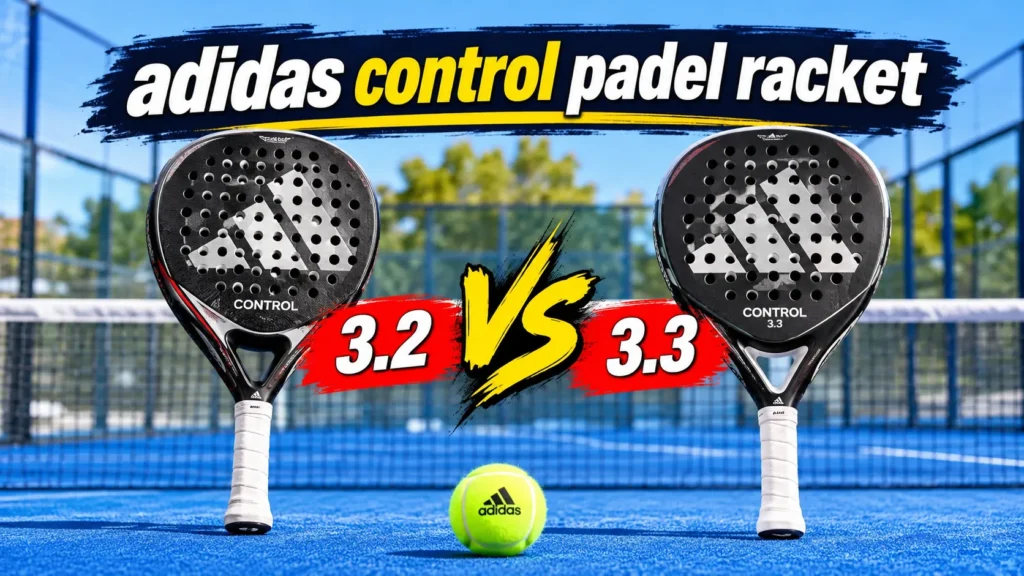
Head-to-Head: adidas adipower control 3.2 padel racket vs. adidas adipower control 3.3 padel racket
For players trying to choose between the premium adidas adipower control 3.3 padel racket and its legendary 3.2 predecessor, the choice comes down to a fundamental split in design philosophy and identifying critical missing angles that most marketing materials omit.
The primary differences in on-court performance and structural engineering are detailed below:
- The Multiweight Controversy: Both generations feature a “Multiweight” spin-off variant, allowing players to shift balance via stainless steel screws. However, the hidden flaw is that drilling weight tracks directly into the carbon perimeter creates severe stress concentration points. Standard, non-multiweight models of both the 3.2 and 3.3 boast a continuous carbon perimeter, drastically outperforming the customisable versions in long-term structural integrity.
- The Handle Length Dilemma: A major missing angle for UK players transitioning from lawn tennis is handle ergonomics. Both the 3.2 and 3.3 feature a restrictive 11-centimetre handle. While this low fulcrum point is brilliant for rapid net reflexes, it completely eliminates the space required for a biomechanically sound two-handed backhand drive. Tennis converts are often forced to look toward alternatives like the Cross It CTRL, which features an elongated 13cm grip.
- Tactical Ball Output: The 3.2 dominates the offensive volley category through its rigid matrix, which locks the ball trajectory down completely. The softer core system used by the 3.3 provides excellent fluid depth on defensive lobs but yields slightly more micro-second delay under extreme, high-velocity smash extensions.
For a complete, comprehensive overview of the broad variety of choices currently occupying the competitive landscape across British clubs, take a moment to explore the official adidas padel equipment portal to select your ideal structural fit.
Essential Thermal Shielding: Bags and Covers
Given the extreme thermodynamic vulnerabilities of EVA foam detailed earlier, the role of padel luggage transcends simple transportation. A high-quality racket bag must function as an environmental shield, protecting the delicate internal polymers from extreme UK temperature cycling.
adidas control 3.2 padel racket bag: The Standard Setup
The adidas control 3.2 padel racket bag represents a highly functional storage solution designed for the club player. Operating with a capacity designed to hold up to 7 rackets within its 56cm x 18cm x 42cm frame, its practical application usually involves transporting one or two rackets alongside basic apparel. Constructed from standard 100% polyester, it offers basic water resistance but lacks specialised environmental protections, making it ideal only for mild conditions or exclusively indoor transitions.
adidas control 3.3 padel racket cover & Bag: Why ThermoTech is Crucial
The transition to the upgraded adidas control 3.3 padel racket cover and full-size bag introduces vital upgrades in material sustainability and thermal defence. The integration of ThermoTech insulated compartments is non-negotiable for premium rackets. This reflective lining isolates the racket from external temperature fluctuations in cold car boots, preserving the elasticity of the EVA foam. Furthermore, the 3.3 series upgrades to 100% recycled PES 900D polyester with a PU coating for superior water repellency, ensuring your gear remains dry during persistent British downpours. Pairing your racket with a dedicated adidas padel bag ensures maximum lifespan for your high-performance equipment.
adidas control padel racket – FAQ
Are these control rackets constructed entirely within the UK?
No. While conceptual design work, aerodynamic prototyping, and structural testing are managed at international corporate hubs, production components and specialised carbon assemblies are handled by premier manufacturing partners in Asia, matching standard practices across the premium sporting goods industry.
Can I safely utilise aftermarket stainless steel screws to adjust the standard model’s balance?
It is highly discouraged. Unless you possess the specific Multiweight variant, attempting to drill or force weighted screws into a standard continuous carbon frame will instantly compromise the structural integrity, leading to catastrophic micro-fractures during high-velocity impacts.
How does the short handle length impact response speed compared to generic tennis variants?
The inclusion of the 11cm handle lowers the fulcrum point and the swing weight significantly over dedicated long-handle rackets. While this removes the real estate needed for a two-handed backhand, it grants unmatched instantaneous micro-response and aerodynamic manoeuvrability during hyper-fast net volleys.