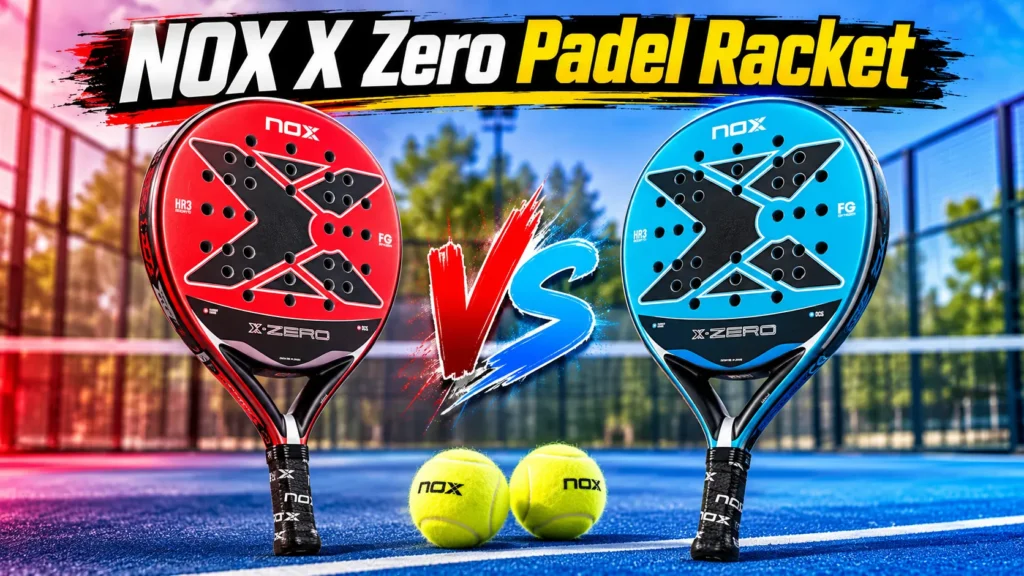
Under £60, carbon-framed and stamped with an independent durability seal. That’s a rare mix at the entry level of the UK padel market, and it’s exactly where the NOX X-Zero padel racket sits. NOX, the Spanish brand behind Agustín Tapia’s AT10 range, built this racket for beginners and improving club players who would rather win points with placement than with brute force. Two questions follow.
Does the colourway actually change anything between the NOX X-Zero red padel racket and the NOX X-Zero blue padel racket? And can a racket at this price survive three sessions a week at your local club? This NOX X-Zero padel racket review answers both, starting with the spec sheet NOX publishes itself, before any retailer adds its own spin.
Type “NOX X Zero padel racket” into a search engine and the results contradict each other surprisingly quickly. One UK shop lists a carbon-fibreglass hybrid frame, another reduces the core to plain “foam”, and an automated comparison blog claims NOX never published the core material at all. None of that matches the manufacturer’s own documentation. Club rentals across the country are being swapped for first personal rackets, so getting the facts right before you spend £50–£60 matters more than ever. This review cross-checks every claim against noxsport.com and covers the practical questions that most rival reviews skip.
Comprehensive NOX X-Zero Padel Racket Review: Anatomical Breakdown and Core Performance
The engineering heart of this NOX X-Zero padel racket review is a four-layer build that prioritises control over raw pace. Rather than borrowing expensive materials from NOX’s tour range, the X-Zero uses accessible components arranged to keep the ball on the racket face for longer and to forgive imperfect timing.
- The Carbon Perimeter: A 100% carbon frame forms the outer hoop. It gives the head a rigidity that budget all-fibreglass frames usually lack, so the face twists less when you catch a defensive block near the edge.
- The Hitting Faces: Both sides use NOX’s “Fiber Glass 3K” with a matt finish. Fibreglass flexes more than carbon, creating a gentle trampoline effect that helps short, compact swings clear the net. The surface is smooth, with no sand grit or 3D relief.
- The Soft Core: Inside sits “HR3 White EVA”, a low-density, soft-touch rubber. It cushions impact and gives easy ball exit at moderate speeds, but it also absorbs energy when you try to accelerate through a hard overhead.
- The Optimised Hole Pattern: NOX re-drilled the face to widen the central sweet spot and reduce the penalty on off-centre contact. This is the feature that separates the X-Zero from the X-Hero.
- The Independent Seal: NOX states that its entire Essential collection is quality certified by Testea Padel. That external check of strength and consistency is rare in the sub-£60 bracket.
The angle most reviews miss is the gap between NOX’s own numbers and independent testing. NOX rates the racket at 100/100 for control and 75/100 for power. Cross-level review databases such as Padelful and PadelGuru score its power far lower, at around 4.5–5.0/10, while agreeing on control (roughly 6.9–8.2/10) and comfort (around 8.0/10). Both views hold up: the 75/100 figure reflects how easily the ball leaves the face at beginner swing speeds, and the lower independent scores reflect what happens once you start hitting hard.
NOX X-Zero Red: The Reference Unit
We treat the NOX X-Zero red padel racket (code PXZERORE) as the reference version, so it carries the full on-court verdict for this review. From the back glass it feels calm and predictable, soaking up incoming pace on lobs and defensive returns even when you are late on the ball. At the net it is light enough for quick hands but lacks the crisp bite of firmer carbon faces. Note that the Red is currently on backorder at noxsport.com, so UK stockists are often the faster route.
- Pros: Large, forgiving sweet spot; a soft feel with less off-centre sting; a carbon frame and an independent quality seal for under £60; steady baseline defence that keeps rallies alive.
- Cons: A low power ceiling on smashes; a smooth face that offers limited spin; no cover or wrist strap in the box; restricted direct availability at the time of writing.
NOX X-Zero Blue: Identical Performance, Different Price Tags
The NOX X-Zero blue padel racket (code PXZEROBL) shares every structural element with the Red: the same 350–360 g weight range, 38 mm round mould, carbon frame, matt fibreglass faces, soft EVA core and optimised hole pattern. NOX also charges the same €64.99 for both colourways. So the decision comes down to looks, stock and price, and UK retailers do not always price the two the same.
- Choose Blue if: it is in stock when the Red is not, or a stockist has it on offer; Express Padel, for example, listed the Blue from £52.99.
- Watch out for: the same limitations as the Red, so the colour will not add power or spin.
NOX X-Hero (Sister Model): Gloss Finish, Standard Holes
Automated blogs often blur the two, but NOX publishes only two differences between the X-Zero and the X-Hero. The X-Hero uses a gloss finish and a standard hole pattern, aiming for consistency and easy handling rather than maximum forgiveness. The materials, the round mould, the core and the €64.99 price are otherwise the same, and the X-Hero comes in White, Red and Blue. Any UK listing that describes the X-Hero as diamond-shaped or head-heavy is wrong: it is round.
- Pros: A wider choice of colours, a classic gloss look and the same accessible price point.
- Cons: It lacks the X-Zero’s optimised hole pattern, so slightly less forgiveness on mishits for genuine beginners.
You can confirm every specification above in the official NOX Essential Series specifications. For context on where these two entry rackets sit within the brand’s wider line-up, browse our overview of the full NOX padel racket range before you commit.
Red vs Blue vs Black/Gold: Deciding on Your NOX X-Zero Blue Padel Racket
Searchers comparing the NOX X-Zero blue padel racket with the NOX X-Zero red padel racket usually suspect a hidden difference in feel. There isn’t one. What does vary is availability, retailer pricing and one limited cosmetic edition that appears regularly in social media clips.
The Specification Variance
Colour changes nothing mechanically, but the 10 g weight tolerance does. NOX specifies a 350–360 g range, so two rackets of the same colour can differ more than a Red and a Blue chosen at random. If you are a lighter player or prefer quick hands at the net, ask your stockist to send a unit close to 350 g. Few buyers know to ask, yet it affects how the racket feels far more than its colour.
Price and Availability Discrepancies
In November 2026, UK specialist stockists priced the X-Zero between £52.99 and £61.99. Express Padel listed the Blue and PDHSports the Red from £52.99, Racketworld listed the Red at £56.99 against £59.99 for the Blue, and Padel Market sat at £61.99. Ordering direct from noxsport.com at €64.99 leaves you €0.01 short of NOX’s €65.00 free-shipping threshold, so a UK stockist usually gives faster dispatch and a lower total. The Black/Gold livery is a cosmetic PadelPROShop exclusive at €79.00 with no performance change. Before choosing a twin-set bundle, always add up the price of two single rackets plus a tube of balls, because the bundle is not always cheaper.
If your budget is tight and you want to see how the X-Zero compares with other entry-level value picks across British retailers, our guide to the best budget padel racket options lays out the wider market clearly.
How the NOX X-Zero Padel Racket Plays: Defence, Volleys and Overheads
On court, the NOX X-Zero padel racket behaves exactly as its build suggests: generous and calm when you are under pressure, and limited when you try to finish points with force. The breakdown below follows a typical rally from the back glass to the net.
- Back-Glass Defence and Lobs: This is the racket’s strongest area. The wide sweet spot and elastic fibreglass absorb incoming pace smoothly, so high defensive lobs land deep even when your contact point drifts.
- Net Volleys: It is agile and steady for compact, placement-first volleys. During fast exchanges at the net, however, it lacks the solid weight and bite of firmer carbon-faced frames.
- Bandejas: Tidy, repeatable and easy to control, which makes it ideal for learning the shot without overhitting.
- Víboras and Flat Smashes: This is where it runs out of gears. The soft core compresses on aggressive swings, so winners off the glass or over the fence are hard to come by.
- Spin: Buyers often confuse “matt” with “rough”. The X-Zero’s matt coat is completely smooth, so any spin comes from your swing path alone. That smooth face gives clean, predictable contact for learners, but it limits the grip on sliced shots for improvers.
If you are building your overhead game around this racket, refine your technique with our step-by-step guide to the bandeja, then move on to our breakdown of the more aggressive víbora once your timing is reliable.
Match-Ready Weight: What 350–360 g Really Feels Like on Court
No ranking review works out the weight you actually play with, yet it is one of the most common questions new owners ask. A bare NOX X-Zero weighs 350–360 g, but almost nobody plays it bare once they own it.
- Out of the Wrapper: 350–360 g, with mass sitting centrally to slightly towards the handle (Tennis-Point lists a 260 mm balance point).
- Add an Overgrip: plus 5–7 g at the handle.
- Add a Frame Protector: plus 7–10 g, placed right at the tip of the head.
- Match-Ready Total: roughly 362–377 g, with the balance nudged slightly towards the head. This explains why some players feel the racket is heavier than their old club rental.
Lighter players who prioritise manoeuvrability can skip heavy head tape or choose a slimmer option. Compare the choices in our guides to the right padel racket grip and the most practical padel racket protector designs.
Cold, Damp UK Courts: The Winter Angle Other Reviews Ignore
Many British venues run open-air or unheated canopy courts through autumn and winter, where evening temperatures often hover around 5 °C. As a ball cools from 20 °C to 5 °C it loses slightly over 1 psi of internal pressure, bounces lower and feels heavier at contact. Every EVA core stiffens in the cold too. High-density cores can feel dead and harsh on mishits in winter, whereas the X-Zero’s low-density “HR3 White EVA” keeps noticeably more elasticity, so it stays comfortable and predictable through January club nights.
- Store It Indoors: Never leave it in a car boot or garage overnight, because sharp temperature swings stress the bond between the resin, fibreglass and foam layers.
- Wipe It Down: Remove court moisture and condensation after damp outdoor sessions.
- Let It Acclimatise: Give a cold frame 15–20 minutes at court temperature before hitting full-pace overheads.
Durability, Warranty and What’s Actually in the Box
Can it handle three sessions a week? Structurally, the carbon frame and the Testea Padel seal give it more edge resilience than most rackets at this price. Players on r/padel and r/Padelracket report two recurring caveats across NOX’s budget range: occasional minor cosmetic blemishes in paint or logo alignment, and soft EVA cores losing some liveliness after roughly 6–12 months of frequent play. Treat that timeline as reported experience rather than a manufacturer figure. Hitting the fence or glass with the frame shortens its life faster than anything else.
- Buying Direct: NOX offers a 2-year warranty on purchases from noxsport.com, activated through its online racket registration.
- Buying from a UK Stockist: NOX states that claims must go through the retailer that sold the racket. PDHSports, for example, quotes defect cover of up to 1 year.
- Typically Covered: A clean manufacturing defect, such as a frame crack with no signs of wear or impact.
- Typically Excluded: Cracks with glass or floor scuffs, dents, multiple fractures, loose butt caps and gradual wear of the core. Many stockists also refuse change-of-mind returns once the plastic wrap is removed from the handle.
Don’t assume a branded racket arrives fully kitted out. NOX lists no cover, frame protector or SmartStrap® wrist cord for the X-Zero, and PDHSports confirms that no cover is supplied, though Ultimate Padel adds its own store bag as a perk. Budget an extra £5–£15, and pick a suitable padel racket cover to protect your investment between sessions.
Head-to-Head: NOX X-Zero Red Padel Racket vs. HEAD Evo Speed
For players weighing the NOX X-Zero red padel racket against the HEAD Evo Speed, the choice comes down to two different ideas of how a beginner should learn. Both sit near the £55 mark at UK retailers, but they reward different styles of play.
The primary differences in on-court performance are detailed below:
- Head Shape and Sweet Spot: The X-Zero’s round head centres the sweet spot low and wide, which suits defence and forgiving blocks. The Evo Speed’s teardrop head lifts the sweet spot slightly, adding leverage on overheads at the cost of some control from the back glass.
- Feel and Frame: The X-Zero’s carbon perimeter feels more stable on off-centre contact. The HEAD frame feels a little livelier and more all-round, which some learners prefer once they start attacking.
- Price and Value: The X-Zero starts lower, at £52.99 against roughly £56.99 for the Evo Speed, and adds the Testea Padel seal. It wins on paper value per pound.
- The Verdict: Pick the X-Zero if you are a pure beginner who mostly defends and wants rallies to last. Pick the Evo Speed if you already feel comfortable at the net and want a little more help with your smash. Tight-budget shoppers might also look at the lighter Adidas Match Light, which usually sells for less.
For a closer look at the rival frame, read our full review of the HEAD Evo Speed padel racket, alongside our independent guide to how to choose a padel racket to match shape, weight and balance to your game.
When to Upgrade: Life After the NOX X-Zero
Retailers often market the X-Zero to “beginners and intermediate players”, but its smooth face and soft core set a clear ceiling. Once-a-week social players can enjoy it for one to two years. Players on court two or three times a week, and anyone arriving from tennis or squash, tend to outgrow it within 6 to 12 months, when they start wanting sharper finishing pace and more spin.
- Same Family, Small Step: The X-One and X-One Silhouette cost €15–€20 more direct but keep the same round, recreational positioning. Most beginners are better off saving that money.
- Real Intermediate Step: The NOX Equation Advanced (around £97.99) and the classic ML10 Pro Cup (around £106.81) add rough-surface spin and firmer feedback while keeping a round control shape.
- Attacking Step: The AT10 range introduces teardrop power for improvers ready to finish points.
When the time comes, compare our dedicated reviews of the NOX X-One, the spin-friendly NOX Equation and our in-depth AT10 Genius 18K Alum review to plan a logical next step. Until then, the X-Zero remains one of the most honest, well-built first rackets you can buy in the UK for under £60.
Frequently Asked Questions (FAQ)
Is the NOX X-Zero worth buying as a first padel racket?
Yes, for genuine beginners and once-a-week social players. From £52.99 at UK stockists, you get a 100% carbon frame, a soft EVA core, an optimised sweet spot and Testea Padel certification, which is strong value compared with worn club rentals.
Is there any difference between the NOX X-Zero Blue and Red?
No. The Blue (PXZEROBL) and Red (PXZERORE) share identical materials, weight, shape and official €64.99 pricing. Buy whichever colourway is cheaper or in stock at your preferred UK retailer.
Is the NOX X Zero padel racket good for intermediate players?
Only for intermediates who play mainly from the back of the court. Independent testers score its power around 4.5–5.0/10, so players who rely on smashes and spin will want a rough-faced intermediate racket instead.
Is 360 g too heavy for a beginner?
Not usually, but remember that an overgrip and a frame protector push playing weight to roughly 362–377 g. Lighter players can ask for a unit near 350 g and skip heavy head tape.
Does the NOX X-Zero come with a cover?
No. NOX does not list a cover, frame protector or SmartStrap® for the X-Zero, and some UK stockists confirm none is supplied. A few retailers add their own bag as a store perk.
Does the X-Zero work on outdoor courts in a British winter?
Yes. Its low-density EVA core stays more elastic in cold air than firmer cores. Store it indoors, wipe away moisture after damp sessions and let it acclimatise for 15–20 minutes before full-pace play.