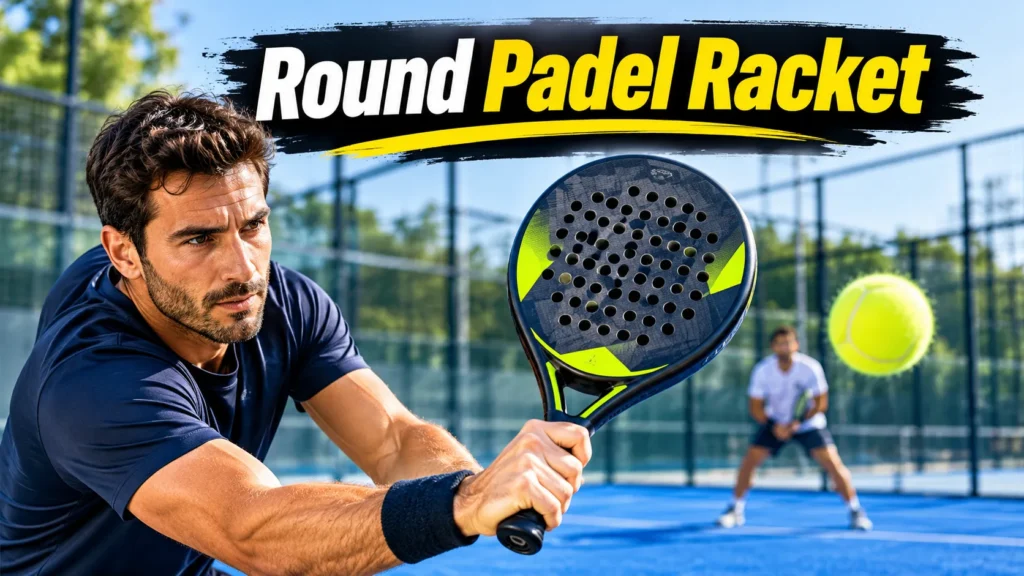
Power gets the applause, but control dictates the scoreboard. Walk into any padel club across the UK, and you will quickly spot players aggressively smashing the ball into the back glass, wondering why their top-heavy, diamond-shaped bats are bleeding points in defence. The brutal truth is that mastering the tactical game—and neutralising heavy opposition fire—starts with a round padel racket. Engineered with a low balance and a highly forgiving, oversized sweet spot dead in the centre, these frames offer the surgical precision required to dominate long rallies.
Whether you are transitioning from tennis or actively seeking to eradicate unforced errors from your technique, investing in the best all round padel racket provides an immediate, tangible upgrade to your court coverage. As the market floods with advanced carbon tech, identifying the right specifications among modern round head shape padel rackets is critical. If you are currently navigating a round head shape padel rackets sale to secure elite gear without the premium price tag, here is the definitive, data-backed breakdown of the top-tier control frames currently dominating the sport.
Best Round Padel Rackets
UK Range · Verified Specifications · Updated 2026
Round padel racket review: Anatomical Breakdown and Core Performance
The engineering core of any modern round padel racket centres upon its ability to maximise the coefficient of restitution (COR) while maintaining a low moment of inertia (swingweight). While legacy racquet equipment relied primarily on static weight, modern round head shape padel rackets bridge advanced composite technology with the rigorous defensive constraints of modern court sports. Let us explore the missing angles that major competitors often overlook.
- The K-Count Carbon Illusion: A widespread myth in the padel community is that a higher K-count (like 18K) automatically means a stiffer, harder racket. In composite engineering, the K-count merely indicates the thousands of carbon filaments per tow. The actual flexural modulus (stiffness) is dictated by the epoxy resin matrix and the core density. For instance, an 18K aluminised carbon face can actually play softer and more forgivingly than a standard 12K carbon face depending on the internal layering.
- UK Climate Impact on EVA Dynamics: Most reviews ignore how materials respond to the cold, damp weather typical of the UK. Standard high-density EVA cores physically contract and harden in temperatures below 12°C, drastically reducing the racket’s trampoline effect and transferring raw shock to the arm. Round padel rackets utilising Soft EVA or Polyolefin cores remain elastic in freezing conditions, making them vital for winter leagues.
- Swingweight vs. Static Mass: Adding accessories alters mechanical performance. Installing an ergonomic grip (which weighs roughly 14–17g) pulls the balance point further down. While this increases the static weight, it drastically lowers the swingweight, enhancing defensive manoeuvrability at the net but slightly reducing the leverage required for heavy smashes.
The outer layer balances ultra-lightweight structural carbon with intelligent vibration dampening systems. This composite shield prevents immediate premature wear caused by continuous high-velocity impacts. For players analysing options across the entire brand matrix, evaluating the dedicated structural differences outlined in our analytical look at a carbon fibre padel racket provides clear contextual background before buying.
Check How to Choose a Padel Racket Guide
Round padel racket for beginners
When entering the sport, the physical transition can be mechanically jarring, especially for those migrating from tennis. Tennis converts often utilise excessively long swing paths and heavy wrist pronation, which, when paired with a stiff, head-heavy racket, leads to significant mechanical strain and mistimed shots. The definitive solution lies in selecting a highly forgiving round profile.
For beginners, the ideal setup involves a fibreglass face paired with a soft EVA core. Fibreglass possesses a lower Young’s Modulus than rigid carbon, meaning it bends and rebounds effectively even at low swing speeds—a phenomenon known as the trampoline effect. This allows beginners to achieve deep, penetrating lobs and consistent defensive blocks without needing the explosive physical acceleration required to “activate” a rigid carbon frame. Furthermore, the expanded, centralised sweet spot forgives off-centre hits, reducing the harsh torsional twisting that sends high-frequency vibrations into the hand. If you are looking to start your journey without a massive financial outlay, exploring our curated list for the best budget padel racket is a sensible first step.
Head-to-Head: Nox ML10 Pro Cup Luxury vs Bullpadel Vertex 04 Control
For players trying to choose between the premium Nox ML10 Pro Cup Luxury and the highly technical Bullpadel Vertex 04 Control, the choice comes down to a fundamental split in design philosophy. Both models command top-tier placement across UK retail outlets but approach court dominance from completely opposing angles.
The primary differences in on-court performance are detailed in the comparison matrix below:
- Core Responsiveness: The Nox ML10 utilises the HR3 Soft EVA, which offers an incredibly plush, comfortable impact that swallows heavy balls and returns them with passive velocity. The Bullpadel features a MultiEva dual-density sandwich core; its rigid outer layer reacts to fast smashes, while the soft inner layer absorbs slow defensive shots.
- Aerodynamics and Frame Rigidity: Bullpadel dominates the aerodynamic category through its Air React Channel system and a 100% CarbonTube frame, allowing the racket to cut through the air faster for rapid net volleys. The Nox relies on a more traditional, stable structural profile that prioritises consistent, predictable feedback over outright air-speed.
- Surface Friction: Both rackets utilise textured faces for spin. However, the Nox employs a 3D rough silica sand finish that aggressively bites into the ball’s felt, which is highly advantageous when playing with damp padel balls on UK outdoor courts. The Bullpadel uses a 3D Grain polygonal finish integrated into the carbon, offering excellent, durable spin without the sandpaper feel.
For a complete, comprehensive overview of the broad variety of choices currently occupying the competitive landscape across British clubs, take a moment to read our detailed breakdown to find the best padel racket for beginners alongside our independent evaluation of the lightest padel rackets to select your ideal structural fit.
Frequently Asked Questions (FAQ)
Are round padel rackets strictly designed for beginners?
Absolutely not. While their massive sweet spot and forgiving nature make them perfect for novices, many top-ranked professional players who specialise in right-side defensive play use round rackets. They rely on the low balance for lightning-fast manoeuvrability and the unparalleled precision required to construct points tactically.
How does playing in the UK winter affect a round control racket?
The cold and damp conditions significantly alter material behaviour. In temperatures below 15°C, high-density EVA foam hardens, and the padel balls absorb moisture, becoming heavier. A round racket with a softer core (like Soft EVA or Polyolefin) and a fibreglass face will retain its elasticity, providing the necessary shock absorption and rebound to counter the heavy, deadened conditions.
Will adding a custom grip or protector ruin the balance of my round racket?
It will shift the balance, but not necessarily ruin it. Adding a frame protector at the top adds 5-10g, pulling the balance slightly higher. Conversely, installing a heavy ergonomic grip at the base adds 14-17g, pulling the balance lower. This increases the total static weight but reduces the swingweight, making the racket feel faster but slightly more demanding on the forearm over a two-hour match.