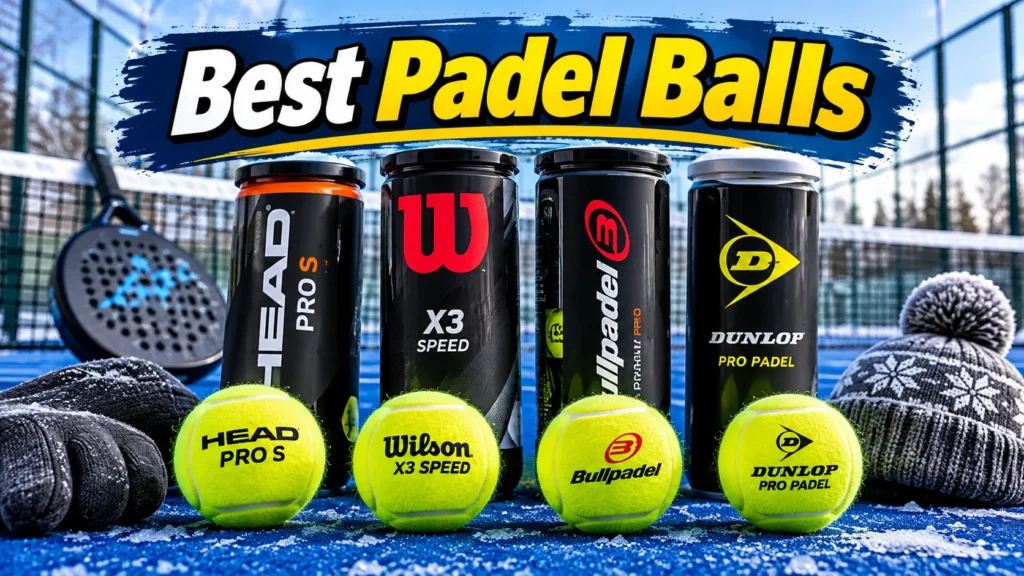
The unmistakable, lifeless thud of a depressurised bounce off the back glass dictates the harsh reality of playing through a damp British winter. Counteracting this climate-induced sluggishness isn’t about forcing raw power; it requires a calculated upgrade in core rubber thickness and internal PSI retention. Pinpointing the best padel balls engineered for low temperatures is the definitive tactical variable to restore explosive kinetic energy and outsmart unpredictable UK court conditions.
Best Padel Balls for UK Courts
Verified Technical Specs · 2026
what are the best padel balls
Answering this definitive question requires a comprehensive anatomical breakdown of the core performance metrics that separate elite choices from generic alternatives. In the UK market, the evolution from the best padel balls 2025 iterations to the advanced 2026 generations focuses heavily on maintaining internal PSI, optimising rubber wall thickness, and engineering felt density to withstand high humidity. Let’s dissect the top contenders dominating British clubs.
Head Padel Pro S+: The Winter Specialist
Head remains a dominant force on the global circuit, and their Pro S+ model has been explicitly re-engineered to tackle the sluggishness associated with cold, sea-level courts.
- Core Anatomy: This model features a natural rubber core that is 15% thicker than the standard Pro variant. This additional mass acts as a highly tensioned spring, capturing kinetic energy upon impact and delivering a significantly faster, more explosive rebound.
- Felt Engineering: It utilises an exclusive, compact felt designed specifically to enhance friction against the racket face. This allows advanced players to generate profound rotational spin without sacrificing aerodynamic speed.
- Pros & Cons: While it is undeniably brilliant for restoring pace during damp UK winters, it can become overly bouncy and difficult to control during the rare, hot summer days in indoor facilities.
For players dedicated to this brand matrix, exploring the specific structural mechanics of Head padel balls will ensure you pair the right model with your specific style of play.
Wilson Premier Padel Speed: The Tour Standard
As the official ball of the premier global circuit, this sphere represents the pinnacle of professional engineering.
- Dura-Weave Technology: Wilson integrates its proprietary Dura-Weave felt, which offers exceptional abrasion resistance on sandy courts while delivering a highly consistent, predictable response off the rear glass walls.
- Speed Optimisation: The “Speed” variant features a specially formulated core designed to inject pace into slower court conditions, making it highly effective for indoor halls and high-humidity environments.
- Pros & Cons: The tracking visibility (HiVis yellow) is exceptional. However, the premium tour status commands a higher retail price, making frequent replacements a costly endeavour for casual players.
If you prefer playing with the exact specifications used by touring professionals, our detailed analysis of Wilson padel balls provides further clarity on their tournament-level performance.
Dunlop Pro Padel and Bullpadel Premium Pro: Durability Kings
For high-frequency training, the Dunlop Pro Padel remains the official choice for LTA Grade 1 and 2 events in Britain. Operating at a highly pressurised 5.2 kg/cm2, it forcefully compensates for the friction of dense artificial grass. Conversely, the Bullpadel Premium Pro relies on a slightly lower pressure but features an incredibly dense rubber matrix. This high-density construction allows it to withstand severe mechanical deformation, making it highly popular among players who utilize external pressure recovery devices.
The Physics of Ball Pressure: Gauge vs. Absolute Pressure
A critical missing angle in most equipment discussions is the fundamental physics governing court speed. The International Padel Federation (FIP) mandates that a regulated padel ball must possess an internal pressure of 4.6 to 5.2 kilograms per 2.54 square centimetres. Translated into standard PSI (Pounds per Square Inch), this equals roughly 10.14 to 11.46 PSI above the surrounding atmospheric pressure.
However, this is merely the “Gauge Pressure.” Because atmospheric pressure at sea level in the UK is approximately 14.7 PSI, the “Absolute Pressure” inside the rubber core is actually between 25 and 28 PSI. Understanding this distinction is vital for two reasons. Firstly, as temperatures plummet during a British winter, the principles of thermodynamics dictate that the internal gas molecules contract. This drop in kinetic energy causes an immediate reduction in internal pressure, transforming a lively sphere into a heavy, unresponsive object. Secondly, this absolute pressure metric is the absolute baseline required when calibrating equipment to restore dead balls.
Engineering Longevity: Evaluating the best padel ball pressurizer
Because rubber is naturally porous, high-velocity impacts inevitably force internal gas out through the microscopic matrix. To combat this, the implementation of a best padel ball pressurizer is no longer a luxury for UK clubs, but a technical necessity.
- The Pascal Box System: Widely regarded as the gold standard in mechanical precision. Constructed from high-resistance polycarbonate and sealed with an exclusive O-ring, it safely generates and holds up to 48 PSI indefinitely. By subjecting used balls to a sustained pressure of 25 to 30 PSI, the system forces ambient air back through the rubber membrane, completely recharging the core within 72 hours.
- The Ball Rescuer: A highly ergonomic, lightweight (150g) alternative that transforms specific original plastic packaging (such as Head or Penn cans) into high-pressure chambers capable of sustaining 30 to 35 PSI. It features a smart depressurisation button for safety. However, players must be aware that certain brand containers (like Wilson) lack the structural integrity to withstand these forces and are strictly incompatible.
- Pressurebox Automation: Representing the technological vanguard, this unit integrates a micro-compressor and electronic sensors directly into the lid. It automatically monitors and maintains a high-pressure environment of 26 to 28 PSI without requiring manual pumping.
Crucially, players must avoid cheap, valveless screw-top tubes (like the standard TuboPlus). These devices merely shrink the internal volume to create roughly 14 PSI. Because this is far below the absolute pressure of the ball (25-28 PSI), these basic tubes only slow down gas leakage; they are physically incapable of pushing air back into the core to restore bounce.
Head-to-Head: Head Padel Pro S+ vs. Wilson Premier Padel Speed
When selecting the best padel balls uk competitors frequently narrow their choice down to the two giants of the industry. Understanding their contrasting structural philosophies dictates which one will align with your tactical requirements.
- Aerodynamic Drag and Felt Wear: The Head Pro S+ utilizes a highly compact weave that resists moisture absorption incredibly well in damp conditions, maintaining a consistent weight. The Wilson Premier Speed leverages its Dura-Weave technology to prioritize extreme abrasion resistance against the grit of the turf. While Wilson may retain its aesthetic visual clarity slightly longer, the Head model prevents the ball from becoming “heavy” during late-night winter matches.
- Rebound Velocity: Both are categorised as fast spheres, but they achieve this differently. Head relies on a thicker physical rubber wall to act as a trampoline, whereas Wilson utilises a proprietary gas and core combination specifically mapped to the Premier Padel circuit’s slow courts. Out of the can, the Head Pro S+ feels marginally livelier on overhead smashes.
- Pressuriser Compatibility: Both models respond exceptionally well to high-pressure recovery systems, though community data suggests the Head core maintains its structural roundness slightly better after multiple 30 PSI pressurisation cycles.
Training Alternatives: The Pressureless Debate
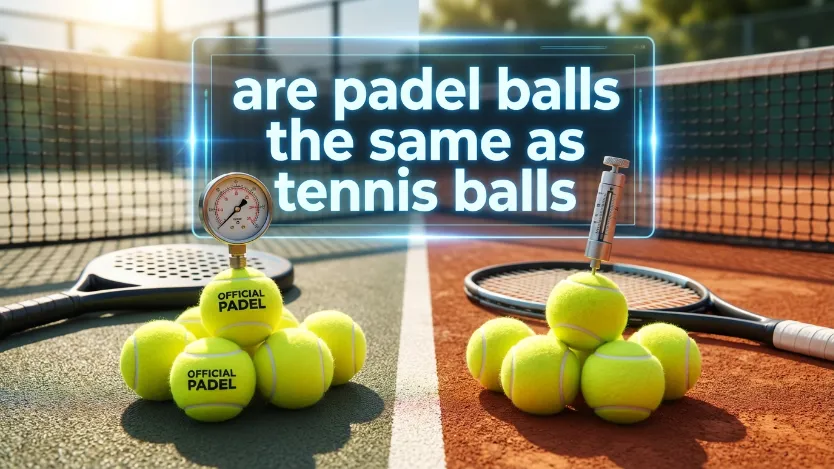
Many beginners ask, are padel balls the same as tennis balls? While visually similar, padel specifications demand a lower internal pressure to prevent the game from becoming uncontrollably fast. In the quest for durability, some coaches turn to completely pressureless options, such as the Tretorn Micro X. Rather than relying on trapped gas, these rely on roughly 700 million air-filled micro-cells embedded within the rubber.
While completely immune to cold weather and altitude, pressureless variants present severe tactical limitations. They generally feel significantly stiffer and heavier upon impact, drastically altering the kinematic response of the racket. Furthermore, their dense structure limits the ability to generate aggressive slice or topspin. Consequently, these should be strictly reserved for high-repetition feeding drills using ball machines, never for competitive match play.
Economic Returns and Environmental Sustainability
The rapid expansion of the sport has brought environmental concerns regarding synthetic rubber waste to the forefront. The leading manufacturers are now addressing this through sustainable material engineering. Head’s “Rethink” initiative has overhauled their packaging, utilising 30% pre-consumer recycled PET plastic and reducing chemical ink usage on their Pro+ and Pro S+ cans. Dunlop has gone a step further with their Eco line, providing fully recyclable, plastic-free packaging.
From an economic standpoint, the Return on Investment (ROI) of pairing premium spheres with a high-end recovery device is indisputable. A player competing twice a week will burn through approximately 30 cans annually. By investing in a £50 to £100 pressurisation unit, the lifespan of a single can is easily multiplied by five to ten times, effectively paying for the device within three months while drastically reducing landfill contributions.
Frequently Asked Questions (FAQ)
what are the best padel balls uk players should use during winter months?
During the freezing and damp UK winter, internal gas contracts and slows the game down. You must transition to “Speed” variants like the Head Padel Pro S+ or Wilson Premier Padel Speed, which feature thicker cores engineered to generate a livelier bounce despite the cold.
Does a 14 PSI screw-tube pressuriser actually recharge dead balls?
No. The absolute pressure inside a new ball is between 25 and 28 PSI. A screw tube that only generates 14 PSI merely slows down the rate of leakage. To actually force air back into the rubber core and restore bounce, you require an advanced device capable of maintaining 30+ PSI, such as the Pascal Box or Ball Rescuer.
Are tournament-grade balls less durable than standard training balls?
Often, yes. Premium tournament balls (like the standard Head Pro or Wilson Premier) are engineered for maximum feel, control, and specific aerodynamic profiles out of the can, assuming they will be replaced every few sets. Training balls (like the Bullpadel Premium Pro) use denser rubber and thicker felt to withstand weeks of abuse, sacrificing a tiny margin of elite responsiveness for massive durability gains.