Your ankles don’t care about the aesthetic of the court; they care about the physics of the pivot. Sliding across a synthetic grass surface in standard trainers isn’t just a performance handicap—it is a physiological gamble. While the two sports share a net, the traction requirements of Padel shoes vs tennis shoes are fundamentally distinct. One is engineered for the long-stride lateral sprints of the baseline; the other is a high-torque tool designed for the vertical leaps and sharp, rotational bursts unique to the cage.
Padel vs Tennis Shoes — Full Comparison
Outsole · Grip · Cushioning · Flexibility · LTA · Durability
Differences between padel and tennis footwear: The Technical Breakdown
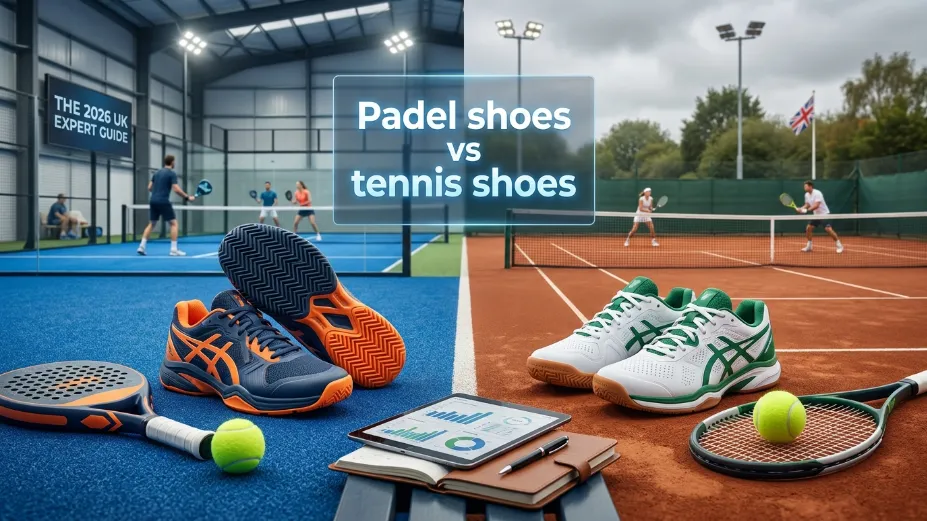
The core differences between padel and tennis footwear stem from the friction coefficient of the court surface and the biomechanical load placed on the athlete. In the UK, the majority of courts utilise artificial grass (turf) with varying levels of sand infill. This requires a specialised outsole that can “bite” into the turf while allowing enough release for rotational turns.
Unlike tennis, where movement is dominated by long, lateral strides across the baseline, padel is a game of constant, explosive padel specific movements. These include the 360-degree turn to recover balls off the glass and the vertical acceleration required for overheads. Consequently, the ankle support in padel shoes is reinforced differently; while tennis shoes focus on heel-lock stability for side-to-side lunges, padel shoes utilise a low-profile drop height to keep the centre of gravity closer to the ground, reducing the leverage that leads to ankle rolls.
- Traction Engineering: Padel soles often feature “pivot points”—circular zones under the ball of the foot—that facilitate rotation without locking the knee.
- Cushioning Logic: Padel shoes prioritise heel cushioning to absorb the shock of repeated jumps for the Bandeja Padel.
- Torsional Rigidity: Midfoot shanks in padel footwear are designed to prevent the shoe from twisting during high-torque pivots.
Can I wear running shoes for padel? (The Physiological Gamble)
A common question amongst beginners at clubs like Stratford Padel Club is: Can I wear running shoes for padel? The answer from a sports science perspective is a resounding no. Running shoes are strictly engineered for linear, forward-motion energy return. They feature high “stack heights” (thick midsoles) which act as a dangerous lever if you attempt a sharp lateral cut. On a padel court, this height makes you statistically more likely to suffer a Grade 2 or 3 ankle ligament tear.
Furthermore, the “sandpaper effect” of the synthetic turf will decimate the soft rubber outsoles of running shoes within weeks. Within three to four sessions, the tread will be worn flat, leaving you with zero traction on sand-dressed surfaces. For those starting their journey, investing in a dedicated pair like the Babolat Padel Racket matching shoes is far more vital for safety than the racket itself.
Padel Specific Movements: Impact on Footwear Geometry
Understanding padel specific movements is key to choosing the right gear. In a typical rally, you aren’t just moving left and right; you are retreating to the glass, rotating 180 degrees, and sprinting forward to catch a drop shot. This “X-axis” and “Y-axis” complexity requires a flexible forefoot. High-end models like the Nox Equation compatible series or Asics models feature “360° Flex” technology, allowing the foot to bend naturally during these transitions.
The most demanding shots, the Bandeja and the Vibora, require a stable base for the jump and a grippy landing to immediately transition back to the net. Without the correct footwear, the “slip-on-landing” effect can cause micro-tears in the patellar tendon over time—a condition often overlooked by casual players.
LTA Padel Footwear Guidelines: Club and Tournament Standards
The LTA padel footwear guidelines are clear: “non-marking” court shoes are mandatory at nearly all UK indoor facilities. If you are competing in an LTA Grade 5 Padel tournament, a referee may technically bar you from play if your shoes are deemed damaging to the court or unsafe for the player.
For those aiming for the LTA Padel Rankings, footwear is viewed as a “performance tool.” The LTA suggests that as a player progresses, they should move away from generalist “all-court” tennis shoes toward 100% padel-specific models that account for the reduced sand on modern “Mondo” grass courts found in new UK builds.
Information Gaps: What Major Sports Sites Miss
While many retailers focus on aesthetics, there are two “hidden” factors that determine the true lifespan of your footwear:
1. The 45-Hour Rule: Hidden Cushioning Death
Most players wait until the sole is bald to replace their shoes. However, the EVA (Ethylene-vinyl acetate) foam in the midsole typically loses its “structural memory” after 45–60 hours of high-intensity play. In the cold UK climate, this foam can harden even faster. If you play twice a week, your shoes may lose their protective cushioning in just six months, even if the tread looks fine. This is a primary cause of lower back pain and knee fatigue in the UK padel community.
2. Lateral Toe Box Breakage
Niche research into player complaints on forums like Reddit reveals a common “blowout” point: the outer side of the shoe near the small toe. This is caused by the extreme lateral force applied during “emergency braking” on the turf. To counter this, look for shoes with reinforced lateral cages or TPU overlays in the forefoot area. Brands like Asics and Babolat have specifically addressed this in their 2026 iterations.
Choosing the Best 2026 Padel Shoes in the UK
When shopping for Padel Shoes in the UK, you must match the sole to your local club’s surface.
- For Sand-Dressed Courts (Visible Sand): Go for a full herringbone (Espiga) sole. This pattern clears the sand effectively, preventing the “ice skating” sensation.
- For Mondo/WPT Surfaces (No Visible Sand): A hybrid or omni-court sole is superior. Too much grip from a deep herringbone on a sandless court can actually “stick” the foot to the ground, increasing the risk of knee ligament injuries.
For more in-depth equipment advice, including how to find the Best Budget Padel Racket to go with your new shoes, visit the Lawn Tennis Association official equipment portal.
Padel shoes vs tennis shoes – FAQ
Q: Can I use Squash shoes for Padel?
A: Squash shoes are designed for dry, indoor wooden floors. While they offer good lateral support, their soles are often too soft for the abrasive “sandpaper” effect of padel turf and provide zero grip on sand-dressed courts. You will likely slide uncontrollably.
Q: Why do my feet ache after playing at an indoor centre?
A: This is often due to “midsole compaction.” If you are over 85kg, standard lightweight speed shoes may not provide enough shock absorption. Consider a “maximalist” shoe like the Asics Gel-Resolution series for better joint protection.
Q: Is there a difference between Men’s and Women’s padel shoes?
A: Yes. Beyond sizing, women’s specific models are typically built on a narrower “last” (the foot mould) and account for different pressure points in the ball of the foot during pivots.
Q: How do I know when to replace my shoes?
A: Check for three signs: reduced grip on familiar courts, visible compression lines in the foam midsole, or if you start experiencing unusual knee or shin pain after a match.