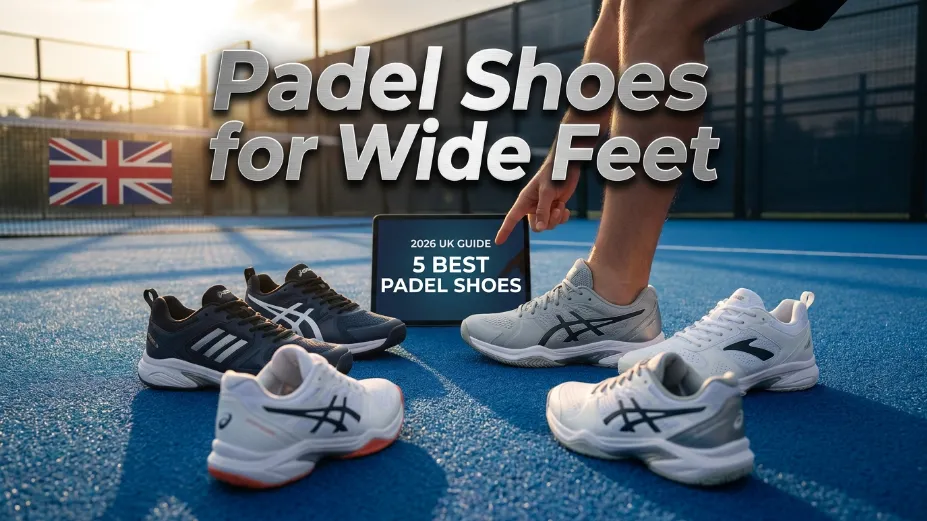
The Lateral Explosiveness Of A High-Intensity Rally Is Unforgiving On A Foot That Feels Like It’s Being Compressed By A Vice. While Most Brands Obsess Over Sleek Aerodynamics, Your Priority Is Structural Integrity And Room To Breathe. Finding The Right Padel Shoes For Wide Feet Is No Longer A Luxury—It Is A Biomechanical Necessity To Prevent The Debilitating Arch Strain And Metatarsal Friction That End Matches Prematurely. We Have Deconstructed The Top-Tier 2E Options Available In The UK To Ensure Your Base Of Support Is As Formidable As Your Overhead Smash.
The Technical Challenge of Finding Padel Shoes for Wide Feet
In the UK, where padel often moves from damp outdoor courts to high-friction indoor surfaces, the stress on a shoe’s lateral wall is immense. For players with wider feet, a standard-width shoe doesn’t just feel tight; it actively compromises your game. When the forefoot is compressed, the metatarsals cannot splay naturally during a split-step, leading to a loss of balance and increased foot pain after padel sessions. You need to distinguish between “volume wide” (more mesh fabric) and “base wide” (a wider rubber outsole platform).
Before investing, it is vital to learn how to choose a padel racket that complements your movement, but your footwear is what dictates your ability to reach the ball. UK stockists like Padel Shack and Direct Sports have seen a surge in demand for 2E width padel shoes as players move away from narrow tennis-centric models.
K-Swiss Hypercourt Express 2 Review: The UK Club Favourite
Our K-Swiss Hypercourt Express 2 review confirms why this remains the top-selling shoe for broad-footed players at clubs from London to Edinburgh. Unlike many competitors that require 10+ hours to “soften,” the Hypercourt is designed on a naturally wider last that accommodates the foot’s anatomy from minute one.
- Upper Construction: The synthetic leather and mesh combination provides a “plush” feel that wraps around the midfoot without pinching the lateral edge.
- Durability Factors: It features the Aosta 7.0 high-density rubber outsole. While it excels in comfort, heavy sliders might find the tread wears faster on sandy surfaces compared to Asics.
- The Wide Foot Advantage: It doesn’t feel “clunky.” Despite the extra room, the heel lockdown remains secure, preventing the dreaded heel slippage that often plagues oversized shoes.
Mizuno Wave Enforce Tour Wide: The Stability Powerhouse
The Mizuno Wave Enforce Tour wide experience is unique. Lab measurements often show a standard width of approximately 89.4mm, which is technically narrower than a New Balance 2E. However, the “perceived width” is much higher. This is due to the high-volume toe box and the incredibly soft Mizuno Enerzy foam that allows the foot to sink into the shoe, effectively expanding the internal space.
For players who prefer a best padel shoes that offers a “marshmallow” feel underfoot while maintaining a rigid Wave plate for stability, the Enforce Tour is a strong contender. A critical technical note for UK players: many find this shoe runs slightly long, so if you are between sizes, stick to your standard UK size rather than sizing up to gain width.
The “Square vs Tapered” Debate: Best Toe Box for Padel
The best toe box for padel is not just about width; it is about shape. Most modern shoes are “tapered,” meaning they point toward the big toe. For players with “square” feet (where the first three toes are of similar length), this causes the pinky toe to be crushed against the lateral wall during sharp pivots.
- Square Toe Boxes: Brands like Babolat (SFX series) and K-Swiss offer a more squared-off front. This allows for natural “toe splay,” which is a primary stabilising mechanism of the human foot.
- Tapered Risks: Shoes like the Asics Solution Speed, while fast, are notoriously narrow. If you experience “little toe pinching,” you are likely in a tapered shoe that is fundamentally incompatible with your foot shape.
Head-to-Head: K-Swiss Express 2 vs. Asics Gel Resolution 9 Wide
Choosing between these two titans comes down to your playing style and weight. The Asics Gel Resolution 9 Wide is built for the “grinder”—the defensive player who thrives on the baseline and makes aggressive lateral slides. Its Dynawall technology provides a rigid plastic wall that prevents your foot from rolling over the sole.
In contrast, the K-Swiss Hypercourt Express 2 is for the player who prioritises “step-in comfort” and a lighter, more flexible feel. If you weigh over 90kg, the Asics will likely offer better structural durability, as the K-Swiss midsole can become “mushy” under extreme vertical loads over time.
Identifying the Causes of Foot Pain After Padel
If you are suffering from foot pain after padel, the culprit is often “lateral spill.” This occurs when your foot is wider than the shoe’s platform. During a lunge, your foot pushes the mesh upper outward, but because there is no rubber sole beneath that area, your arch collapses or your lateral ligaments are overstretched.
To mitigate this, look for shoes with an outrigger—a small extension of the sole on the outside of the shoe. The New Balance Fresh Foam X CT-Rally and the Nox AT10 Lux both feature wide-base outsoles designed specifically to support the lateral forces unique to padel. Players looking for best padel rackets for tennis elbow often forget that shock absorption starts at the feet; a well-cushioned, wide shoe reduces the kinetic vibration that travels up the arm.
Content Gaps: What Most Guides Miss
While most reviews focus on grip, they ignore Midsole Compression. For heavy players in the UK, a “wide” shoe can lose its width within 3 months. As the foam compresses, the foot sits deeper in the shoe, often pressing against hard plastic “cages” that were previously unnoticeable. Always check the technical lab measurements of a shoe’s stack height before buying; a higher stack (like the 33mm in the Mizuno) usually offers longer-lasting width-integrity than thin, speed-oriented models.
Additionally, for female players, finding a women’s padel racket is easy, but finding wide-fit women’s shoes is notoriously difficult. Many UK women find that switching to a Men’s UK size (which is naturally built on a wider ‘D’ last compared to the Women’s ‘B’ last) solves the width problem instantly.
Frequently Asked Questions
Q: How do I know if I need a 2E width padel shoe?
A: If you see “spill-over” (the fabric of your shoe hanging over the rubber sole) or experience numbness in your outer toes during play, you likely require a 2E width or a shoe with a more generous toe box volume.
Q: Are tennis shoes okay for wide feet on a padel court?
A: Yes, but only if they have a clay-court herringbone sole. Hard-court tennis shoes will be dangerously slippery on sandy UK padel courts. Models like the New Balance 1006 are excellent crossover options.
Q: Do wide-fit padel shoes stretch over time?
A: Synthetic uppers have very little “memory” and will not stretch significantly. It is a myth that you can “break in” a shoe that is fundamentally too narrow. Always aim for comfort from the first session.
Q: What is the best way to prevent little toe pinching?
A: Look for a square toe box design. The Babolat SFX 4 is specifically engineered with more volume in the forefoot to prevent the fifth metatarsal from being squeezed.
Final Verdict for UK Players
Don’t settle for “sizing up” in a narrow shoe. This leaves too much space at the front, leading to toe-jamming and blisters. Instead, prioritise brands that respect the 2E width standard. For the ultimate balance of durability and stability, the Asics Gel Resolution 9 Wide is hard to beat. For those seeking the “golden goose” of comfort, the K-Swiss Hypercourt Express 2 remains the most accommodating shoe in the UK today. Match your new shoes with high-quality gear by checking our review of the Nox Equation padel racket to ensure your entire setup is geared for performance.