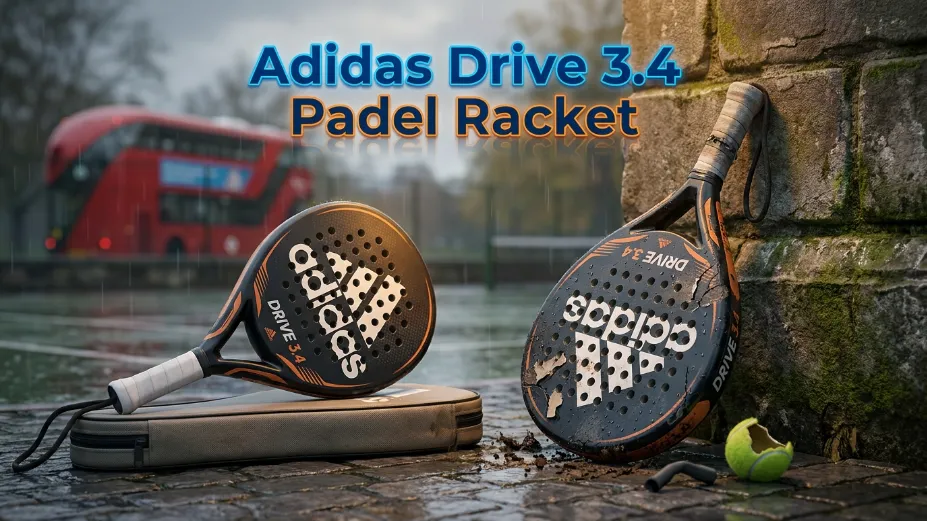
The cold truth about stepping onto a padel court for the first time is that power means absolutely nothing if your ball is constantly flying straight into the glass. True confidence on the court doesn’t come from mimicry; it comes from a frame that behaves exactly how your hands want it to. That is precisely why the adidas drive 3.4 padel racket is capturing the attention of evolving players across the UK who are ready to transition from casual weekend rallies to genuine tactical control. If you have been searching for that elusive sweet spot between effortless manoeuvrability and unforgiving durability, this might just be the exact gear upgrade your game has been waiting for.
Adidas Drive 3.4 vs Drive Light 3.4
Verified Specifications & Player Profiles · 2026
For UK club players navigating the initial learning phases of padel, the best option depends strictly on your physical needs and susceptibility to arm strain. If you prioritise structural stability and a solid, reassuring feel through your defensive strikes, the standard weight adidas drive 3.4 is your perfect baseline match. However, players looking to mitigate joint fatigue, junior players, or those who prefer lightning-fast net reactions should immediately opt for the lighter, highly agile adidas drive light 3.4.
The rapid expansion of the club scene across the United Kingdom has fundamentally altered player expectations regarding specialised gear. Generic fitness rackets or heavy tennis-adapted designs no longer suffice on highly technical, sand-filled synthetic turf. With specialised premium entry-level platforms arriving on the market, understanding the engineering beneath your hands becomes paramount to maintaining technical execution, mastering consistent lobs, and avoiding chronic wrist injuries.
adidas drive 3.4 padel racket review: Biomechanical Analysis & On-Court Feel
The engineering core of the adidas drive 3.4 padel racket review centres upon its highly forgiving, round-shaped structural setup. While aggressive player silhouettes rely on head-heavy, rigid diamond frames, this model bridges modern polymer flexibility with the rigorous constraints of low-speed control play.
- The Fibreglass Matrix: Utilising a high-quality glass fibre composite on both the frame and the face, the hitting surface offers an exceptionally elastic touch. When receiving heavy baseline lobs, the fibres flex dynamically, absorbing the impact energy before releasing the ball with a smooth, predictable rebound.
- The Smart Holes Lineal layout: To strengthen the structural integrity of the fibreglass surface, Adidas implements an equidistant arrangement of holes in groups of three. This layout minimises localized stress concentrations, ensuring the face resists micro-cracks during high-velocity impacts while maintaining a consistent sweet spot across the entire hitting zone.
- Rotational Inertia Mechanics: From a physical standpoint, the round geometry concentrates the racket’s mass close to the hand. This design fundamentally alters the swingweight, allowing players to swing freely without experiencing heavy torque on the wrist.
The biomechanical distribution of the mass can be mathematically evaluated using the classic rotational inertia formula:
$$I = \int r^2 \, dm$$
where $r$ represents the distance of the differential mass element ($dm$) from the pivot point (the player’s hand). Because the round format of the Drive series keeps the mass concentrated near the grip, the value of $r$ is minimised, resulting in a low rotational inertia ($I$). This reduction in rotational resistance allows players to adjust their hand orientation instantly during rapid net exchanges, turning defensive blocks into precise, targeted placements. For players seeking a comprehensive breakdown of racket geometries, checking our analytical guide on how to choose a padel racket provides excellent contextual background before making a purchase.
The Lightweight Choice: adidas drive light 3.4 padel racket & adidas drive light 3.4 padel racket review
Navigating the entry-level Adidas product family requires a clear understanding of the mechanical differences between the standard layout and its stripped-back counterpart. Selecting your specific version of the adidas drive light 3.4 padel racket dictates both your physical recovery cycles and your kinetic velocity on the court.
The Weight Discrepancy & Biomechanical Relief
The standard model operates within a 360–375g weight bracket, providing a reassuringly solid sensation at impact. Conversely, the adidas drive light 3.4 padel racket review focuses extensively on a lighter weight signature of 345–360g. This weight reduction is achieved through lighter glass fibre layering, offering a highly agile tool that feels like a natural extension of the arm. For players suffering from physical fatigue or existing injuries, this structural difference is critical to sustaining long-term playability.
On-Court Performance and Kinetic Trade-Offs
The 15g weight drop introduced in the light variant offers outstanding manoeuvrability when executing quick reflex volleys at the net or rescuing low balls near the glass. However, players must recognize the kinetic trade-off: a lighter mass transfers less linear momentum ($p = mv$) to the ball at impact. To execute deep lobs or push back aggressive baseline players, you will need to accelerate your arm faster to compensate for the reduced weight. If your primary goal is to protect your joints, exploring this lightweight choice alongside our curated list of the best padel rackets for tennis elbow will ensure your physical health and playing style remain in perfect technical alignment.
Cosmetic Shifts vs. Structural Reality: The adidas drive black 3.4 2025 padel racket
A major missing angle across major commercial e-commerce spaces is the technical continuity of the beginner ranges. When reviewing the adidas drive black 3.4 2025 padel racket, many players are led to believe that each annual iteration introduces a complete structural revolution. The reality, however, is much more conservative.
The “Drive 3.3” (2024), “Drive 3.4” (2025/2026), and the latest “Drive 3.5” (2026) models share an identical structural blueprint. They all feature the same round mould, a 38mm frame profile, a 100% glass fibre frame and surface face, and the low-density Soft Performance EVA core. The primary differences lie entirely in the aesthetic colourways and visual decals, such as the sleek black-and-grey pattern of the 2025 Black edition compared to the green or blue variants of other years. This cosmetic-led strategy allows Adidas to maintain manufacturing efficiency while keeping retail prices stable.
For the smart UK club player, this generational continuity presents a significant financial opportunity. Choosing a previous model year like the 3.4 or even the 3.3 on clearance offers the exact same on-court performance, structural durability, and vibration absorption as the latest model year, but at a fraction of the cost. This saved capital can then be reinvested into premium overgrips, high-quality balls, or professional coaching sessions to rapidly accelerate your skill development.
Head-to-Head: Adidas Drive Series vs. Adidas Match Series
For players trying to choose between the round-shaped Drive and the teardrop-shaped Match series, the choice comes down to a fundamental split in design philosophy. Both models occupy the entry-level price bracket but approach court control and power from completely opposing angles.
The primary structural differences and on-court performance variations are detailed below:
- Sweet Spot Forgiveness and Shape: The Drive series features a fully round shape with a perfectly centred sweet spot. This provides massive forgiveness on off-centre hits, making it easy to return balls consistently even with flawed technique. The Match series employs an all-round hybrid teardrop shape, which raises the sweet spot into the upper third of the face, narrowing the margin for error on defensive shots.
- Leverage and Attacking Power: Because the Match series has a slightly higher balance point, it increases the natural leverage of your swing. This makes it significantly easier to generate downward pace on aggressive overhead smashes compared to the control-biased, lower-balanced Drive frame.
- Defensive Recovery and Maneuverability: Near the back glass, the Drive series wins decisively. Its low-even balance point allows you to scoop up low, fast-descending balls with minimal preparation time. The Match series feels slightly heavier to move in tight, defensive corners, requiring a more calculated preparation phase.
Exposing the Missing Angles: Real-World Limitations on UK Courts
While mainstream marketing materials highlight the smooth playability and comfortable touch of the Drive 3.4, deep analysis under real-world play conditions in the UK reveals distinct manufacturing limitations and performance degradation.
- The Damp, Cold British Weather Impact on Soft EVA: Most padel rackets are designed and tested in Spain or Italy under warm, dry conditions. When played outdoors in typical UK climates (10–20°C or colder), the low-density Soft Performance EVA core stiffens dramatically. This reduction in material elasticity destroys the natural trampoline effect, turning a soft, forgiving racket into a surprisingly stiff tool that transmits harsh, jarring vibrations directly to your elbow.
- Shiny Smooth Face Slippage: The fiberglass hitting surface is finished with a completely smooth, glossy clear coat, lacking any 3D relief or sand-like texture. In high-humidity UK playing environments, moisture and condensation quickly settle on the face. This causes the ball to slip dynamically across the surface during slice or cut attempts, resulting in an unpredictable launch angle and making it nearly impossible to generate reliable spin.
- Non-Adjustable Wrist Strap Safety Hazard: The base of the handle features a standard, flat nylon loop without an adjustable plastic toggle or neoprene padding. In damp, sweaty playing conditions, if the thin factory grip slips from your hand, the loose wrist strap cannot tighten automatically, posing a direct hazard to your double partners or the surrounding glass court panels.
- The Ultra-Thin Factory Grip: The racket is supplied with a very thin, basic factory grip over a short handle. This setup offers minimal vibration dampening, leaving players with large hands struggling to secure a stable hold without experiencing fingers cramping during extended baseline defence rallies.
Evolving Beyond Control: The Technical Transition Path
While the Drive 3.4 serves as an outstanding learning platform, its structural composition of 100% glass fibre eventually acts as a performance ceiling for improving intermediate players. Once you master the continental grip and begin executing reliable, high-tempo volleys and flat smashes, you will notice that the flexible fibreglass face absorbs too much energy, dampening your offensive potential.
When you reach this transition point, the logical upgrade path within the Adidas family is to move to a carbon-reinforced intermediate racket, such as the adidas rx series padel racket. This step-up incorporates structural carbon inserts into the frame’s heart, providing a crisper, more direct ball feedback and significantly higher torsional stability without sacrificing the arm-friendly comfort of a soft core. For a broader overview of the entire brand ecosystem, consulting the official adidas padel platform will help you align your technique with their latest carbon and hybrid technologies.
Frequently Asked Questions (FAQ)
Are these entry-level Adidas rackets manufactured within the UK?
No. While all conceptual design, structural prototyping, and performance testing are managed at the brand’s international corporate hubs, the physical manufacturing and component assemblies of the Drive series are handled by primary production partners in Asia, adhering to standard athletic industry practices.
How can I protect my Drive 3.4 racket from cold weather deterioration on UK courts?
To prevent the low-density Soft Performance EVA foam from degrading, always store your racket inside a thermally insulated bag when travelling between clubs. Never leave the racket in your car boot overnight during cold autumn or winter periods, as extreme temperature cycles can cause the inner core to lose its elastic memory prematurely.
What is the best way to resolve the thin grip and basic wrist strap issues?
We highly recommend wrapping a premium polyurethane overgrip directly over the factory grip to increase the handle’s volume and absorb vibration. For the non-adjustable wrist strap, you can slide a small, spring-loaded plastic toggle onto the nylon loop, allowing you to secure it firmly around your wrist before every match.