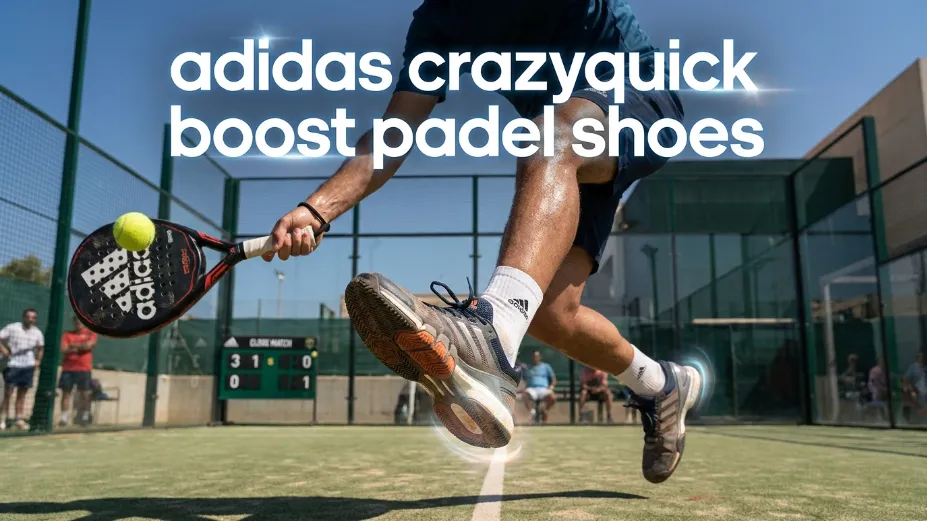
Padel is defined by milliseconds. That split-second transition from a defensive lob to an aggressive smash requires more than just instinct—it demands absolute traction. While many players focus heavily on carbon-fibre rackets, the real court dominance is anchored in what connects you to the turf. The adidas crazyquick boost padel shoes aren’t designed to just sit in your kit bag; they are engineered to redirect lateral kinetic energy and provide instantaneous response. If your movement feels compromised during intense rallies, the issue isn’t your fitness—it is your footwear. Let’s dissect whether this specific silhouette delivers the stability promised, or if it is merely clever marketing.
Adidas Padel Shoe Specifications
Technical specs & on-court performance benefits
For UK club players navigating intensive court schedules, the best option depends strictly on your history with joint stress and your typical court conditions. If you prioritise pristine shock absorption and immediate out-of-the-box comfort, the flagship Boost edition is the superior choices despite its premium retail price. However, players seeking maximum physical shell longevity or those operating on slick, un-sanded outdoor synthetic turf might find more stable long-term value elsewhere in competitive line-ups.
The rapid expansion of the club scene across the United Kingdom has fundamentally altered player expectations regarding specialised gear. Generic fitness trainers or hard-court tennis shoes no longer suffice on highly abrasive, sand-filled synthetic turf. With specialized premium footprints arriving on the market, understanding the engineering beneath your feet becomes paramount to maintaining technical execution and avoiding injury.
Comprehensive Adidas Crazyquick Boost Padel Shoes Review: Technical Anatomy
The engineering core of the adidas crazyquick boost padel shoes review centers upon its non-traditional midsole setup. While legacy racquet footwear relied primarily on standard compressed foam variants, this silhouette bridges modern running technology with the rigorous lateral constraints of modern court sports.
- The Midsole Matrix: Utilising expanded thermoplastic polyurethane (E-TPU) granules developed via specialized German chemical processing, the primary cushioning engine offers exceptional mechanical bounce. When landing from high vertical extensions, the cells absorb massive downwards energy before rebounding immediately to assist the next stride.
- The Slingframe Boundary: Because E-TPU is naturally volatile and soft under high loads, it requires a structural countermeasure. The internal Slingframe chassis wraps around the midfoot perimeter using dense, low-profile EVA foam, locking the heel and arch into place during sharp lateral cuts.
- Outsole Mechanics: The Adiwear rubber formulation incorporates multi-directional Flex-Crosses alongside a designated Pivot Point positioned beneath the ball of the foot. This allows players to execute sudden 360-degree spins near the rear glass walls without catching their treads on the turf fibers.
The upper layer balances ultra-lightweight structural yarns with the protective Adituff composite toe wrap. This rubberised shield prevents immediate premature wear caused by continuous foot-dragging during low defensive lunges. For players analyzing options across the entire brand matrix, evaluating the dedicated structural differences outlined in our analytical look at adidas crazyquick vs courtquick padel shoes provides clear contextual background before buying.
BOOST vs. Lightstrike: Deciding on your Adidas Men’s Crazyquick Boost Padel Shoes
Navigating the product family requires a clear understanding of the mechanical differences between the flagship Boost layout and its stripped-back counterpart. Selecting your specific version of the adidas men’s crazyquick boost padel shoes dictates both your physical recovery cycles and your kinetic velocity on court.
The Cushioning Variance
The Boost architecture focuses extensively on energy return and physical longevity. The E-TPU composite resists structural pack-out over months of intense court play. Conversely, the Lightstrike configuration employs an ultra-light, high-density foam compound designed for low-to-the-ground responsiveness. This gives speed-focused players a sharper sense of court feel but significantly less vertical dampening during heavy landing sequences.
Weight and Commercial Discrepancies
The extreme density of the premium Boost foam introduces an undeniable weight penalty, pushing a standard UK size 8 to roughly 366 grams. The Lightstrike option drops this weight signature noticeably, providing a floating sensation for nimble baseline sprinters. This weight variance reflects clearly across UK commercial retail channels, where the premium Boost version commands a £139.99 to £140.00 RRP, while the Lightstrike variant enters the market at a accessible £99.95 RRP.
If you are a high-level competitor seeking to match advanced footwear dynamics with elite-tier control tools, exploring the definitive structural mechanics detailed in our guide to the adidas padel racket ale galan will ensure your entire equipment setup functions in perfect technical alignment.
The Critical Fit Guide: Why You Must Size Up in Adidas Padel Shoes Crazyquick Boost
A major missing angle across major commercial e-commerce review spaces is the highly specific volumetric interior geometry of the shoe. When choosing the adidas padel shoes crazyquick boost, ordering your standard street-shoe size can lead to severe operational issues on court.
The shoe is built around a distinct, narrow D-width racing last that tapers aggressively through the lateral forefoot zone. This streamlined shape is designed to stop internal foot slippage during explosive movements, but it restricts players possessing intermediate or broad foot profiles. The problem is amplified by the structural height of the lower foam bedding itself.
Because the Boost element sits thicker within the midfoot cavity than generic court shoes, the vertical clearance inside the toe box is highly compressed. The top of the foot is pushed firmly against the lower ceiling of the engineered textile upper. During violent stop-and-start actions on the court, this lack of vertical space forces the outer toes into persistent friction against the inner walls, often causing painful blistering and nail bruising within the first fortnight of use.
To avoid these performance limitations, players must adjust their purchasing metrics. It is highly recommended to size up by at least a half-size over your standard UK rating. For players with exceptionally wide foot profiles, selecting a full size larger is essential to provide adequate spatial tolerance for thick court socks and natural foot swelling during prolonged tournament blocks.
Exposing the Information Gaps: Real-World Durability Under the Microscope
While mainstream marketing materials highlight the premium aesthetic choices of the footwear, deep analysis across independent UK playing groups reveals distinct manufacturing limitations and accelerated wear patterns under high-stress conditions.
- The Lateral Logo Peeling Phenomenon: The iconic three-stripe visual branding applied to the lateral side walls uses a heat-bonded polymer film rather than direct stitching. Under the continuous flexing forces generated by low lunges, this adhesive bond frequently shears away, leading to noticeable peeling within 2 to 4 weeks of regular club play.
- Forefoot Mesh Degradation: The engineered knit upper offers superb climate ventilation but completely lacks thermoplastic polyurethane (TPU) weld overlays across the primary lateral flex crease. As a result, the repeated folding actions of the foot during aggressive recovery sprints put intense stress on the raw fabric, causing premature tearing along the outer edge within 3 to 6 months.
- Internal Heel Pocket Friction: The interior lining fabric covering the heel counter features a standard synthetic weave. Players who do not utilise specialized lock-down lacing patterns will experience micro-slippage against the stiff heel counter, causing the fabric lining to shred quickly and exposing the raw internal structure beneath.
These persistent structural concerns create a continuous cycle of warranty replacements for dedicated club players who log more than three competitive sessions per week. While the functional traction matrix remains intact, the cosmetic and structural deterioration of the upper components is a critical factor for budget-conscious buyers to monitor closely.
Performance on British Courts: Wet, Sand, and Mondo Turf
Evaluating the Adiwear rubber footprint requires analyzing the highly variable, unpredictable court environments found throughout the United Kingdom. The tread design behaves fundamentally differently based on the moisture levels and specific turf configuration of your local venue.
On traditional, heavily sanded synthetic carpet courts, the deep-set groove geometry works beautifully. The channels manage sand displacement effectively, allowing for predictable, controlled sliding stops without sharp joint jarring. However, the open, highly breathable textile upper features zero integrated water-repellent treatments. When playing on typical damp, un-covered British courts during autumn or winter, surface water immediately passes through the mesh, soaking your socks and causing frustrating internal foot slippage.
Modern premium venues increasingly implement low-sand Mondo turf setups, which deliver incredibly high natural dry friction. When running across these modern carpets in this silhouette, the sheer stickiness of the Adiwear compound can occasionally prevent the progressive sliding action that players rely on. This abrupt mechanical stopping effect places extra stress on the ankles and knees, requiring acute physical awareness during quick deceleration maneuvers.
Head-to-Head: Adidas Crazyquick Boost Men’s Padel Shoes vs. ASICS Gel-Resolution 9
For players trying to choose between the premium adidas crazyquick boost men’s padel shoes and the legendary ASICS Gel-Resolution 9, the choice comes down to a fundamental split in design philosophy. Both models command top-tier placement across UK retail outlets but approach court stability from completely opposing angles.
The primary differences in on-court performance are detailed in the comparison matrix below:
- Comfort and Break-In Period: The Boost compound wins decisively on instant comfort, delivering a plush, energetic feel the very first time you lace them up. The ASICS Gel-Resolution 9 features a remarkably stiff, heavy-duty structural layout that requires 3 to 5 weeks of continuous match play to break in and flex naturally.
- Ankle Lock-down and Support: ASICS dominates the stability category through its rigid, external Dynawall plastic resin sidewall, which locks the heel down completely. The softer Slingframe system used by the brand provides excellent fluid comfort but yields slightly more under extreme, high-velocity ankle extensions.
- Lifespan and Value: The heavy reinforcements on the ASICS model easily deliver 9 to 12 months of structural integrity under harsh conditions. The lighter, un-reinforced upper of the Boost model generally shows significant wear within 3 to 6 months of intense use, requiring more frequent investment cycles.
For a complete, comprehensive overview of the broad variety of choices currently occupying the competitive landscape across British clubs, take a moment to read our detailed breakdown of the premier adidas padel shoes alongside our independent evaluation of alternative premium asics padel shoes to select your ideal structural fit.
Buying Advice in the UK: Prices, Retailers, and Colourways
Tracking down the flagship silhouette across the United Kingdom involves navigating a mix of traditional tennis retail houses and specialized court specialty operations. The standard baseline retail price hovers consistently around the £140.00 RRP threshold, but careful shoppers can regularly source promotional exceptions.
Major international distributors such as Decathlon UK keep steady stock of the standard monochrome variations, while boutique operations like Altimus in Kensington cater directly to premium buyers with bespoke service. For those searching for discounted pricing, online general retailers like Studio.co.uk occasionally drop seasonal prices to around £114.99, while specialized regional suppliers like All Things Padel hold intermediate options at approximately £129.99.
The sizing selection remains highly accessible across the UK market, running from compact unisex sizes starting at UK 3.5 all the way up to specialized men’s options reaching UK 12. Aesthetic updates have evolved smoothly from the initial late-2024 launch colours into the vibrant orange, lucid red, and premium cloud white tones that define the current 2026 catalogue across English tennis clubs.
Verdict: Is the Adidas Crazyquick Boost Worth Your Money?
The final evaluation of this high-performance footprint depends entirely on your personal playing profile, structural injury history, and financial approach to seasonal gear replacement.
- Who Should Buy: Players who prioritize elite-level shock absorption, those recovering from persistent knee or Achilles tendon discomfort, and competitors who play predominantly on indoor courts where rain is never a factor.
- Who Should Avoid: Broad-footed players who refuse to size up, budget-focused club players who expect a single pair of shoes to survive a full calendar year of punishing outdoor play, and individuals who dislike early cosmetic peeling on premium gear.
Frequently Asked Questions (FAQ)
Are these court shoes constructed entirely within the UK?
No. While all conceptual design work and player prototyping are managed at international corporate hubs, production components and specialized synthetic assemblies are handled by primary manufacturing partners in Asia, matching standard practices across the athletic industry.
Can I safely utilize a standard washing machine cycle to clean the upper mesh?
It is highly discouraged. The intense heat and mechanical agitation of a domestic washing machine will destroy the delicate heat-bonded adhesive holding the lateral three-stripe polymer branding, accelerating the peeling process. Hand cleaning with cold water and a soft brush is recommended.
How does the overall stack height impact response speed compared to generic tennis variants?
The inclusion of the thick Boost foam raises your center of gravity slightly over dedicated minimalist low-profile shoes. While this adds unmatched impact cushion, it trades away a small amount of instantaneous micro-response during hyper-fast net volleys.