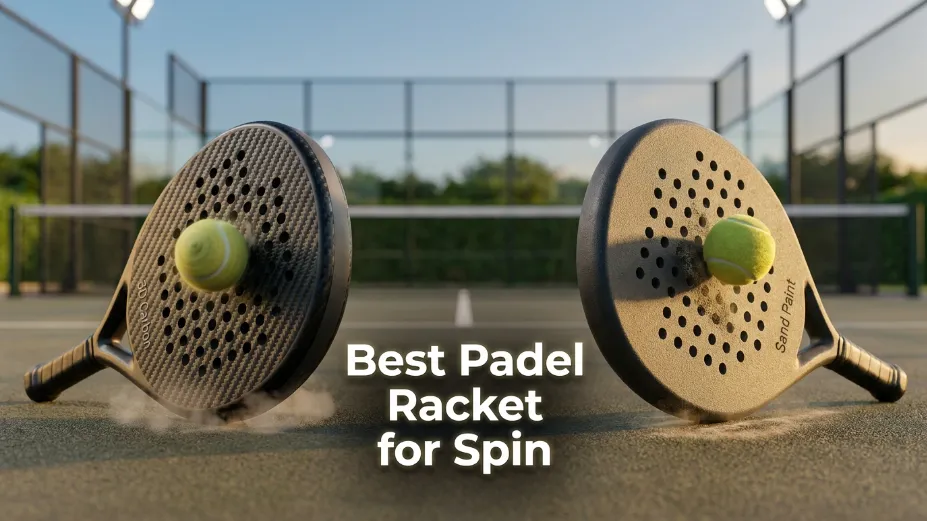
The difference between a predictable volley and an unreturnable, dipping shot into the glass isn’t just your wrist action—it’s the friction on your face. In a game where margins are razor-thin, relying on flat power is a tactical dead-end. To truly dictate the tempo on the court, you need a weapon engineered to grip the ball, alter its trajectory, and leave your opponents guessing. Finding the best padel racket for spin requires looking past flashy aesthetics and diving into the physics of surface texture, core density, and aerodynamic balance.
Let’s break down the definitive gear that will transform your slice from a basic defensive transition into an aggressive point-winner.
Best Padel Rackets for Spin — 2026
Verified Engineering Metrics & Core Materials
Frictional Tribology and the Physics of Padel Spin
The physical mechanisms underlying spin generation in padel are governed by complex contact mechanics, shear deformation, and polymer dynamics. Unlike tennis, where high-elasticity polyester strings pocket and snap back to impart rotation, a padel racket features a solid composite face backed by an elastomeric core. The rotational velocity imparted to a padel ball during an oblique impact is mathematically defined by the tangential shear force integrated over the contact dwell time at the ball’s outer radius, relative to its moment of inertia.
Under dry sliding conditions, the maximum tangential force is limited by Coulomb’s law of dry friction. To optimise spin output, a racket must be engineered to balance both the friction coefficient and the physical contact duration. The structural rigidity of the racket core directly dictates the balance between dwell time and peak normal force. Low-density elastomeric cores undergo substantial local deformation upon ball impact, creating an enveloping “pocketing” effect that drastically expands the contact area and extends the dwell time.
A common misconception among club players is that the edges of drilled holes act as “teeth” that grip the ball felt to generate spin. However, laboratory tests and high-speed video analyses reveal that during impact, the ball compresses into a flat contact disc across the racket face. Because the ball felt cannot deeply penetrate the vertical walls of the holes, the contribution of hole edges to tangential friction is negligible. The drilled hole pattern primarily serves to reduce aerodynamic drag, allowing players to swing the racket faster.
This increased swing speed directly translates to a higher normal force, which is the true driver of mechanical spin. Mastering these concepts with professional coaching or applying strategic padel serve tips helps players exploit aerodynamic efficiency to hit heavy under-spin slices, high-velocity topspin vibora padel lines, kick smashes, or delicate drop shots.
Core Dynamics: How Density Dictates the Best Padel Racket for Control and Spin
The structural rigidity of the racket core directly dictates the balance between dwell time and peak normal force. Low-density elastomeric cores, manufactured from soft Ethylene Vinyl Acetate (such as Eva Soft 30) or flexible Polyethylene (FOAM), undergo substantial local deformation upon ball impact. This physical deformation creates an enveloping “pocketing” effect, which drastically expands the contact area and extends the dwell time, making such configurations highly viable candidates when searching for the best padel racket for control and spin.
This extended contact allows players to guide the ball with precise directional control, which is highly beneficial for executing low-speed under-spin (slices) and delicate drop shots from the baseline. However, soft elastomers exhibit high physical and thermal hysteresis. Under high-velocity impacts, the material absorbs substantial kinetic energy—often referred to as the “trampoline effect”—which dampens the raw energy return and limits explosive spin generation on fast, offensive strokes.
Conversely, highly rigid racket assemblies—combining high-modulus carbon fibre faces (such as 12K or 18K Alum carbon) with high-density cores (such as EVA Pro 50 or High Memory EVA)—exhibit minimal surface deformation. In this configuration, the ball’s rubber core must deform to absorb the impact energy. This results in a significantly shorter dwell time but a massive increase in peak normal force. At rapid swing speeds, such as those used in a kick smash or aggressive víbora, this elevated normal force generates high instantaneous tangential shear across the composite surface.
For players with advanced, high-velocity swing mechanics, a stiff structural setup provides a direct, highly predictable 1-to-1 power transfer, maximizing both ball exit speed and aggressive top-spin. These premium setups are explored extensively in guides targeting the best padel rackets for advanced players.
Face Tribology: Evaluating the Best Padel Racket for Power and Spin
To increase the friction coefficient, manufacturers apply different texturing techniques to the carbon fibre face. These techniques differ significantly in their manufacturing processes, initial spin potential, and long-term durability, directly impacting the profile of the best padel racket for power and spin.
- Sand-Blasted / Silica-Based Roughness: Created by spraying fine quartz, silica, or sand-like particles onto the racket face, secured with a thin polyurethane or epoxy resin layer. When new, these sharp, exposed particles hook directly into the wool and nylon fibres of the ball felt, delivering a very high coefficient of friction at low-to-medium swing speeds. However, sand-blasted surfaces have low-to-medium durability. Under repeated impacts, these silica particles shear off or smooth out, causing the surface to lose its abrasive “bite” within 6 to 12 months of regular use.
- Pure 3D Moulded Relief (Raised Carbon Patterns): Moulded directly into the carbon fibre layup during the lamination process, forming permanent geometric shapes like hexagonal ridges, grids, or concentric circles. Because the texture is a structural part of the carbon face, it does not wear off or degrade over the lifespan of the racket, ensuring stable and predictable performance. However, because pure 3D textures lack micro-abrasive particles, they generate less friction at low swing speeds, meaning spin is generated mechanically and relies on faster, more aggressive swings.
- Hybrid Surfaces (The Modern Compromise): Combines a moulded 3D carbon structure with a secondary light coating of silica sand. This design generates spin in two ways simultaneously: mechanical grip from the underlying 3D structure and friction from the sand particles. As the sand particles gradually wear down over months of play, the underlying 3D moulded ridges remain fully intact, preventing a steep drop-off in spin.
- Advanced Laser-Etched Surfaces: A premium manufacturing technique where a CNC laser precisely burns away microscopic portions of the cured surface resin on raw carbon fibre faces. This computer-controlled process creates a highly uniform micro-texture with precise depth control to avoid exposing or damaging the underlying carbon structural filaments. Because there is no external paint or sand coating to peel or wear off, laser-etched faces are highly durable and offer exceptionally consistent performance.
The UK Environmental Challenge: Outdoor Play, Damp Weather, and Core Fatigue
Padel players in the United Kingdom frequently play on outdoor courts exposed to rain, dampness, and high humidity. These environmental factors alter both the properties of the racket and the behaviour of the ball. The wool and synthetic felt of a padel ball can absorb significant moisture, increasing its mass by 10% to 20% and turning the felt into a damp sponge. When a wet ball impacts a smooth racket face, a thin liquid film is squeezed between the two surfaces. This film acts as a boundary layer lubricant, reducing the coefficient of friction to near-zero and causing the ball to slip along the face with minimal spin.
Under these damp conditions, a rough surface is essential. The micro-channels in sand, hybrid, or laser-etched textures help disperse the water film on impact. By providing paths for the water to escape, these textures allow the racket surface to make direct contact with the ball felt. Striking a wet, heavy ball significantly increases the physical load on the racket, causing greater bending stress on the racket face upon impact. Over time, this increased load accelerates polymer fatigue in the core, especially in soft EVA or FOAM cores, leading to micro-cracking and a gradual loss of elasticity.
If you notice a complete loss of response under these heavy environmental loads, check out the best padel rackets for tennis elbow to find arm-friendly dampening alternatives, and ensure you use water-resistant balls like premium wilson padel balls to mitigate fluid saturation.
Temperature changes also affect core performance. In typical UK winter temperatures (2–8°C), EVA polymers approach their glass transition temperature, causing the core to stiffen significantly. This reduces the size of the sweet spot and increases vibration transmission to the handle, which can lead to joint strain. To maintain a consistent feel across cold and warm seasons, advanced rackets use hybrid cores or thermal-stabilising face materials. For example, aluminised carbon fibres combine high thermal stability with a low thermal expansion coefficient, helping to keep the racket’s playing properties stable despite extreme UK temperature shifts.
Detailed Engineering Profiles: Evaluating the Best Padel Racket for Spin 2025
To help players choose the right model, several premier rackets designed for spin, power, and control have been structurally analysed, offering complete teardowns for those hunting down the absolute best padel racket for spin 2025 and 2026 models.
Babolat Technical Viper 3.0 (2026)
This model is a highly powerful, diamond-shaped racket featuring a head-heavy balance and a weight range of 365–375g. The face is made from a rigid 3K carbon weave over a 3-layer X-EVA core, which combines two stiff outer layers for explosive power with a softer inner layer to maintain comfort. The racket uses the 3D Spin+ system—a textured pattern moulded into the face and finished with a rough coating to maximise ball grip and spin. To help manage vibrations, the Vibrabsorb System 2 integrates SMAC elastomers directly into the core and handle. For a deeper breakdown of this line, see our dedicated babolat technical viper padel racket review.
Nox AT10 Genius 18K Alum (2026)
This teardrop-shaped hybrid racket, designed in collaboration with Agustín Tapia, features a medium balance and a weight range of 360–375g. The face is made from aluminised 18K carbon, which offers excellent structural stability across varying temperatures. The core uses a multilayered MLD Black EVA foam with variable densities to balance control and power. The racket features Dual Spin technology, which combines a moulded 3D texture with a light silica sand finish to deliver high, long-lasting spin. It also includes an adjustable Weight Balance system with 2g and 4g counterweights. Read our comprehensive nox at10 genius 18k alum 2026 review to see how this model fares across outdoor UK setups.
Bullpadel Vertex 04 (2025)
This diamond-shaped, head-heavy racket ranges from 365–375g and is designed for aggressive, power-focused play. The face is made from high-rigidity XT-Carbon 12K, paired with a dual-density MultiEva core featuring a dense outer layer for power and a softer inner layer for control. The racket features the Top Spin rough surface finish, which uses post-cure sand roughness to maximise initial friction. Maneuverability is enhanced by the AIR POWER system, which expands the lower throat channels by 50% to reduce aerodynamic drag. For a head-to-head performance comparison of similar builds, look at the structural insights on the bullpadel vertex 04 hybrid padel racket 25.
Head Extreme Motion (2025/2026)
This lightweight, diamond-shaped racket weighs approximately 358–360g and features a head-heavy 270mm balance. The face uses a unidirectional UD Carbon layer for a firm, direct response, paired with a Power Foam core for fast ball exit. It generates spin via its Extreme Spin 3D texture, a moulded surface structure that grips the ball well without relying on fragile external coatings. The racket incorporates Auxetic 2.0 technology in the throat to improve structural feedback, along with a Soft Cap+ end plug to absorb vibrations. Despite its head-heavy balance, the lower 360g weight makes this racket highly manoeuvrable and quick to handle at the net.
Starvie Astrum 2025
This round racket features a central sweet spot, an even balance, and a weight range of 350–375g, making it ideal for control-oriented players. The face is built with two layers of 3K carbon over a Soft 30 EVA core, providing high precision and a comfortable, cushioned feel. It uses Full Plan Effect technology—a 3D texture moulded directly into the carbon layup that remains stable and durable over time. The round shape and central sweet spot offer excellent stability on defensive shots and baseline blocks. For comfort, the racket incorporates Noene Inside technology in the grip, which absorbs high-frequency vibrations before they reach the hand.
Adidas Metalbone 3.5 (2026)
This diamond-shaped, head-heavy racket weighs 345–360g and is built with a Carbon Aluminised 16K face over a Soft Performance EVA core. This combination pairs a rigid outer face with a more forgiving core to balance power and comfort. The surface uses the Spin Blade Decal system—a moulded 3D relief texture that enhances spin without compromising accuracy. Rigidity is boosted by an Octagonal Structure frame and Low Poly geometry on the core. It also features a Weight & Balance System with removable screws in the bridge, allowing players to adjust the racket’s weight by up to 11.2g to shift the balance point as needed. You can review the hard-core variant details in our technical adidas metalbone hrd 2026 review.
Head-to-Head: Micro-Rough Paint vs. Moulded 3D Carbon
When selecting a spin-optimized framework, players face a primary engineering trade-off: a post-cure micro-rough spray or a compression-moulded structural macro-texture. Understanding the performance profiles of these two systems is key to avoiding rapid gear degradation.
Micro-Rough Paint (e.g., Bullpadel Top Spin, Babolat 3D Spin+ Surface Coating): This methodology relies on chemical adhesion. The quartz or silica grain creates an instantly aggressive boundary layer that catches ball felt with minimal tangential force. At lower head speeds, this yields a significantly higher immediate spin output. The missing angle that legacy marketing departments ignore, however, is the structural decay rate. Ball felt behaves like high-grit sandpaper under repetitive shear stress. Within 60 to 100 hours of regular play, the micro-particles peel or smooth out down to the clear coat, leaving a slick surface that struggles to displace environmental moisture.
Moulded 3D Carbon Relief (e.g., Starvie Full Plan Effect, Head Extreme Spin): This configuration relies entirely on macro-mechanical deformation. The ridges or hexagonal grids are pressed directly into the carbon composite during the thermoforming phase. Because the relief is structural, its decay rate is virtually non-existent over the lifetime of the racket. The trade-off is velocity dependence. At low swing speeds, the ball does not compress deeply enough over the ridges to catch, requiring a fast, highly advanced swing path to generate identical RPM figures to paint-based alternatives. For players training multiple times a week in open outdoor environments, structural 3D carbon proves far more cost-effective.
Aftermarket Modifications and Regulatory Compliance
To increase spin, some players use aftermarket modifications to increase the friction coefficient of their rackets. These DIY methods include applying skateboard grip tape, bonding loose sand with transparent lacquer, or spraying specialized products like 4ON Total Spin onto the face. These abrasive modifications are highly effective at generating massive spin, as they create a very rough surface that grips the ball felt firmly.
However, they carry significant practical disadvantages. Highly abrasive surfaces quickly damage the ball, wearing down the felt and rendering the balls unusable within a few games. Additionally, applying tape or lacquer adds weight to the racket head, which can disrupt its balance and make it more difficult to handle. Furthermore, players must consider tournament regulations. Major governing bodies, including the Lawn Tennis Association (LTA) and the International Padel Federation (FIP), enforce strict rules regarding racket modifications.
According to official rules monitored during lta padel tournaments, any external substance or coating that drastically modifies the surface roughness or compresses the ball beyond factory parameters is strictly prohibited, meaning factory-engineered textures remain the only legal choice for sanctioned match play.
Strategic Selection: The UK Player’s Decision Matrix
To pick your defensive or offensive weapon, map out your typical playing environment alongside your physiological limits. If you spend your winter months battling crosswinds on unheated public outdoor courts, prioritize an aluminised carbon face with a hybrid texture. The metal-carbon blend preserves structural elasticity when temperatures plunge toward freezing, while the hybrid micro-grit cuts through boundary-layer surface moisture to prevent ball slip.
Conversely, if you play inside climate-controlled commercial indoor centers like padium canary wharf, you can ignore thermal stiffening and focus exclusively on swing mechanics. Stiff, high-density cores yield a direct 1-to-1 power output ideal for players who possess fast, mechanical swing speeds. Soft-core round profiles excel at extending contact dwell time, offering a massive margin of error for defensive players who win points via surgical, slow-speed placement at the kitchen line.
To preserve your racket’s lifespan in damp climates, always dry the frame with a microfiber towel immediately after outdoor use. Store your racket inside an insulated thermal cover to prevent structural foam degradation from extreme temperature shifts, change your padel racket grip regularly to prevent handle slip, and always protect the outer frame with a high-density padel racket protector to safeguard your investment from structural glass wall impacts.
Frequently Asked Questions (FAQ)
Do drilled hole patterns directly generate ball spin?
No. High-speed camera arrays show the ball compressing into a flat contact disc upon impact, meaning the ball felt does not bite into the vertical walls of the holes. Hole geometries exist purely to minimize aerodynamic drag, allowing players to increase head velocity and maximize normal force.
How long do sand-blasted spin coatings last on a premium racket?
A standard sand-blasted finish degrades within 6 to 12 months of consistent use (3–4 sessions per week). The ball felt acts like fine sandpaper, gradually smoothing the micro-abrasive quartz particles until the face relies entirely on the underlying composite structure for grip.
Are aftermarket spin sprays legal under FIP and LTA regulations?
No. Applying external texturing sprays or adhesive sandpaper modifications alters the factory surface parameters and can be deemed a violation of official equipment standards during competitive tournament match play.
Which racket core is better for players suffering from tennis elbow?
Low-density soft cores (like Eva Soft 30 or FOAM) are ideal for arm protection. Their high structural deformation properties absorb high-frequency impact vibrations, reducing shock transmission to the handle and joints compared to high-density rigid cores.