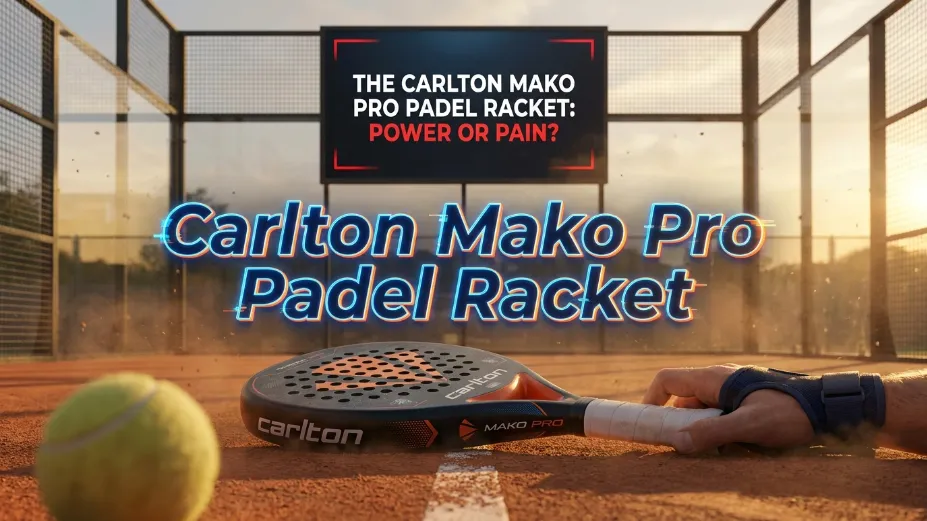
Carlton isn’t just a heritage name ruling badminton courts anymore; they have quietly engineered something genuinely ruthless for the padel cage. The carlton mako pro padel racket lands in the UK market aiming straight at intermediate and advanced players who refuse to compromise between raw power and clinical control. Instead of relying on flashy marketing hype, this stick bets everything on its structural carbon fibre stability and aerodynamically optimised frame profile. If you are looking to discover whether this racket actually delivers crisp volleys at your local club or simply looks premium in your kit bag, here is the unfiltered, data-backed breakdown.
Padel Racket Specifications
Technical detail & on-court performance impact
For intermediate to advanced attacking players seeking a premium carbon build under £90, the carlton mako pro padel racket represents an absolute value-for-money steal on the UK market. However, because of its head-heavy balance and demanding 3K carbon face, beginners or players prone to forearm injuries should avoid it to prevent physical fatigue and control loss. We strongly recommend this model to players with established technique who want to dominate the net with aggressive overheads.
An Honest Carlton Mako Pro Padel Racket Review
To write a truly objective carlton mako pro padel racket review, we must first address the commercial paradox of Carlton’s brand positioning in the United Kingdom. Founded in 1946, Carlton holds a legendary heritage in racket sports engineering, particularly in badminton, where they pioneered the first all-metal frames. However, their modern distribution through Frasers Group retail giants—such as Sports Direct and House of Fraser—has created a fascinating market anomaly.
While premium continental brands like Nox, Bullpadel, and Starvie are sold at specialist padel shops for upwards of £200, the mako pro padel racket sits quietly on discount racks for £60 to £90. This massive retail discount leads many players to write it off as a cheap supermarket-grade option. This is a critical mistake.
When we look past the budget price tag, the technical specifications of the Mako Pro reveal a high-performance profile. It is built with a 100% carbon fibre frame and a 3K woven carbon face, materials typically reserved for elite-tier rackets. The main challenge is that mass-market sports shops sell this racket to complete beginners who are attracted solely by the low price.
Because of its head-heavy weight distribution, these players often find it incredibly difficult to control and maneuver. For players who are still developing their court positioning and swing mechanics, we always recommend starting with a more forgiving setup. You can find excellent alternatives in our curated guide to the best padel rackets for beginners, which focus on ease of handling and a central sweet spot.
For players who have already transitioned past the basic learning curve, the Mako Pro presents a highly rewarding upgrade. The transition from entry-level glass fibre models to a stiffer, carbon-faced frame is a major milestone in a player’s development. It allows for faster ball speeds and a much crisper feel on impact. If you want to see how the Mako Pro compares to other mid-tier and premium intermediate models currently dominating UK clubs, explore our comprehensive breakdown of the best padel rackets for intermediate players to find your perfect technical match.
Portfolio Architecture: Where the Mako Pro Fits
To fully evaluate the carlton mako pro padel racket reviews found on online forums, we must understand how Carlton structures its padel portfolio. The brand categorises its range into three distinct performance tiers, transitioning from beginner-friendly glass fibre layups to advanced carbon weaves:
- Carlton Tetra Force (Entry-Level): Built with a 100% glass fibre frame and a round head shape. It features a very low balance point and weighs between 330g and 345g, making it highly manoeuvrable for new players.
- Carlton Piranha Strike (Intermediate): Constructed with a hybrid 50% carbon and 50% glass fibre frame, a 100% glass fibre face, and a soft EVA rubber core. It features a teardrop shape with a medium balance, weighting 345g to 360g.
- Carlton Mako Pro (Premium): The flagship model featuring a 100% carbon fibre frame, a 3K woven carbon face, and a denser EVA30 Soft Performance rubber core. It uses a teardrop shape with a head-heavy balance, weighing 360g to 375g.
This structural hierarchy shows that the Mako Pro is engineered as a high-performance racket. It requires a fast, consistent swing to unlock its full potential. While the Tetra Force and Piranha Strike focus on high flexibility and shock absorption, the Mako Pro focuses on structural stability and maximum energy transfer.
The Materials Science and Physics of the 3K Carbon Shell
In this technical mako pro padel racket review, we examine the materials science that governs how this racket performs under pressure. The hitting surface of the Mako Pro features a 3K woven carbon fibre shell, meaning 3,000 individual carbon filaments are woven into each cross-tow of the fabric. In the hierarchy of carbon composites, a 3K weave is highly elastic compared to stiffer 12K or 18K surfaces. This elasticity is crucial when paired with the EVA30 Soft Performance rubber core.
When executing a high-power smash, the ball compresses deeply into the racket. The EVA30 core absorbs the initial shock, while the 3K carbon face provides a quick, spring-like rebound. This physical synergy gives the racket excellent “pop” on offensive plays while retaining comfort during slower defensive blocks. If you want to understand why premium composite structures perform differently, read our detailed analysis on the structural benefits of carbon fibre padel rackets.
Another key engineering feature is the Optimised Curved Hole Pattern across the face. During fast swings—such as a flat smash or a high-speed *víbora*—a standard 38mm padel profile experiences significant aerodynamic drag. Carlton’s curved hole layout is designed to reduce air resistance and turbulence, allowing players to accelerate the racket head more quickly. It also distributes mechanical stress more evenly across the teardrop face, which helps expand the sweet spot toward the outer edges of the frame.
To understand the racket’s behavior on overhead shots, we can calculate its rotational inertia (or moment of inertia, $I$) around the player’s wrist joint using the following formula:
$$I = \int r^2 \, dm$$
Where $r$ is the distance of each mass element ($dm$) from the pivot point in the hand. Because the mass of the Mako Pro is concentrated further up the frame (high balance point), its rotational inertia is much higher than a head-light or round racket of the same static weight. This higher inertia means it takes more physical effort to start your swing, but it transfers significantly more kinetic energy to the ball on impact, resulting in exceptional power.
The Mass Retail Marketing Blunder: The “String Tension” Mistake
A major information gap in modern carlton mako pro padel racket reviews is a bizarre technical copywriting error found on the official listings of its UK distributors. On Sports Direct and House of Fraser platforms, the product descriptions for the Mako Pro, Piranha Strike, and Tetra Force include explicit care instructions telling players to “monitor string tension and adjust as needed” and to “check regularly for… loose strings.”
For any experienced padel player, this is a laughable mistake. Padel rackets are solid-state composite structures made of a foam core sandwiched between carbon or glass fibre faces; they do not have strings. This error indicates that the distributor’s marketing team copy-pasted care instructions directly from Carlton’s badminton racket lines, such as the Vapour Trail series. While this oversight does not affect the physical quality of the racket, it shows a clear lack of specialised padel knowledge from mass-market retailers. This underscores why buying from a specialized source matters.
Biomechanical Analysis: Torque and Joint Strain Risk
While the head-heavy balance of the Mako Pro is excellent for generating raw power, it introduces distinct biomechanical challenges that players must consider. During fast play at the net, blocking a high-velocity ball produces significant rotational torque ($T$) on the player’s wrist and elbow joint, calculated as:
$$T = F \times d$$
Where $F$ is the impact force of the ball and $d$ is the distance from the pivot point in the wrist to the impact centre on the racket face. Because a head-heavy racket places the centre of mass further from your hand, the effective distance ($d$) is longer, generating more torque than a head-light or evenly balanced racket. If your forearm muscles are undeveloped or your technique is inconsistent, this repetitive torque can lead to micro-tears in your tendons, commonly known as tennis elbow (lateral epicondylitis). If you are recovering from joint strain or want to prevent injuries, we highly recommend reading our specialized guide to the best padel rackets for tennis elbow to find a highly forgiving, shock-absorbing frame.
Head-to-Head Comparison: Carlton Mako Pro vs. Industry Giants
To help you understand where the Mako Pro truly stands in the market, we have compared its on-court performance directly against two of the most popular rackets in the UK:
Carlton Mako Pro vs. Babolat Counter Origin
The Babolat Counter Origin is widely considered one of the most comfortable and forgiving rackets for improving players. It features a round head shape, a head-light balance, and a flexible glass fibre face. In contrast, the Mako Pro is a head-heavy teardrop racket with a stiff 3K carbon face. While the Babolat is incredibly easy to maneuver during fast defensive exchanges at the back wall, it lacks the power needed for aggressive smashes. The Mako Pro requires much more effort to control, but it delivers far more speed and power on overhead shots.
Carlton Mako Pro vs. Nox AT10 Pro Cup Soft
The Nox AT10 Pro Cup Soft is a highly respected intermediate racket. It features a teardrop shape with a central sweet spot, utilizing an aluminised glass fibre face and a soft rubber core. This setup offers an excellent balance of comfort, control, and power. Compared to the Nox, the Mako Pro feels noticeably heavier in the head and has a stiffer, more responsive feel on impact. The Nox is more forgiving on off-centre hits, making it a safer option for general play, while the Mako Pro is a more specialised tool designed for aggressive, attack-minded players.
On-Court Playability: Offensive Power vs. Defensive Manoeuvrability
In actual play, the mako pro padel racket review reveals a clear divide in performance depending on where you are standing on the court:
- Offensive Play (The Net and Smashes): When dominating the net, the Mako Pro is exceptionally powerful. Its head-heavy balance allows you to execute flat smashes and kick serves with high ball speed and a satisfying “pop” off the 3K carbon face, with testers rating its offensive play a stellar 8.7 to 9.0 out of 10.
- Defensive Play (The Back Glass and Lobs): In defensive situations near the back walls, the racket is much more challenging. The high rotational inertia makes it harder to maneuver quickly, which can make half-volleys and fast reflex blocks feel heavy and sluggish.
- Spin Generation: Although the Mako Pro features a completely smooth surface finish rather than a deeply textured sand face, its curved hole pattern creates excellent drag and friction. This allows players to apply effective slice on volleys and cut serves, keeping the ball low off the back glass.
If you are looking for a high-performance alternative from a specialised boutique brand in the UK, we recommend checking out our detailed review of the Padelized Aero Pro Tour, which offers an impressive balance of power and manoeuvrability.
Structural Maintenance & UK Court Longevity
To protect your carbon investment and ensure the long-term performance of your Mako Pro, you should follow these essential maintenance guidelines:
- Thermal Management: Carbon fibre and epoxy resins are highly sensitive to extreme temperature changes. Leaving your racket in a hot car trunk in summer can soften the composite bond, while freezing winter temperatures can make the EVA30 core rigid and brittle. Always store your racket in an insulated, padded bag.
- Moisture Protection: Playing on wet outdoor courts in the UK can cause the internal EVA30 core to absorb water through the raw edges of the holes over time. This ruins the core’s elasticity and makes the racket feel heavy and dead. Always wipe the frame dry after damp sessions.
- Frame Protection: Carbon frames are strong but susceptible to cracking from sharp impacts against metal mesh or glass walls. Installing a high-quality adhesive frame guard along the top edge of your racket is a simple, highly effective way to prevent structural damage.
For more details on original sports gear and accessories, you can check out the official Sports Direct UK website to browse the latest padel ranges and current brand offers.
Strategic Verdict: Who Should Buy the Carlton Mako Pro?
The Carlton Mako Pro is an exceptional, high-specification padel racket that offers incredible value, but its unique design means it is not suitable for everyone. It is an ideal purchase for intermediate to advanced attacking players who want the premium feel, power, and spin of a high-end carbon racket without the high price tag. However, complete beginners, defensive-minded control players, and those recovering from tennis elbow or wrist injuries should avoid this model. For these players, a lighter, more forgiving racket with a glass fibre face is a much safer and more comfortable option to develop their game.
Frequently Asked Questions (FAQ)
- Is the Carlton Mako Pro constructed from genuine 100% carbon fibre?
Yes, the Mako Pro is built with a genuine 100% carbon fibre frame and a 3K carbon face. This premium construction provides superior structural strength and durability compared to cheaper glass fibre or plastic composite frames. - How does the head-heavy balance affect transition play and fast net volleys?
The head-heavy balance makes the racket feel heavier during quick net exchanges, reducing your reaction time. However, it provides excellent stability and power on overhead smashes, rewarding players with a fast, confident swing. - Will the stiffer 3K carbon face worsen existing tennis elbow or wrist injuries?
Yes. Because carbon is stiffer and absorbs less impact vibration than glass fibre, it transmits more shock to your arm. If you are prone to joint pain, we recommend using a lighter, more flexible racket. - Does the smooth surface finish limit your ability to play effective spin serves?
Not significantly. While the face is smooth, the aerodynamically optimised curved hole pattern generates effective friction and drag on angled shots, allowing you to play heavy slice and topspin serves with the proper technique. - What is the warranty policy when buying through major UK discount stores?
Purchasing through mass discount retailers in the UK often means you only get standard return policies, with no extended manufacturer warranty against structural cracks. Always check the specific return terms before buying.