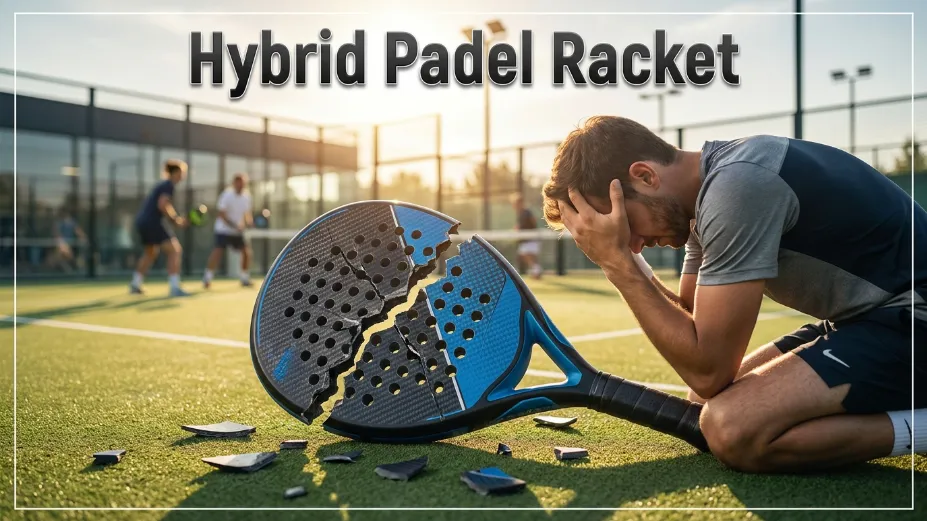
The sweet spot of a pure diamond mould sits frustratingly high, yet switching to a round shape leaves your overhead volleys utterly powerless on increasingly fast UK synthetic grass courts. Striking the definitive balance between raw aggression and baseline composure requires a precise evolution in gear—which is exactly why selecting the right hybrid padel racket has become the defining decision for advanced players this season. Instead of forcing you to compromise, the premium 2025 line-up re-engineers weight distribution to deliver explosive smash potential without leaving you exposed during high-speed defensive rallies.
Best Hybrid Padel Rackets — 2026
Verified Specifications & On-Court Performance
For players navigating competitive play, selecting the perfect hybrid padel racket depends heavily on your court conditions and physical tolerance. If you primarily play on unheated, damp outdoor UK courts where arm comfort and natural depth are essential, we confidently recommend the highly elastic nox nextgen pro hybrid 3k padel racket 2025. However, for elite technical competitors seeking customisable weights and rigid precision on warm indoor courts, the bullpadel vertex 04 hybrid padel racket 25 stands out as the ultimate weapon.
The Structural Engineering and Physics of the Hybrid Mould
The rise of the hybrid mould is not merely a marketing trend; it is a direct response to the physical constraints of traditional racket geometries. In the rapidly expanding UK sports landscape monitored by the Lawn Tennis Association, players are constantly searching for ways to optimise their games without suffering from physical strain. To understand why a hybrid racket functions so effectively, one must analyse how mould shape dictates weight distribution and rotational physics.
Traditional round models place the sweet spot low, offering superior handling but zero leverage during overhead swings. Conversely, diamond models push the sweet spot and balance point to the extreme tip of the frame, generating immense smash power but demanding perfect physical technique to avoid forearm fatigue. The hybrid shape represents a mathematical blend, sporting slightly wider shoulders than a standard teardrop and curved edges that preserve the sweet spot’s lateral diameter while shifting the balance point toward the upper-middle sector.
From a biomechanical perspective, this geometric configuration directly alters the racket’s Moment of Inertia ($I$) relative to the player’s wrist. This relationship is defined by the Parallel Axis Theorem:
$$I = I_{\text{COM}} + M d^2$$
Where $I_{\text{COM}}$ represents the racket’s moment of inertia about its centre of mass, $M$ represents the total static weight of the racket, and $d$ is the distance from the player’s hand to the racket’s centre of mass (balance point). By maintaining a moderate static weight (typically around 360g to 365g) but dynamically optimizing the balance point ($d$), hybrid rackets allow players to generate greater angular acceleration during high-speed smashes without requiring a heavy, fatiguing frame. This physical optimization is the catalyst for the explosive growth of hybrid padel rackets among competitive UK club players.
Material Science: Carbon Weaves, Core Foams, and Shock Absorption
The playing characteristics of a hybrid racket are governed by the interaction between the structural outer face and the polymer foam core. Understanding these elements is essential for anyone learning how to choose a padel racket that matches their physical capabilities.
Carbon Thread Density Explained
The carbon face of a racket is composed of woven carbon filaments, rated by the number of threads per bundle (3K, 12K, or 18K):
- 3K Carbon: Composed of approximately 3,000 filaments per thread. This weave is highly flexible, offering a softer touch and excellent shock absorption. It provides a highly forgiving sweet spot and is particularly suited to defensive play.
- 12K Carbon: Composed of 12,000 filaments. It offers a balanced intermediate touch, delivering excellent structural rigidity for fast smashes while retaining enough flex for defensive recovery.
- 18K Carbon: Composed of 18,000 filaments, creating an exceptionally stiff surface. It provides maximum energy return on aggressive overheads but has a smaller sweet spot and demands clean, advanced technique.
Core Foam Chemistry
Internally, modern rackets rely on Ethylene-Vinyl Acetate (EVA) foam, which varies in density to react to different shot speeds. For example, Bullpadel’s MultiEva core utilizes a “sandwich” design with three distinct layers. The outer layers are made of highly dense, rigid EVA that responds to powerful smashes with instant energy return. The inner layer is a soft, low-density EVA designed to absorb slower, defensive balls, increasing the contact time to provide absolute control. Conversely, Nox relies on high-density HR3 Black EVA, a rubber with exceptional shape memory that returns to its original state rapidly after impact, offering a consistent and powerful ball exit.
Head-to-Head: Bullpadel Vertex 04 Hybrid 2025 vs Nox NextGen Pro Hybrid 3K 2025
To see how these engineering principles translate to the court, we must conduct a detailed head-to-head analysis of the two most prominent hybrid models of the 2025 season.
The bullpadel vertex 04 hybrid padel racket 25 is a highly advanced, technical tool designed for advanced and professional players. It features a triple-density MultiEva core paired with an X-Tend Carbon 12K face, delivering a dry, crisp contact feel. To optimize aerodynamics, Bullpadel has integrated their patented CurvAktiv frame design alongside the Air Power system. By twisting the carbon sections of the frame and expanding the hollow throat channel by 50%, they have reduced aerodynamic drag by up to 23.5%. This allows players to generate exceptional swing speeds on explosive overheads while maintaining absolute structural stability.
In contrast, the nox nextgen pro hybrid 3k padel racket 2025 is engineered to prioritize all-court versatility, intermediate player progression, and physical comfort. Built with a full carbon frame and a highly elastic 3K Carbon face, it uses high-density HR3 Black EVA to provide a softer, more reactive impact. It features Nox’s Dynamic Composite Structure (DCS), which extends the structural carbon frame 4mm into the face, significantly reducing the difference in hardness at the borders and preventing structural cracking. While it lacks the raw, high-velocity power of the Vertex 04, it offers an exceptionally generous sweet spot and a comfortable, predictable rebound.
Unmasking the Information Gaps (What Competitors Won’t Tell You)
While standard reviews focus on generic marketing terms, competitive club players require deep technical analysis to avoid injuries and optimize their performance. Here, we expose four critical on-court realities that are rarely discussed in mainstream commercial reviews.
1. Exposing the “Hesacore Balance Shift”
On paper, Bullpadel advertises the Vertex 04 Hybrid 25 as an exceptionally low-balance racket (~25.0 cm), promoting it as a highly maneuverable, control-first model. However, this measurement is taken with the factory-installed 15g to 18g Hesacore grip at the base of the handle. This substantial mass at the extreme lower end of the frame acts as a counterweight, artificially pulling the centre of mass downward.
If a player removes the Hesacore grip to use a traditional overgrip setup, the balance point instantly rises to approximately 25.7 cm or 25.8 cm. This shift alters the physics of the racket, transforming a low-balance control frame into a head-heavy weapon that demands greater forearm strength. Players who undergo this modification without adjusting their swing mechanics often experience severe wrist strain and tricep fatigue.
2. Decoupling Ball Output (Salida de Bola) from Raw Power (Potencia)
Many intermediate players mistakenly conflate “ball output” and “raw power”, leading to incorrect equipment purchases. Ball output refers to how easily a racket rebounds the ball during slow-paced defensive shots without requiring a full, active swing. Raw power, on the other hand, is the racket’s ability to return high-velocity energy during hard smashes.
Because of its rigid 12K Carbon face, the Vertex 04 Hybrid has a very dry touch and incredibly low ball output. If you are caught out of position at the back of the court, you must execute a clean, full swing to clear the net. However, during high-velocity smashes, the stiff carbon face does not deform, transferring 100% of your power directly to the ball. Conversely, the Nox NextGen Pro Hybrid 3K 2025 has high ball output due to its flexible 3K Carbon face, allowing for easy defensive lobs. Yet, under maximum smash velocity, the face flexes, absorbing energy and limiting the racket’s raw power ceiling.
3. The Sub-10°C Winter Core Freeze: Protecting Your Joints
The climate in the United Kingdom presents a unique challenge for padel equipment. Ethylene-Vinyl Acetate (EVA) is a polymer that is highly sensitive to ambient temperature. When playing on unheated indoor or outdoor UK courts during late autumn and winter, sub-10°C temperatures cause the polymer molecules within the EVA core to contract, significantly hardening the racket.
Playing with a rigid frame like the Vertex 04 Hybrid in cold weather turns the face into an unyielding, unforgiving block of carbon. The sweet spot shrinks, and the micro-vibrations from off-centre hits are transmitted directly up the arm, risking injury. For year-round play in the UK, players seeking joint comfort should consult our guide on the best padel rackets for tennis elbow to understand how softer materials protect your joints during the colder winter months.
4. Commercial Build-Quality Realities and Premium Alternatives
As padel has grown, many major commercial brands have faced criticism regarding the long-term durability of mass-produced carbon frames. Under intensive play, standard hollow frames can develop micro-fractures, particularly around the throat and outer borders. This has driven advanced club players to seek out premium, handcrafted alternatives.
For players demanding exceptional durability and natural vibration dampening, the hand-made cork padel racket line-up has become a highly respected alternative. Utilizing a composite face wrapped in natural cork, these rackets absorb peak shock frequencies far more effectively than traditional mass-produced carbon frames while offering exceptional resistance to structural cracking. Highly technical competitors looking for the absolute pinnacle of performance should consult our curated analysis of the best padel rackets for advanced players to explore these high-end, durable options.
Frequently Asked Questions (UK Club Player Guide)
1. What is the practical difference between a hybrid padel racket and a teardrop racket?
While both shapes aim to provide versatility, a hybrid racket typically features slightly wider, angular shoulders—drawing inspiration from a diamond profile—but pairs this with curved corners to maintain a wider sweet spot. Teardrop rackets are slightly narrower at the bottom, offering a medium balance, whereas a hybrid frame can be adjusted or balanced closer to the hand or the head depending on structural carbon placement and custom weight systems.
2. Why does my hybrid racket feel much stiffer during outdoor winter matches in the UK?
Padel cores are constructed from EVA foam, which contracts and hardens in cold temperatures (typically below 10°C). This physical reaction increases the hardness of your racket, shrinking the sweet spot and sending more vibrations through your wrist and elbow. If you play outdoors year-round in the UK, using a more elastic 3K carbon face or softer EVA foam will help prevent joint strain.
3. Can intermediate players use the Bullpadel Vertex 04 Hybrid 25 safely?
The Vertex 04 Hybrid is a technical, low-rebound racket that demands precise timing and swing mechanics. Intermediate players who struggle with consistent contact may find that defensive balls fall short of the net due to its low ball output. For developing players, a more forgiving, high-rebound hybrid frame—like the Nox NextGen Pro Hybrid 3K—is a significantly safer option for long-term progression.
4. How much does a Hesacore grip actually affect the swing weight of my racket?
A Hesacore grip weighs between 15g and 18g, which is placed directly at the handle. Because this mass is positioned at the pivot point (where $d \approx 0$), it acts as a counterweight that lowers the physical balance point. Removing the Hesacore grip shifts the centre of mass toward the head, raising the balance by nearly 1cm and substantially increasing the dynamic swing weight during overhead play.