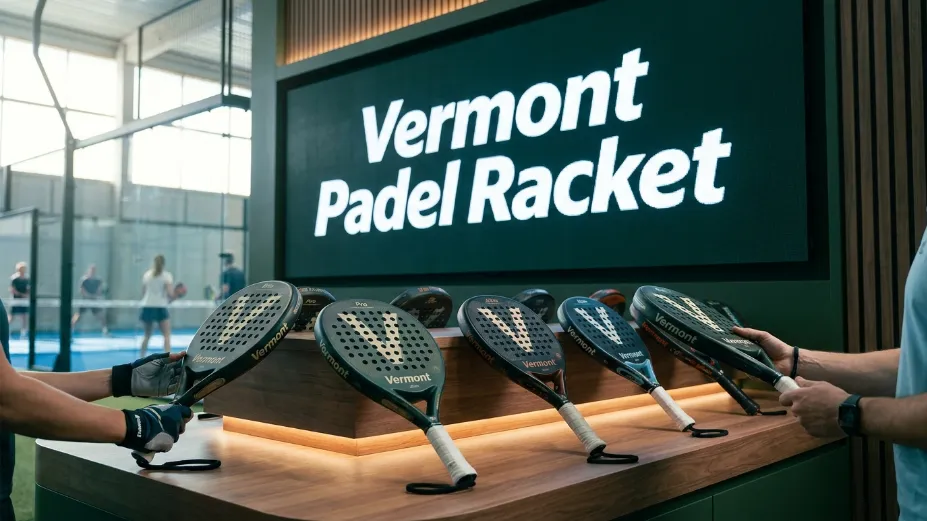
Choosing a padel bat shouldn’t feel like a game of chance, yet British courts are flooded with players wielding mismatched power and control. Finding the definitive vermont padel racket tailored to your specific technique is the exact margin between controlling the glass or smashing a forced unforced error into the net. Every core density, carbon weave pattern, and balance point changes how the ball behaves on impact. Below, we break down the engineering behind Vermont’s entire flagship lineup so you can confidently select the exact model meant for your style of play.
Vermont Padel Rackets — Full Range
Level · Core · Shape · Weight · Primary Benefit
For British players navigating wet, high-humidity court conditions, the optimal selection depends on structural technique: the Vermont Imperium Padel Racket stands out as the supreme option for elite players seeking maximum spin and a highly responsive sweet spot, whereas intermediate defenders looking for structural forgiveness and budget accessibility will find the Vermont Origin Padel Racket to be the most stable tool across indoor and outdoor UK venues.
Anatomy & Materials Science: Under the Hood
Raw QuadCarbon Fibre Face & Structural Friction
The engineering core of the premium Vermont range relies heavily on the integration of Raw QuadCarbon Fibre. Utilizing top-tier T700 carbon woven in a multi-directional matrix, this face construction enhances the structural integrity of the racket. Unlike traditional construction methods that rely on external grit coatings or sprayed-on chemical paint textures—which degrade rapidly under the friction of abrasive carbon fibre padel racket impacts—the QuadCarbon face generates mechanical friction through the weave itself. This cross-hatched alignment grips the felt of the ball, maximizing the instantaneous Spin Rate without losing texturing over months of heavy use.
Vanguard X5+ Polypropylene Honeycomb Core
Beneath the raw carbon face lies the 16mm Vanguard X5+ Polypropylene Honeycomb core. This specific core depth provides a critical physical barrier against kinetic shockwaves. Inspired by advanced composite research protocols, the core cells are precisely calibrated to absorb vibrational frequencies upon impact. By spreading the energy distribution outward across the cell walls rather than bouncing it straight back into the handle, the core widens the effective Sweet Spot dramatically. This dampening mechanism translates to an exceptionally plush feel, allowing players to absorb heavy smashes at the net and reset the point with maximum stability.
The Invikta Geometry & Fixed-Weight Analytics
The outer dimensions conform to elite geometric standards: a tailored length of 16.45 inches coupled with a streamlined width of 7.44 inches. This elongated silhouette moves the centre of mass slightly higher up the face. To counterbalance this upper displacement, Vermont integrates an ergonomic Octagonal Grip featuring a length of 5.5 inches and a 4.25-inch circumference. This extended handle is engineered intentionally to accommodate a Two-Handed Backhand, allowing the non-dominant hand to rest securely on the handle for added leverage during fast rallies. Weight categories are strictly maintained to suit specific physical profiles:
- Midweight Specification (7.7 – 8.1 oz / 365g – 372g): Optimized for driving deep groundstrokes and offering extra stability against high-velocity balls.
- Lightweight Specification (7.3 – 7.6 oz / 345g – 360g): Purpose-built for quick reactions at the kitchen line and reducing wrist fatigue during extended matches.
On-Court Performance & Playability
The Soft Game (Dinks, Drops, and Resets)
When executing delicate drop shots and soft touch volleys, the premium Vermont platform operates as a benchmarking tool. The combination of the thick 16mm core and the raw face gives the ball an extended Dwell Time—the microscopic window where the ball remains compressed against the surface. This long contact period provides the sensory feedback required to drop the ball safely over the net. When facing an aggressive, fast smash, the racket functions like a dampening pad, taking the sting out of the ball and allowing you to drop it short into the opponent’s court with precision.
Spin Weaponry & Ball Flight Path
The raw T700 face alters the aerodynamics of the ball post-impact. Because the mechanical cross-weave locks onto the ball’s outer layer, players can slice underneath or roll over the ball with intense rotational speed. This massive spin causes a sharp drop in the ball’s flight path as it clears the net. When the ball lands at the opponent’s non-volley zone, it skids low instead of bouncing up, making it extremely difficult for defenders to clear and frequently forcing them into unforced errors.
The Power Deficit & Speed-Up Rallies
Every design focused on control involves a trade-off. Because the core is engineered to absorb energy, these rackets naturally lack the explosive, immediate rebound pop seen in modern thermoformed rackets. In ultra-fast net battles where points are decided in split seconds, a pure control paddle requires a faster, cleaner stroke to generate identical ball speed. To overcome this power deficit, players must focus on accelerating their swing speed, utilizing a clean, fluid technique rather than relying on the stiffness of the racket frame to generate pace.
The Twistweight Physics & Sweet Spot Trade-Off
The Elongated Design Penalty
Opting for an elongated racket shape introduces specific physical consequences. While the extra length provides excellent reach and overhead leverage, it narrows the hitting area from side to side. On off-centre hits near the edges, the racket frame naturally wants to twist in the player’s hand. With a measured twistweight value of just 5.88, the blade lacks the natural resistance to twisting found in wider, traditionally round shapes. If a ball hits too far to the left or right of centre, the racket will rotate slightly around its long axis, resulting in a loss of directional accuracy.
Mathematical Expression of Twistweight
To understand how stability changes across the face, we analyse the rotational moment of inertia. The physical calculation of twistweight determines exactly how well the frame resists twisting along its central axis:
$$TW = \sum m_i y_i^2$$
Within this physical formula, $m_i$ represents the individual elements of mass distributed across the frame, while $y_i$ represents the precise distance of those mass units from the central longitudinal axis. Because the elongated body pulls the structural mass closer to the centre line (reducing the value of $y_i$), the overall twistweight drops. This mathematical reality proves that without adding extra weight to the outer edges, an elongated shape will always remain more vulnerable to twisting on off-centre hits than a wider, round shape.
Advanced Customization: The Lead/Tungsten Tape Blueprint
To bypass the natural geometric limitations of these frames and adjust performance to match elite playing styles, players can strategically add high-density tungsten or lead tape to the perimeter of the racket:
- Plow-Through Power Boost (12:00 Position): Applying 1 gram of tungsten tape per inch directly at the absolute top of the frame shifts the balance point toward the head. This modification increases the total swingweight, maximizing kinetic energy transfer during full-extension overhead smashes and helping baseline drives land deeper in the opposing court.
- Perimeter Stability Modification (3:00 & 9:00 Positions): Adding weighted strips directly to the sides of the frame spreads the mass outward. This change increases the distance of the mass elements from the centre line, artificially raising the twistweight. This setup widens the sweet spot from side to side, preventing the frame from twisting on off-centre volleys and ensuring defensive blocks return straight over the net.
- The Hybrid Pro Setup (10:30 & 1:30 Positions): For a balanced setup, placing weights diagonally along the upper corners offers a great compromise. This method increases power and deep court depth while maintaining lateral stability, all without adding too much heavy head weight that could slow down quick wrist movements during fast net exchanges.
Comprehensive Deep-Dive into the Vermont Lineup
Understanding the internal engineering differences across the Vermont lineup is essential for selecting a frame that matches your personal style. Each model features a distinct core density, structural shape, and face material designed to target specific tactical playstyles.
Engineering the Court: The vermont imperium padel racket Technical Analysis
The vermont imperium padel racket is the absolute pinnacle of technical engineering within the lineup, purpose-built for advanced players who demand total control over ball rotation and placement. It features a high-grade QuadCarbon T700 face layered over a dual-density 16mm core, maximizing the contact time between ball and face. This configuration provides advanced players with the precise tactile feedback needed to execute delicate drop shots and angled volleys. For competitive players seeking to master advanced tactics, knowing how to choose a padel racket with this level of structural consistency is vital for maintaining a high standard of play under intense match pressure.
Grassroots Control: Inside the vermont origin padel racket
Designed with maximum forgiveness in mind, the vermont origin padel racket features an oversized round profile paired with a soft fiberglass-carbon hybrid face. This setup moves the weight distribution down toward the handle, creating an exceptionally lightweight and easy-to-use feel. The softer face material cushions hits, making this model the best padel racket for beginners who are focused on building clean stroke habits and avoiding unforced errors. It minimizes off-centre vibrations, allowing developing players to master baseline consistency and accurate defensive returns before moving on to stiffer, more powerful frames.
Attacking Mechanics: The vermont apex padel racket Blueprint
The vermont apex padel racket uses an aggressive, head-heavy diamond shape tailored exclusively for offensive baseline playstyles. Built with a rigid high-rebound polymer core and a dense 12K carbon face, it maximizes energy return upon impact. The higher balance point acts as a natural lever, generating explosive head speed during overhead smashes and quick volleys. This model is engineered to deliver raw power, making it an excellent choice for tournament players who generate their own pace and want to dictate the tempo of the game with deep, heavy drives.
Aerial Supremacy: Decoupling the vermont ascend padel racket
The vermont ascend padel racket features a versatile teardrop shape that bridges the gap between pure defensive control and raw power. It utilizes a medium-density responsive EVA core paired with an aerodynamic frame design, allowing for incredibly fast handling during quick net rallies. This balanced weight distribution makes it highly effective for intermediate to advanced players who switch rapidly between deep defensive lobs and quick attacking volleys, offering a versatile tool for all-court performance.
Head-to-Head Market Comparison
When stacked against global industry standard alternatives, the differences in design and manufacturing philosophy become clear:
Vermont Vanguard Control vs. Luxx Control Air Invikta
- Core Profile: The Vermont features a solid 16mm core that provides predictable mechanical feedback across the entire surface. In contrast, the Luxx uses a thicker 20mm profile designed to maximize shock dampening, though it can occasionally create a slightly disconnected, overly cushioned feel on soft touches.
- Face Texture Durability: Vermont relies on a raw woven T700 carbon finish that maintains its grip over long-term use. The Luxx uses a sprayed-on grit texture over a composite face, which can smooth out over months of regular play, leading to a gradual drop-off in maximum spin generation.
- Ball Response: Advanced competitive players often prefer the crisp, natural feedback of the Vermont over the deeply dampened feel of thicker 20mm frames, as it allows for cleaner judgment of power and depth on delicate drop shots.
Vermont Vanguard Control vs. Vatic Pro Prism Flash & Six Zero DBD
- Manufacturing Methods: The Vatic Pro and Six Zero utilize thermoformed edges, which seal the frame under heat to create a very stiff, highly responsive edge. The Vermont uses a cold-pressed assembly process, which prioritizes a softer feel and greater control over outright power.
- Value & Build Quality: While imported carbon frames offer a lower entry price, Vermont backs its premium lineup with a dedicated warranty and strict quality control standards, ensuring structural integrity over a much longer competitive lifespan.
Real-World Durability & The Warranty Safeguard
Surface Degradation & Maintenance
Over time, tiny fragments of plastic ball felt and court dust become trapped within the raw carbon weave. This buildup fills the microscopic gaps in the texturing, causing a noticeable drop in spin performance. To restore the surface grip, players should regularly clean the face with a specialized rubber block. Firmly wiping the block across the face pulls out trapped debris without scratching the carbon fibers, keeping the surface in peak condition.
The “Core Crackling” Phenomenon
Under the stress of repeated high-velocity impacts, the internal bond between the raw carbon face and the honeycomb core can break down. This structural fatigue shows up as a faint crackling sound when you press on the face with your thumb. This internal delamination creates dead spots where the ball bounces unpredictably and loses power, signaling that the core has suffered internal damage and the frame needs to be replaced.
Navigating Warranty Frameworks
When dealing with internal core issues, manufacturers typically require definitive proof of structural failure before approving a replacement. Players should document the issue by recording a clear video showing the flexing or clicking sound under pressure. To avoid premature wear, rackets should never be stored in high-heat environments like car trunks, as excessive heat softens the internal adhesives and can void your warranty coverage.
Final Verdict & Player Profiling
The premium Vermont range is specifically engineered for tactical players who build their strategy around court positioning, patience, and precise ball placement. It provides an ideal platform for players with a strong tennis background who naturally generate plenty of swing power and need a controllable, predictable frame to keep deep drives inside the lines. It excels in defensive play, allowing for accurate resets and controlled positioning battles at the net.
Conversely, aggressive players who rely on pure power and explosive, immediate pace should look toward stiffer, thermoformed options. For experienced competitive players seeking the absolute highest tier of control and rotational spin, investing in the best padel rackets for advanced players like the top-tier Vermont models delivers the structural consistency needed to perform at your best.
Frequently Asked Questions (UK Padel Edition)
Q: What is the main structural difference between the Vermont Imperium and the Vermont Origin?
A: The Imperium features a raw QuadCarbon T700 face with a 16mm dual-density core designed for maximum spin and tactical control. The Origin utilizes a softer fiberglass-carbon hybrid face with an oversized round shape, making it much more forgiving for developing players.
Q: How long does the raw carbon face texture last on Vermont rackets before losing spin?
A: Unlike sprayed-on grit coatings that wear down within months, Vermont’s raw T700 carbon face features a texture woven directly into the material. With regular cleaning using a rubber block, it will maintain its spin generation for over a year of consistent play.
Q: Does the Vermont Apex racket help with tennis elbow symptoms?
A: While we focus strictly on the engineering aspects of the racket, the Apex features a rigid high-rebound core and a head-heavy balance. Players looking for maximum vibration absorption typically prefer the softer, handle-heavy balance of the Origin or the dampening core of the Imperium.
Q: Can I add lead or tungsten weight tape to a teardrop frame like the Vermont Ascend?
A: Yes. Adding weight to the 3:00 and 9:00 positions on the Ascend frame will increase its lateral twistweight, broadening the sweet spot and improving stability during fast net volleys without altering its all-around playing style.