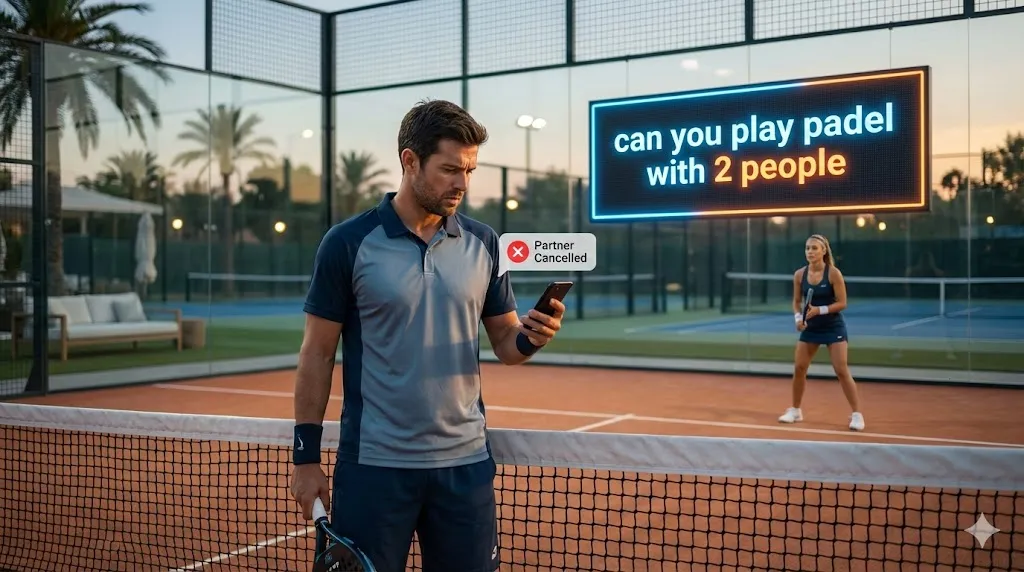
It’s the classic Sunday morning nightmare for any club player: you have a court booked at your local centre, your bag is packed, and suddenly, a notification pops up on your phone. One of your four players has dropped out last minute.
Do you cancel the booking and lose your fee? Do you scramble to find a replacement on WhatsApp groups? Or do you head to the court anyway?
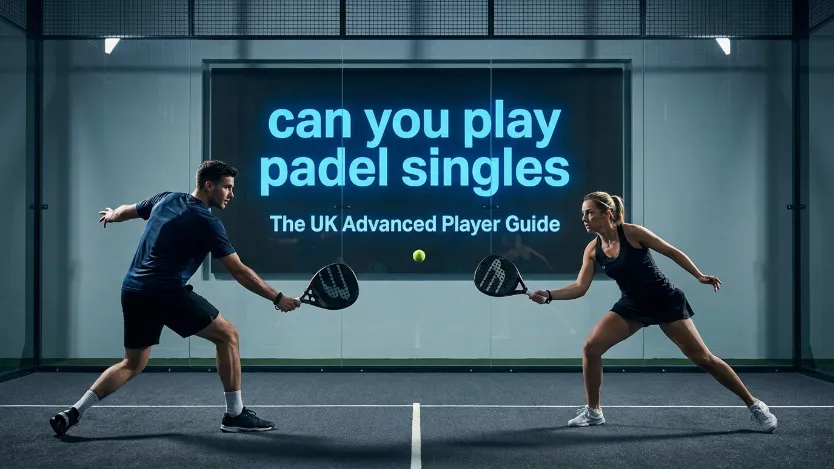
The good news is, you don’t have to cancel. Can you play padel with 2 people? Absolutely. While Padel is traditionally a doubles sport designed for four players, playing singles (1 vs 1) is not only possible but is rapidly becoming a popular training method across the UK.
In this guide, we will explore exactly how to play singles effectively, the specific rules for 1v1 on a standard court, and how this format can actually skyrocket your technical skills faster than traditional doubles play.
Can You Play Padel With Just 2 People? (The Basics)
First, let’s clear up the confusion. If you look at the official padel rules, Padel is defined as a doubles sport. The professional tours you see on TV, like Premier Padel, are strictly 2 vs 2 affairs.
However, the reality of recreational sport is different. Whether it’s due to a lack of players or a specific desire to train harder, playing with two people is very common. You have two main options:
- Official Singles Padel: Played on a specific, smaller court.
- Casual 1v1 Padel: Played on a standard doubles court using modified rules.
For most players in the UK, option two is the reality. Finding a dedicated singles court can be like finding a needle in a haystack (though we will discuss where they exist shortly). Therefore, learning how to adapt your game to a standard court is an essential skill for any padel addict.
If you are completely new to the sport and wondering how the standard game works before diving into singles, you might want to read our guide on what is Padel first.
Where to Play: Singles Court vs. Standard Court
What is a Singles Padel Court?
Yes, they do exist! A purpose-built singles padel court is designed specifically for high-intensity 1v1 matches. The length remains the same as a doubles court, but the width is significantly reduced.
- Standard Doubles Court: 20m long x 10m wide.
- Singles Padel Court: 20m long x 6m wide.
On a 6-metre wide court, the dynamics are incredibly fast. You don’t have a partner to cover the lob, and the angles are tighter. However, these courts are rare in the UK. While new venues like Rocket Padel Bristol or others popping up might experiment with them, the vast majority of clubs only install standard courts to maximise revenue (as doubles courts accommodate 4 players).
The Challenge of the Standard Court
If you try to play a normal game of 1v1 on a standard 10m wide court, you will quickly realise the problem: the court is simply too big. It is impossible to cover the net effectively. If you move to volley, your opponent has 10 metres of width to pass you. If you stay back, the points become endless rallies down the middle.
To make can you play padel with 2 people a viable and enjoyable experience on a standard court, we need to introduce specific constraints and rules.
How to Play 1v1 on a Standard Court (Rules & Setup)
Since most of us don’t have access to a bespoke singles court, here is how to play effectively on the court you already have booked.
Option A: Cross-Court Singles (Diagonal Padel)
This is the “Gold Standard” of 2-player padel. It is widely used by coaches and pros to refine consistency and tactical awareness.
The Setup:
- Both players choose a diagonal (e.g., Player A stands in the right service box, Player B stands in their right service box—which is diagonally opposite).
- The full length of the court is used, but only the chosen diagonal half of the width is “in play”.
The Rules:
- The Service: Serve as normal, diagonally.
- The Rally: Every shot must bounce in the opponent’s diagonal half of the court.
- The Net & Glass: You can use the glass as normal. If the ball hits the side fence in the opponent’s diagonal, it is usually considered “in” (depending on the strictness of your agreement).
- The “Second Bounce” Rule: This is crucial for avoiding arguments. If a ball lands in the correct diagonal box but bounces a second time in the other half of the court (the “out” zone), does it count?
- Strict Rule: No. The ball must stay in the diagonal zone.
- Training Rule (Recommended): Yes. As long as the first bounce was in the correct zone, the point continues or is won.
This format is excellent because it mimics the exact angles you experience in a real match. You practice the Bandeja to the corner, the Chiquita to the feet, and the cross-court lob.
Option B: Down-the-Line (Half Court)
This format involves using one longitudinal half of the court (e.g., just the right side or just the left side).
The Limitations:
While simpler to understand, this format has a major flaw: the net post and the central metal bar of the fence. Playing “down the line” restricts your angles significantly and feels less like a real match. However, it is useful for practicing straight passing shots.
Is Singles Padel Good for Training? (Pros & Cons)
You might be asking, “Is it worth the effort?” The answer depends on your goals. If you want a social laugh, doubles is better. If you want a serious workout and technical improvement, 1v1 is unbeatable.
The Physical Benefits (Cardio)
Playing 1v1 is physically demanding. In a doubles match, you might hit the ball every 10-15 seconds. In singles, you are hitting every single ball. There is no downtime. Players often find that 60 minutes of singles burns significantly more calories than 90 minutes of doubles.
Because of the increased movement, ensuring you have the correct footwear is vital to prevent injury. Check out our guide to the best padel shoes to ensure you have the grip required for these sharp, frequent turns.
Impact on Your Doubles Game
The Pros:
- Volume of Play: You hit hundreds of balls in a session.
- Consistency: You cannot hide. If your backhand is weak, your opponent will exploit it relentlessly until you improve.
- Net Play: It forces you to be precise with your volleys. A loose volley in singles is an instant lost point.
The Cons:
- Positioning Habits: In singles, you cover the court differently. Be careful not to carry “singles habits” back to your doubles game, such as leaving your partner’s middle exposed.
Top 3 Padel Drills for 2 People
If you don’t want to play a competitive set, use your 2-person booking for dedicated drilling. This is often more valuable than a match.
1. The “1 Up, 1 Back” (Attacker vs Defender)
This is the ultimate drill for mastering the transition game.
- Setup: Player A starts at the net (volley position). Player B starts at the back of the court.
- The Goal: Player A tries to win the point with volleys and smashes. Player B tries to defend and lob.
- Rotation: Swap roles every 5 minutes or after a set number of points.
- Tip: Use high-quality balls for this, as the rallies can get long. We recommend checking our list of quality padel balls that maintain pressure longer.
2. The “7-Point Tie Break” (Cross-Court)
Play a competitive tie-break to 7 points, but strictly cross-court. This adds pressure to your practice. The loser buys the post-match coffee!
3. The Deep Ball Game (Groundstrokes Only)
This is a cooperative drill to improve your touch.
- Rule: You must hit the ball so it bounces behind the service line.
- Objective: Keep the rally going as long as possible. If a ball lands short (in the service box), you reset.
- Equipment: Using a racket with a large sweet spot helps here. See our reviews on the latest Head padel rackets for control-focused options.
Frequently Asked Questions
Do I pay less for the court booking if we are only 2?
Generally, no. Most clubs in the UK, such as Pure Padel Manchester, charge per court per hour, regardless of how many people are playing. This means playing 1v1 is usually twice the price per person compared to doubles.
Can we play ranked matches 1v1?
Currently, the LTA ranking system focuses on doubles. While you can find local ladders for singles, official LTA padel tournaments are almost exclusively doubles formats.
Is there a specific racket for singles?
No, you use the same equipment. However, because singles is faster, some players prefer a lighter racket for quicker reactions. You might consider checking out the Babolat Air Viper or similar agile frames in our best padel rackets in the UK guide.
Common user query: “can you play padel.with 2 people?”
We often see players typing this quickly into search engines. The answer remains the same: Yes, absolutely! Just ensure you agree on the boundaries (cross-court vs full court) before you start to avoid disputes.
Conclusion
So, can you play padel with 2 people? Yes, and you should. It is a fantastic way to improve your fitness, refine your technique, and ensure you never miss a week of Padel just because a partner dropped out.
Next time you find yourself with only one partner, don’t cancel the court. Head down, set up a cross-court battle, and watch your control improve. For more official guidance on the sport, you can always visit the official LTA guidance page.
Now, grab your racket—perhaps a flashy new Lamborghini padel racket if you’re feeling fancy—and get on the court!