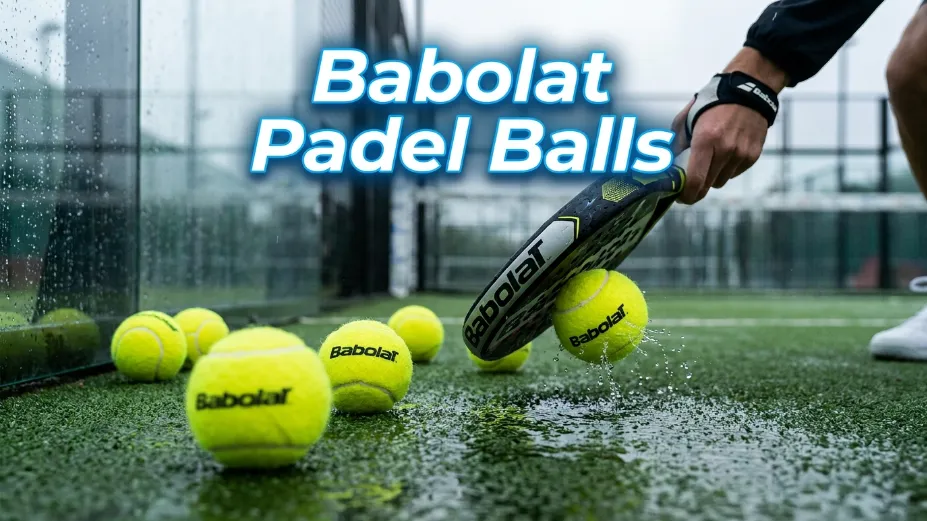
Text on a Padel court moves fast, but nothing kills a high-intensity rally quicker than a dead bounce. If you have ever watched a perfect smash die on the glass, you already know that your racket is only as good as the rubber it strikes. Finding the definitive babolat padel balls setup for the UK’s notoriously damp synthetic grass courts isn’t just about grabbing a pressurised three-pack; it is about matching core density to your specific swing speed.
Whether you are aiming for the grit and durability of a club training session or the explosive velocity needed to kick the ball out of the court, the French tennis giants have engineered three distinct responses to the modern game. Let’s dissect the physics behind each felt type so you can stop guessing and start dominating from the baseline.
Babolat Padel Balls — Range & Specification Comparison
Felt · Core · Speed · Durability/Performance · Price (GBP)
If you are playing year-round on the UK’s typically cold and damp outdoor courts, we highly recommend the babolat court padel balls as they retain their elastomeric elasticity far better in lower temperatures. For indoor competitive games where you want maximum speed and high-intensity overhead smashes, the babolat ace padel balls or the spin-heavy babolat padel tour balls are your gold standard. Always pair your setup with a high-quality pressuriser to prevent early pressure loss and get the most value out of your tubes.
The Science of Padel Ball Dynamics: Dissecting the Tennis Ball Fallacy
The materials science governing low-impact court sports is frequently misunderstood by intermediate players and club coordinators alike. A major structural issue in UK clubs centers on the systemic selection of standard tennis options instead of custom-engineered padel balls babolat. While superficially identical to an untrained eye, their manufacturing specifications diverge sharply across internal atmospheric pressures, core thicknesses, and compound elasticity thresholds, meaning substitutes can severely damage specialized padel gear.
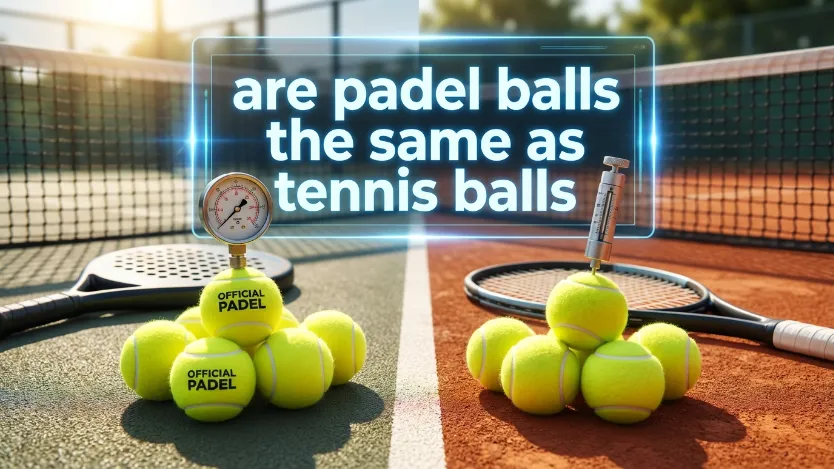
Internal pressure parameters dictate the core mechanical performance of the product. True padel specifications necessitate an internal gauge pressure of approximately 10 to 11 PSI (~24 PSI absolute pressure), whereas tennis spheres are loaded to roughly 14 to 15 PSI (~28 PSI absolute pressure). Striking a high-pressure tennis alternative with a standard 38mm padel racket transfers immense localized impact forces directly into the paddle face.
This elevated mechanical loading rapidly fatigues the delicate polyethylene or ethylene-vinyl acetate (EVA) foam cores of premium rackets, causing early matrix cracking, collapsing the internal cell structures, and creating permanent flat spots that instantly ruin a racket’s touch.
Furthermore, the physical dimensions and flight mechanics differ. Padel balls must maintain a precise diameter between 6.35cm and 6.77cm, with a mass window of 56.0g to 59.4g. Tennis variants can be significantly larger and heavier, generating substantially more torque upon impact. This extra weight alters the racket’s balance point during high-speed defensive recoveries off the rear glass, putting excessive strain on the player’s wrist and elbow tendons, which often triggers chronic lateral epicondylitis (tennis elbow).
The Ideal Gas Law & Thermodynamic Drag in the Damp UK Climate
Playing outdoor padel in the United Kingdom during autumn and winter introduces unique thermodynamic variables that completely change ball behavior. These micro-environmental shifts can be analyzed through fundamental physics, starting with the Ideal Gas Law to calculate air density adjustments:
$$\rho = \frac{P}{R \cdot T}$$
Where:
- $\rho$ represents the localized atmospheric air density in $\text{kg/m}^3$.
- $P$ represents local barometric pressure, measured in Pascals.
- $R$ represents the specific gas constant for dry atmospheric air ($287.05\text{ J/kg}\cdot\text{K}$).
- $T$ represents absolute thermodynamic temperature, measured in Kelvin.
When temperatures drop from an indoor ambient 21°C (294.15K) to a freezing 3°C (276.15K) on an outdoor court in Yorkshire, the absolute air density ($\rho$) increases dramatically. This denser air mass exerts a significantly stronger aerodynamic drag force ($F_d$) against the ball during high-speed overhead drives, which is calculated using the standard aerodynamic drag equation:
$$F_d = \frac{1}{2}\rho v^2 C_d A$$
Where:
- $F_d$ is the resulting total aerodynamic drag force experienced in Newtons.
- $v$ is the instantaneous forward velocity vector of the ball relative to the air flow.
- $C_d$ is the non-dimensional drag coefficient determined by the relative roughness of the felt weave.
- $A$ is the projected cross-sectional area of the sphere ($A = \pi r^2$).
Because the drag force ($F_d$) increases linearly with air density ($\rho$), a smash hit at identical speeds travels noticeably slower in winter conditions. This deceleration is further exacerbated by the viscoelastic behavior of the natural rubber core. In sub-zero environments, the rubber molecules lose their flexibility and stiffen, a phenomenon known as approaching the glass transition phase.
This molecular change reduces the internal coefficient of restitution (CoR), making the ball feel heavy and dead, and preventing it from popping high enough off the back wall for easy smashes.
Moisture on synthetic turf courts also accelerates performance drops. As the ball skids across wet artificial grass, the felt fibers absorb water droplets, increasing the ball’s mass past the legal 59.4g threshold. This extra weight increases the kinetic energy needed to drive the ball forward, while also lowering the internal temperature of the rubber core, killing its bounce and making long, high-intensity rallies highly fatiguing.
Babolat Court Padel Balls: Technical Analysis of the Club Workhorse
The babolat court padel balls are purpose-engineered to counter the brutal, high-moisture degradation typical of daily UK club use. Rather than using brittle wool blends that fray quickly when exposed to sand-dressed synthetic turf, Babolat developed a heavy-duty synthetic felt shell. This formulation blends high-tensile polyester with reinforced polyamide fibres, maximizing abrasion resistance against coarse glass walls and sand coatings.
The core relies on a high-density, sulfur-vulcanised rubber compound that resists cold-weather flattening. During manufacturing, the internal rubber matrix is infused with specialized elastomeric plasticizers, which stabilize its flexibility across a wide temperature range. This structural design ensures a highly consistent rebound height, making it an excellent option for training academies and winter ladder matches across Great Britain.
- The 12-Hour Heavy Play Threshold: Unlike standard entry-level options that split or go soft after four hours of play, this synthetic felt maintains its structural integrity well past twelve hours of intense court use.
- Synthetic Hydrophobic Guard: The treated outer synthetic layer repels superficial water drops, keeping the ball from absorbing excess moisture and preventing it from feeling heavy during rainy autumn matches.
- Muted Acoustic Profile: The dense synthetic outer shell dampens high-frequency impact sounds, producing a deeper, bass-heavy acoustic profile that helps neighborhood padel facilities comply with local noise regulations.
Babolat Ace Padel Balls: The Advanced Indoor Speed Velocity Engine
When players move indoors to specialized courts in London or Manchester, the game’s tactical needs shift toward sheer speed, quick reflexes, and explosive power. The babolat ace padel balls are engineered exactly for this high-speed style. They feature a pressurized core tuned to the upper limit of international regulatory standards, maximizing energy return upon impact.
To reduce air resistance, the model uses an ultra-packed, thin-weave natural wool felt imported from top textile mills. This tight weave creates a very low surface roughness profile, lowering the drag coefficient ($C_d$) so the ball cuts through the air with minimal speed decay. This allows advanced players to generate exceptional velocity on low baseline drives and hit explosive kick smashes that bounce clean out of the 4-metre court walls.
- Accelerated CoR Profile: The pressurized core delivers an elite coefficient of restitution, yielding instant rebound response off carbon fiber faces for hyper-aggressive volley battles.
- Low Interstitial Volumetric Space: The ultra-packed felt keeps the outer fibers tight and flush against the rubber shell, preventing fluffing even after multiple consecutive high-force smashes.
- Extreme Heat Sensitivity: Because the internal pressure is highly tuned, playing on warm indoor courts causes the inner air to expand further, making the ball bounce even faster. This requires precise touch adjustments on delicate drop shots.
Babolat Padel Tour Balls: Precision Aerodynamics for Tournament Play
For competitive tournament play and elite matches, control must perfectly balance raw power. The babolat padel tour balls achieve this compromise by utilizing a specialized, custom-woven braided felt system. This technical weave mixes premium natural wool with long-staple synthetic nylon fibers using a proprietary interlocking layout.
This interlocking pattern creates a unique surface texture that interacts dynamically with the air. As the ball flies forward with high topspin or heavy backspin, the braided fibers create a predictable boundary layer of air around the ball, ensuring stable, reliable flight paths. This precise aerodynamic performance gives tournament players the confidence to aim for tight angles, drop the ball close to the metal fence, or execute deep lob shots that land exactly along the rear glass baseline.
- Smart-Fibre Expansion: Under high spin loads, the unique braided wool fibers fluff up slightly, increasing surface friction against the racket face for maximum grip and rotational control.
- Reinforced Core Longevity: The core is wrapped in a high-modulus elastomer membrane, preventing micro-porous pressure leaks and keeping the ball tournament-legal over multi-hour tournament matches.
- Symmetric Bounce Profiling: Advanced molding guarantees uniform wall thickness around the entire shell, removing unpredictable directional bounces off the glass panels.
Head-to-Head Battle: Babolat Range vs. Market Competitors
Choosing the right equipment requires a clear comparison between Babolat’s premium lineup and the top alternative options on the market today.
Babolat Court vs. Head Padel Pro (The Club Durability Duel)
The Head Padel Pro is widely considered a standard benchmark for recreational club play across Europe. However, its performance changes noticeably when used in cold, damp UK conditions:
- The Head Padel Pro relies on a high-percentage natural wool felt face. This offers a very comfortable, plush feel during warm, dry summer days, but the natural fibers absorb moisture like a sponge when exposed to morning dew or light winter rain on outdoor courts. This turns the ball heavy and sluggish within three games, putting extra strain on the player’s elbow.
- The babolat court padel balls solve this with their tough, synthetic-heavy felt blend. This custom synthetic shell repels moisture and resists fraying against sand-dressed turf, allowing the ball to maintain a consistent weight, clean bounce, and predictable flight path through long winter club sessions.
Babolat Ace vs. Bullpadel Premium Pro (The Pure Velocity Sprint)
For aggressive players looking for ultimate speed and fast overheads, these two models offer distinct design approaches:
- The Bullpadel Premium Pro uses a highly pressurized lightweight core to generate fast speeds right out of the box. However, its lightweight shell is prone to rapid pressure loss. After just four to six hours of intensive play, the core loses significant pressure, causing the ball to drop below competitive bounce standards.
- The babolat ace padel balls combine their high-pressure core with a thick, premium natural wool weave. This tight wool layer acts as a protective structural jacket, preventing early pressure loss while maintaining a low drag coefficient ($C_d$). This ensures explosive speeds and reliable bounce performance over multiple consecutive matches.
Lifecycle, Cost, and Environmental Optimisation in the UK
Managing equipment costs is a key priority for club managers, coaching academies, and active players across the UK. Purchasing individual three-ball canisters at retail prices often leads to high long-term expenses, with prices ranging from £6.50 to £7.50 per tube. In contrast, purchasing bulk boxes containing 24 tubes (72 balls total) reduces the cost per tube by up to 30%, lowering the price per can to roughly £4.50 to £5.20. For high-volume commercial centers, this bulk strategy saves hundreds of pounds monthly while ensuring a steady supply of fresh, tournament-grade balls for league matches and club clinics.
This focus on cost efficiency matches the rapid expansion of infrastructure across the British Isles. According to recent market reports tracking how many padel courts in UK venues are currently operating, court numbers have grown by over 45% year-on-year. This rapid growth includes new premium indoor hubs and upgraded outdoor multi-sport facilities, creating a massive nationwide surge in ball usage and highlighting the need for smart, bulk-purchasing strategies.
To maximize your investment, players should pair their gear with premium pressurisation canisters like the Pascal Box or TuboPlus. These devices work by sealing the balls under a controlled counter-pressure environment between matches, reversing the natural outward leakage of gas. By storing balls at 11 PSI after play, you prevent early pressure loss and maintain a legal bounce height, extending the competitive lifespan of a single tube from 4 hours to over 15 hours of play before the felt finally wears down.
Finally, as court numbers grow, clubs must prioritize eco-friendly recycling initiatives. Used padel balls that can no longer hold a steady bounce should be collected in dedicated club recycling bins rather than thrown into regular landfills. Organizations like the International Padel Federation are actively encouraging manufacturers to switch to fully recyclable packaging, while partnering with industrial recycling firms to shred old rubber cores into crumb rubber rubberized bases for new court tracks and children’s playgrounds.
Frequently Asked Questions (FAQ)
Q: Can I use standard tennis balls on a padel court as a cheaper alternative?
A: No. Tennis balls are pressurized to a significantly higher level (~28 PSI absolute) and carry greater mass torque than genuine padel balls. Using them transfers excessive impact energy into your padel racket, which rapidly degrades the delicate EVA or polyethylene foam core, creating dead spots and cracking the face matrix while increasing your risk of tennis elbow.
Q: Exactly how long do Babolat padel tour balls last before losing their tournament-grade bounce?
A: In standard UK atmospheric conditions, Babolat Tour balls maintain their optimal tournament-grade pressure and bounce profile for approximately 4 to 6 hours of intensive match play. After this threshold, micro-porous leaking lowers the internal pressure, though you can significantly extend this lifespan by storing them in a dedicated pressuriser tube between sessions.
Q: How do cold and wet winter conditions alter outdoor ball flight mechanics in the UK?
A: Cold winter temperatures increase absolute air density, which generates a stronger aerodynamic drag force that slows down high-speed drives and smashes. Additionally, lower temperatures cause the rubber core to lose its flexibility, reducing its coefficient of restitution and making the ball feel heavy, dead, and unresponsive off the walls.
Q: What are the main design and performance differences between the Babolat Court and Ace models?
A: The Babolat Court utilizes a high-density rubber core wrapped in a rugged synthetic-heavy felt, making it highly durable and water-resistant for outdoor training and club use. The Babolat Ace features a highly pressurized core and an ultra-packed, thin natural wool felt, maximizing ball speed and rebound height for fast indoor competitive play.