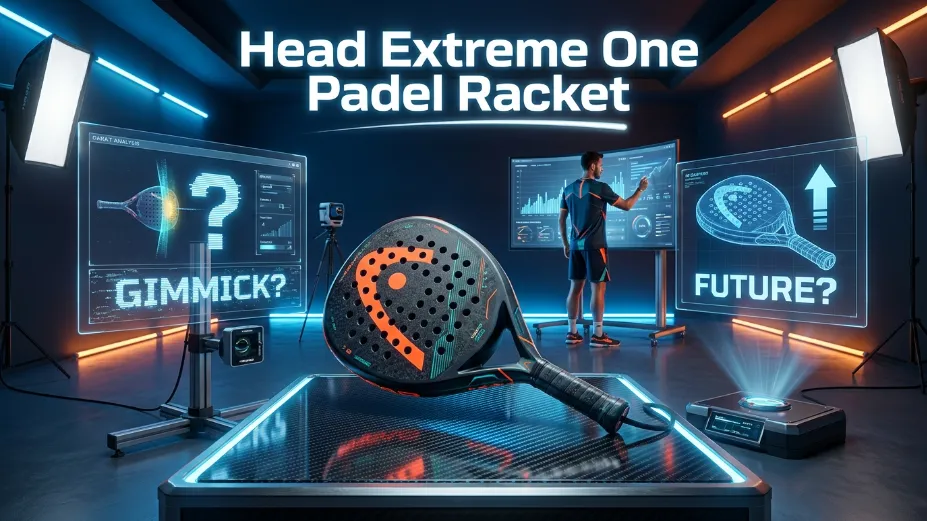
Breaking convention is a risky move in padel, yet the launch of a racket with just a single hole has completely disrupted the court. The head extreme one padel racket is not just a design quirk; it is a fundamental re-engineering of how power and structural integrity co-exist. By leaving the carbon face intact, this stick challenges every aerodynamic norm you have come to expect from traditional setups. If you are wondering whether this bold engineering translates into genuine court dominance or simply creates an unpredictable sweet spot, the technical data and real-world performance shifts reveal exactly what happens when you step away from the multi-hole standard.
Head Extreme One vs Extreme One X — 2025/26
Side-by-Side Technical Attribute Comparison
The Short Answer: For dedicated intermediate-to-advanced offensive players looking for maximum speed and raw smashing power without putting unnecessary strain on their joints, the standard Head Extreme One is the definitive recommendation. Advanced heavy-hitters who demand maximum plow-through stability during high-intensity volleys should choose the Extreme One X. If you struggle with consistent ball striking or suffer from chronic tennis elbow, you may want to read our guide on the best padel rackets for tennis elbow before buying.
Head Extreme One Padel Racket Review: On-Court Performance Notes
Stepping onto the court with the padel racket head extreme one requires a brief mental recalibration. Because the racket face lacks standard perforations, the ball compression dynamics feel entirely different from what most players are used to. At low swing speeds, the racket surface feels incredibly stiff, almost unforgiving, demanding that you generate clean power directly from your core and legs.
Baseline Defence and Low-Speed Manoeuvrability
Defending close to the glass with a head-heavy diamond racket is historically a recipe for unforced errors. However, because this stick is exceptionally light at 345 grams, retrieving low balls is surprisingly fluid. The absence of traditional holes means the ball never catches an uneven edge on the face, giving you incredibly consistent angles on defensive lobs. If you are explicitly hunting for a frame with an effortless, featherweight feel to escape tough defensive positions, check out our ranked selection of the best lightweight padel rackets for women, which highlights similar high-manoeuvrability options.
Net Play, Volleys, and Aerodynamic Acceleration
The net is where the single-hole setup truly shines. When blocking fast, incoming body shots, the racket face functions like an impenetrable wall. The ball does not sink deep into the core; instead, it snaps off the 12K carbon face with crisp velocity. When hitting deep, slicing volleys, the Auxetic construction provides tactile feedback directly to your hand, allowing you to control the depth of your shot with pinpoint accuracy. The smooth surface grips the ball beautifully, imparting heavy backspin that causes the ball to drop dead against the back glass.
Overhead Power and the Smash Phase
If your ultimate goal is to hit the ball out of the court with a “Por Tres” smash, this frame will feel like a dream come true. The combination of a head-heavy 275mm balance and a slick, drag-free aerodynamic profile allows you to generate incredible head speed. The ball compresses evenly against the solid carbon surface, producing an explosive, loud pop that echoes across the club. The power output is linear and remarkably predictable: the harder you swing, the more devastating the result.
Aerodynamic Fluid Dynamics and the Science of the Single-Hole Design
To truly comprehend why the head padel racket extreme one is a milestone in racket sports engineering, we must analyse the underlying physics of a traditional padel frame. Standard models use anywhere between 40 and 60 drilled holes to reduce drag coefficient during the swing phase. However, every hole drilled represents a point of structural failure, disrupting the weave of the carbon fibre sheets and reducing the overall material density.
Head’s R&D department utilised computational fluid dynamics (CFD) to prove that air resistance does not pass through the microscopic holes of a rapid-moving racket as efficiently as once assumed. Instead, the air stalls across the face, causing turbulence. By engineering a completely solid, smooth 12K carbon face with only a single functional bridge hole at the throat, the air flows cleanly around the outer perimeter of the frame. The structural drag equation dictates that maximum shear stress is heavily influenced by surface uniformity:
By eliminating the drilled entry points, the stress concentration factor $$K_{t}$$ is reduced significantly. This structural integrity allows the racket to be built remarkably light at 345 grams without losing its physical momentum or breaking under heavy usage. It moves cleanly through the air, giving players an outstanding sense of manoeuvrability and accelerated tip speed during fast defensive transitions.
Head-to-Head: The Evolution from 2023 to the 2025/2026 Models
The original launch of the head extreme one 2023 padel racket took the market by storm, but it was not without its flaws. Early versions suffered from a harsh, uncompromising feel on off-centre hits, which quickly fatigued the forearms of intermediate players. The newer iterations have refined the internal foam formulation and adjusted the carbon weave density to create a much more balanced playing experience.
- Sweet Spot Expansion: The 2023 model had a demanding sweet spot positioned right at the top of the frame. The 2025 and 2026 updates have widened the effective striking zone slightly downward, making the racket far more forgiving when you are caught out of position.
- Vibration Management: By integrating an updated Auxetic 2.0 carbon layer into the yoke area, Head has successfully mitigated the harsh vibrations that plagued the original 2023 edition. This makes long, multi-set matches much more comfortable on your joints.
- Surface Texture: The latest models feature an aggressive, long-lasting circular spin graphic etched directly into the carbon shell. This texture grips the ball far better than the sandblasted finish used on the first-generation frame.
For a complete breakdown of how to match these specific technical evolutions to your personal playing style, read our comprehensive analytical resource on how to choose a padel racket.
The Missing Perspective: What Other Reviews Won’t Tell You
Most commercial reviews focus entirely on how powerful the single-hole layout feels on smashes. What they omit is how the frame handles extreme humidity or wet balls. In cold, damp indoor environments typical of UK winter clubs, traditional multi-hole rackets trap moisture inside the drilled cavities, altering the ball’s weight and bounce. Because the Extreme One has a completely flat, sealed surface, water cannot settle inside the frame, allowing it to maintain consistent performance metrics even in humid conditions.
Furthermore, we must address its structural durability. Traditional rackets tend to develop hairline fractures connecting the drill holes after months of heavy overhead hitting. By removing these structural vulnerabilities entirely, Head has produced one of the toughest, most long-lasting premium frames available today. It easily withstands accidental surface collisions with the glass or your partner’s racket. This incredible structural integrity earns it a top spot among the best padel rackets for advanced players looking for a long-term investment.
Frequently Asked Questions (UK Market Context)
Is the Head Extreme One legal for official LTA and FIP padel tournaments?
Yes. Both the Lawn Tennis Association (LTA) and the International Padel Federation (FIP) regulations explicitly state that a padel racket must have at least one hole located on the face. Because Head engineered a single, functional hole within the lower hitting surface area, the racket fully adheres to all professional tournament specifications.
Does the lack of holes make the racket vibrate more than standard models?
No, quite the opposite. Drilled holes actually weaken the structural profile, which can cause erratic twisting vibrations. The unbroken 12K carbon face on the Extreme One acts as a uniform dampening field, while the internal Power Foam absorbs shockwaves before they travel up the shaft into your elbow.
How does the single-hole layout affect the overall spin potential?
Spin in padel is primarily generated by ball compression against the face and the surface texture of the racket. Because this racket face is completely solid, the ball compresses evenly without slipping over hole edges, which actually increases your spin potential when hitting aggressive Viboras and heavy cut volleys.
Can an intermediate club player comfortably handle this racket?
Yes, but it requires solid, clean technique. Thanks to its lightweight 345g build, it is exceptionally easy to swing. However, if you often hit the ball far off-centre, the rigid face will offer minimal assistance, meaning you will lose significant depth on your defensive shots.
Where can I find additional technical specifications for the Head range?
For verified product listings, regional distribution networks, and official balance charts, you can consult the official HEAD website.